
Inform: The use of AI in 2026
Five key AI trends in 2026

Software developer Inform outlines five key AI trends that will shape industrial practice in 2026. The use of artificial intelligence is developing rapidly and will become an integral part of production, logistics and the supply chain. The focus is on integration into processes, software and infrastructures.
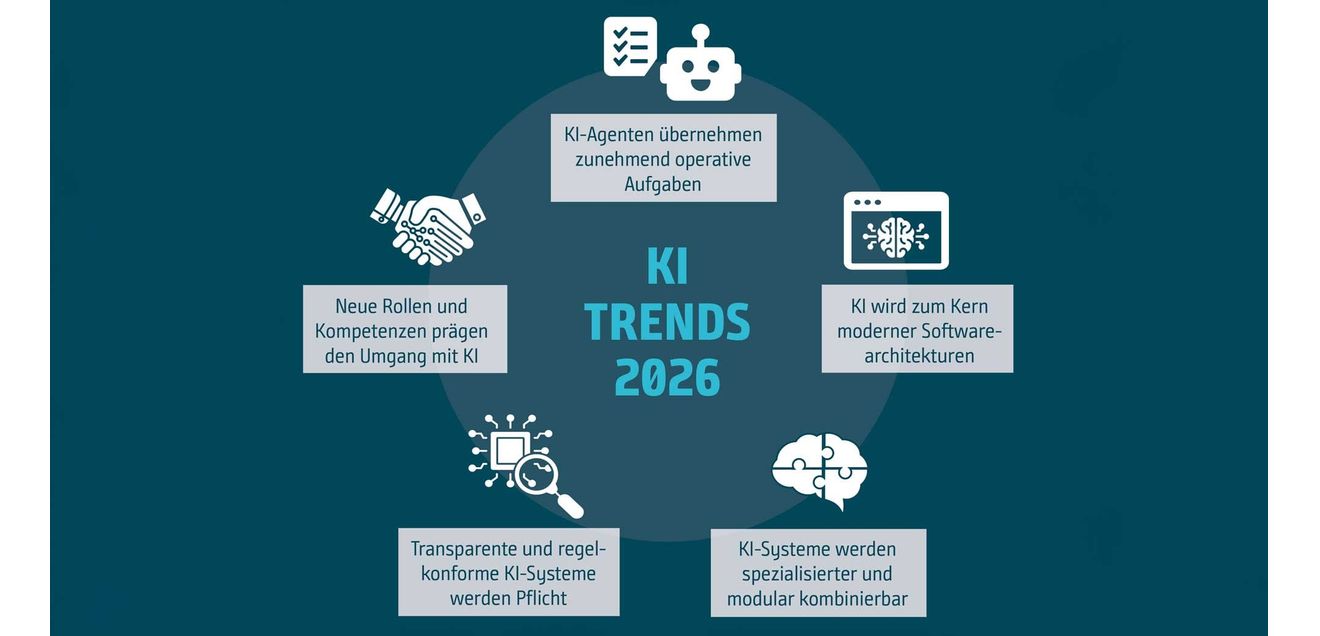
"2025 was a year in which AI spread incredibly quickly and became noticeably more professional," says Konstantin Leitz, Vice President Business Innovation at Inform, and defines five trends.
Trend 1: AI agents take over operational tasks
AI agents will be increasingly integrated into operational processes in 2026. They will monitor processes in real time, detect deviations and support decisions in the event of short-term changes, for example in logistics or material supply. Several specialized agents will work together in parallel and coordinate automatically across departmental boundaries.
Trend 2: AI is becoming the core of modern software architectures
In future, software will be developed with AI in mind right from the start. Learning, data processing and decision logic are integral components of the architecture. The development process itself is also changing: AI-generated code, automated tests and adaptive deployment pipelines are becoming standard. At the same time, new skills such as prompt design, validation of AI results and system architecture are becoming increasingly important.
Trend 3: AI systems are becoming more specialized and modularly combined
Instead of universal models, companies rely on domain-specific AI systems that are trained with specialist and industry data. These deliver more precise results and can be combined in a modular way, for example for forecasts, prioritization or the evaluation of resource situations along complex process chains.
Trend 4: Transparent and compliant AI systems are becoming mandatory
As complexity increases, so does the need for transparency. "AI observability - i.e. the monitoring of behavior, performance and decision-making logic - is becoming a key quality feature. At the same time, companies must meet new regulatory requirements such as the AI Act, NIS-2 or the Cyber Resilience Act and demonstrate the secure, compliant operation of their AI systems.
Trend 5: New roles and skills characterize the use of AI
People are moving more into the focus of AI use. New roles are emerging at the interfaces between specialist departments, data and AI. Employees such as planners and dispatchers are increasingly working with AI-supported recommendations. Training and change management will be crucial in order to use AI safely and effectively in day-to-day work.
"For companies, 2026 will above all be a year in which the practical use of AI will become much more mature," summarizes Leitz. "Many developments will move closer to the operational core and show where AI makes a difference."


You might also be interested in
IKEA launches all-electric heavy-duty logistics project
Together with Mercedes-Benz Trucks and LC3 Trasporti, the Inter IKEA Group is focusing on battery-electric trucks and driving forward the decarbonization of road freight transport in Italy.
 read more...
End-of-line systems for industry and logistics
MSK, a specialist in intralogistics solutions for all aspects of pallet handling, will be showcasing innovative end-of-line systems at Logimat 2026 that have been developed to meet the requirements of manufacturers and distribution/logistics centers.
read more...The materialfluss products of 2023
39 nominees competed in five categories for the materialfluss products of the year 2023. The winners were honored on the evening of May 2, 2023.
read more...A Centralized View of Complex Processes
Today, medium-sized logistics companies must manage an increasingly diverse range of operations efficiently and reliably. Different modes of transport, customized customer solutions, and established workflows can hardly be accommodated by...
read more...Robotics Integration for Greater Efficiency in Inbound Goods Processing
Infios is helping Kellner & Kunz, a specialist in tooling and C-parts, expand its automation strategy. The next step in this long-standing partnership is the integration of robotics into inbound logistics.
read more...Flying warehouse robot impresses the jury
The Swiss deep-tech company Verity has been awarded the 2026 IERA Award for its autonomous indoor drone system. The flying robots monitor inventory levels autonomously, operate without GPS, and are already in use in approximately 200 warehouses...
read more...The Right Warehousing Solution for Every Logistics Need
Whether it’s an S/4HANA implementation, the urgently needed replacement of the traditional SAP WM, or the growing demands for digitalization and automation—many companies are faced with the question of which warehouse management system will best...
read more...Digital processes shorten delivery times
trans-o-flex makes delivery times easier to plan
trans-o-flex ThermoMed Austria is optimizing its delivery processes with new scheduling software and a digital self-handling module for drivers.
read more...Route planning and optimization solution
Jumbo backs Greenspan
The Dutch supermarket chain Jumbo has realigned its e-commerce logistics with Greenplan, the intelligent route planning and optimization solution from the Ehrhardt Partner Group.
read more...