
Measures discussed
Greening the Fleet in Short Sea Shipping and Inland Navigation
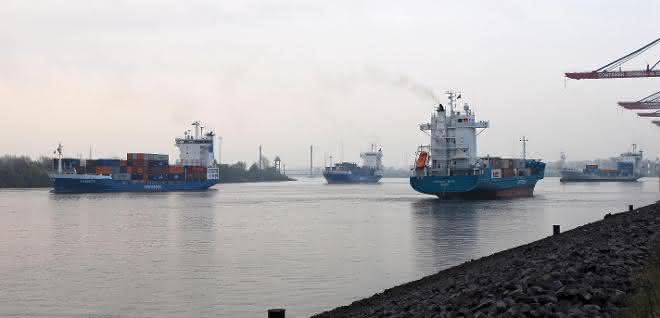
Although inland navigation, short sea shipping and river-sea shipping are already more CO2 efficient compared to other means of transport, there is still potential to make European fleets greener.
During the digital workshop "Greening of Inland Navigation, Short Sea Shipping and River-Sea Shipping", six high-ranking representatives presented and discussed various potentials and problems in the sector and presented solutions to make these modes of transport even more climate and environmentally friendly.
In her keynote speech, Theresia Hacksteiner, Secretary General of the EBU, emphasized that inland waterway transport in particular must play a key role in achieving the EU's climate targets. However, a strong political framework and investments of around EUR 47 billion in infrastructure and fleet renewal are needed to unleash the sector's full potential. In the next funding period 2021 to 2027, however, only EUR 2 billion in CEF funding has been pledged so far. In addition to the obvious lack of financial support, access to research programs is still needed to test and validate measures for the sustainable expansion of the inland waterway fleet, says Theresia Hacksteiner.
Political framework conditions and subsidies are also key aspects in the process of the general energy transition, emphasized Saeed Mohebbi, consultant for electrical safety and alternative fuels at the Swedish Transport Administration. He pointed out the importance of regulations and guidelines at both national and regional level to support companies and authorities in the transition from fossil fuels to alternative fuels.
For ARKON Shipping, a medium-sized shipping company from Haren/Ems with a focus on European short sea shipping, methanol is the alternative fuel to focus on, according to project manager Werner Plenkmann. Retrofitting existing engines is already possible today and regular (including gray) methanol is competitive compared to other alternative fuels. Sufficient availability of gray methanol already exists and a green methanol economy will be geared towards increasing demand and gradually replace gray methanol over the next few years.
With this in mind, Ingvar Landälv, who has more than 45 years of experience with process plants based on gasification technology, broke down the complex chemical processes of biomethanol production for the audience and presented a list of methanol projects currently under development. Unfortunately, he noted, the amount of green methanol on the market does not yet correspond to the amount that is actually needed to cover all the planned projects. As Theresia Hacksteiner pointed out, these are still heavily dependent on subsidies.
Overall, it is almost impossible to predict which alternative fuels and technologies are the most promising, said Friederike Dahlke-Wallat, naval architect at the Development Center for Ship Technology and Transport Systems (DST). Her contributions to the CCNR studies on the energy transition towards emission-free inland navigation show what a future alternative fuel mix could potentially look like, but in reality it is a question of cost and infrastructure. The best option now is to look at it on a case-by-case basis and be aware of the obstacles and challenges that need to be overcome to make inland navigation greener, she explained.
This case-by-case strategy is also emphasized by Benjamin Weinacht when it comes to the certification and regulation of alternative fuels. As Managing Director of CMB, he sees great potential in hydrogen dual-fuel engines, which promise a wide range of industrial applications, from ships to trains to power generators. CMB has an entire division (CMB.TECH) dedicated to hydrogen-powered technology and infrastructure to produce and distribute the clean fuels of the future. Weinacht emphasizes the importance of first movers in this field, as they lay the foundation for large-scale application. In his words: "Small steps create big successes."


You might also be interested in
Roman Fürtig is Port of Hamburg Marketing Representative Germany East
At the turn of the year, Roman Fürtig took over the management of the HHM Representative Office Germany East of the Port of Hamburg.
 read more...
Port of Hamburg handles 58.2 million tons
Both the tense economic situation in Europe, and in Germany in particular, and the geopolitical conditions continue to have an impact on handling in the Port of Hamburg.
read more...Sustainable across the Rhine
The "GAS 95", another innovative ship design from the HGK Shipping Design Center, has been sailing on the Rhine since 8 February: low-emission thanks to diesel-electric propulsion, future-oriented thanks to its "future-fuel-ready" design and...
read more...Germany's first center for remote-controlled ships opened
Seafar, a Belgian technology and service provider for remote-controlled and crew-reduced inland navigation, has set up the first so-called Remote Operations Center in Germany together with its project partners HGK Shipping and Reederei Deymann.
read more...Ole Trumpfheller new Head of Northern Europe at Maersk
Effective May 1, 2024, Ole Trumpfheller will assume the role of Vice President and Managing Director of Maersk's North Europe Continent (NEC) Area, based in Hamburg.
read more...NWL and DBR Hamburg cooperate in container handling
Norddeutsche Wasserweg Logistik (NWL) and Deutsche Binnenreederei (DBR) Hamburg declare their official merger in the container business.
read more...LHG holds its own in a difficult environment
Total throughput decreases moderately by 4.8 percent
read more...Maersk and Hapag-Lloyd agree on joint operational cooperation
Hapag-Lloyd and Maersk have signed an agreement for a new, long-term operational cooperation called "Gemini Cooperation", which will start in February 2025. The aim is to create a flexible and interconnected service network in maritime...
read more...Port of Hamburg: Zapp becomes EMP
The Zapp IT platform - the comprehensive and mandatory IT system for the customs export process in the Port of Hamburg - is being relaunched and renamed.
read more...