
2020 balance sheet and outlook
German maritime shipping optimistic about the future
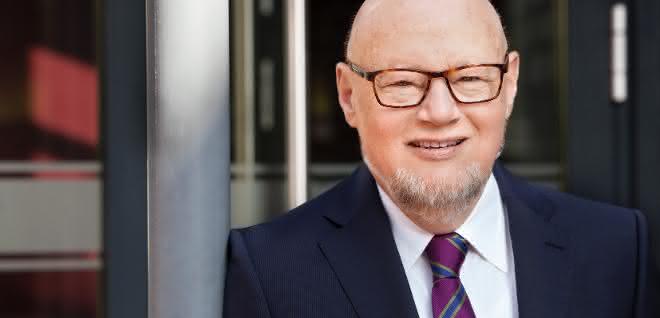
The German Shipowners' Association (VDR) has presented new figures on the situation of German merchant shipping. On this occasion, President Alfred Hartmann (pictured) and Ralf Nagel, Executive Member of the Executive Committee, explained the most important topics on the German shipping industry's agenda for this year: Germany as a shipping location, seafarers during the pandemic and climate protection.
Almost a year after the outbreak of the coronavirus pandemic, many of the larger German shipping companies in particular are now optimistic about the future. "We have largely left the crisis that has preoccupied us since 2009 behind us and have come through the pandemic surprisingly unscathed in many areas so far," said VDR President Hartmann, but added: "No one can currently predict whether the positive trend, especially in container shipping, will continue.
positive trend will continue, especially in container shipping." However, shipping has shown what an important role it plays in trade and supply in the current exceptional global situation: "We have continued to sail, we have delivered, in the truest sense of the word," said Hartmann.
According to the figures, Germany remains the fifth-largest shipping nation in the world with a 4.5% share of the global merchant fleet (-0.4 percentage points compared to the previous year). At the end of 2020, a total of 2,001 ships with 48.7 million GT were registered in German shipping registers, 139 fewer than a year earlier. A large proportion (now more than 45%) of the ships in the German fleet now fly the flag of an EU country, particularly Portugal, Cyprus and Malta. The number of ships sailing under the German flag has stabilized at 290 The number of seafarers employed in Germany and subject to social security contributions has recently fallen slightly to 7,558 due to the decline in the German merchant fleet, while the number of newcomers on board remained roughly the same at 409 in 2020 despite coronavirus.
Germany as a business location: "new normality" after boom and crisis
Ralf Nagel, Executive Member of the Executive Committee, explains: "After the years of unusual growth, especially in container shipping at the beginning of the 2000s and the subsequent decline, we now have a new normality: the German fleet is similarly strong, in large parts stronger than before this boom." This applies to the number of ships in various segments, the number of trainees, the number of seafarers and the number of shipping companies. "Despite the pandemic, we are seeing a new dynamic in some shipping markets in which German companies are active." Reliable framework conditions that support the shipping industry in Germany are therefore all the more important.
Seafarers in the pandemic: VDR calls for preferential vaccinations for seafarers
Crew changes are still a major problem, and not just for German shipping companies. As with goods, a logistics chain must be in place: entry and exit in a port must be permitted, there must be flights to and from the home country and entry into the respective home countries must be possible. "We are faced with constantly changing regulations for testing and quarantine, which makes the task much more difficult," says VDR President Hartmann. It is estimated that around 400,000 seafarers worldwide are still affected by the crew change crisis.
It was also becoming apparent that seafarers were not being given sufficient consideration in the ongoing global vaccinations. "Many more countries need to give them key worker status and give them priority vaccination," the VDR President demanded: "We must not end up in a situation where seafarers cannot come on board because they have not yet been vaccinated." This would exacerbate the crew change problem, warns Hartmann: "There is a threat of repercussions for the global trade in goods with consequences for us all."
Climate protection: EU emissions trading the wrong way, IMO should set the course
With regard to climate protection, the VDR renewed its criticism of a regionally limited emissions trading system, as proposed by the European Union this year. "Shipping is an international industry like no other, which is why it needs international regulations," says Executive Committee member Nagel. "We have doubts that regionally limited emissions trading will achieve the decisive factor, namely sustainably lower CO2 emissions. In aviation, which is already regulated in this way, this has not been achieved, on the contrary."
"The German shipping industry is determined to actively support sensible, global regulation," Nagel emphasized: "The appropriate forum for regulation is the IMO, which recently proved that it can regulate shipping globally with the mandatory switch to lower-sulphur fuels." As an industry, we want to achieve or, where possible, exceed the IMO's climate targets. The Executive Committee member concluded:
"Crucially, we need an energy revolution. All the efficiency measures on ships are not enough, we need other, marketable fuels."


You might also be interested in
Test shipment with RoRo Car Carrier via Bremerhaven
Last August, the RoRo Car Carrier MV Cosco Shengshi moored in the northern port of Bremerhaven and started its first test shipment in order to expand the service to Europe.
 read more...
Hamburg Nautical Center steers shipping traffic with the power of the sun
The Nautical Headquarters in the Port of Hamburg will be relying fully on solar energy for its energy supply in future: Q.Partner Betrieb Nordic Solar GmbH has installed a solar system with Q Cells solar modules on the roofs of the Nautical...
read more...Max Johns leaves the German Shipowners' Association
Prof. Dr. Dirk Max Johns is leaving the management of the German Shipowners' Association (VDR) on August 15.
read more...Hamburg Süd christens "Polar Ecuador" in Antwerp
The shipping company Hamburg Süd has christened the container ship "Polar Ecuador" in Antwerp. With an overall length of 230 meters and a width of 37.30 meters, the ship has a container slot capacity of 3,800 TEU and is equipped with 1,000 reefer...
read more...World's largest bunker ship christened
The official christening of the world's largest LNG bunker vessel "Kairos" took place in the Port of Hamburg on February 8.
read more...Holger Strack takes the helm at Zeaborn Ship Management
Holger Strack, previously co-CEO of Zeaborn Ship Management together with Nils Aden, will take over as CEO on January 1 and will be responsible for all shipping activities of the third-party ship manager.
read more...VDR welcomes appointment of Dieter Janecek
The German Shipowners' Association (VDR) welcomes the appointment of Dieter Janecek (Alliance 90/The Greens) as the Federal Government's Maritime Coordinator.
read more...First woman after 114 years of association...
Dr. Gaby Bornheim new President of the German Shipowners' Association
The Board of Directors of the German Shipowners' Association (VDR) has elected Dr. Gaby Bornheim, Managing Director of Peter Döhle Schiffahrts-KG, as President of the Association.
read more...Sustainable across the Rhine
The "GAS 95", another innovative ship design from the HGK Shipping Design Center, has been sailing on the Rhine since 8 February: low-emission thanks to diesel-electric propulsion, future-oriented thanks to its "future-fuel-ready" design and...
read more...