
Market overview of the maritime industry
"Together we will overcome this crisis"
How will shipowners, shipyards and suppliers get out of the crisis? Will the virus change their business permanently? A market overview. Global trade has collapsed, the shipyard landscape is lying idle and the world's leading trade fair SMM has had to be postponed: The economic consequences of the coronavirus pandemic are shaking the maritime industry.
The global economy has been hit hard by the Covid-19 pandemic. "The recession this year is likely to be deeper and the recovery in 2021 slower than we thought two months ago," says Gita Gopinath, Chief Economist at the International Monetary Fund (IMF). According to her, the global economy will shrink by almost five percent. This is hitting the maritime industry particularly hard: the global lockdown has disrupted important trade chains. At industry leader Maersk, container transport fell by at least 15 percent in the second quarter.
SMM 2020 was not spared by corona either: an event with over 2,000 exhibitors and around 50,000 visitors in September was simply inconceivable. The world's leading maritime trade fair was therefore postponed to February 2-5, 2021. The industry's response to the new date has been positive: "We are pleased to say that around 90 percent of exhibitors at SMM 2020 will also be taking part in SMM 2021," says Claus Ulrich Selbach, Vice President Maritime and Technology Fairs at Hamburg Messe und Congress (HMC). "Together we will overcome this crisis," says Selbach. The gradual easing of restrictions in many countries gives cause for optimism. China's economy is gaining a foothold and many countries are reopening their borders. However, this is not yet a return to normality, as the pandemic is only just reaching its peak in many emerging and developing countries. An uncertain situation that also poses enormous challenges for the maritime industry.
Renaissance through digitalization
"We know that we can't predict the future. But we can try to prepare for changes that are clearly on the horizon," says Martin Stopford, President of Clarkson Research. "Not preparing can be riskier and more expensive than the 'safe' option of doing nothing," says the shipping expert. The coronavirus crisis is forcing the maritime industry to quickly open up to new approaches. Innovative digital products are being developed and launched in record time. "The pandemic has accelerated the digitalization of the industry and brought it forward by half a decade," says Knut Ørbeck-Nielssen, CEO of the classification society DNV GL - Maritime. "The crisis has the potential to trigger many innovations and new ideas throughout the maritime world - and thus lead the industry to a renaissance." The main sponsor of SMM is one of the pioneers in digital remote maintenance, the use of digital twins and data analysis. The "green" shipping industry is also benefiting from this. In February 2021, experts will discuss how the industry intends to translate the technology boost into sustainable propulsion solutions at the SMM environmental conference gmec and the Maritime Future Summit. Driving the maritime transition - the leitmotif of the world's leading maritime trade fair - has gained further momentum due to coronavirus.
Suppliers feed off the sales buffer
Martin Johannsmann, Chairman of the Executive Board of VDMA Marine Equipment and Systems and CEO of SKF, knows that good preparation is half the battle: "Overall, we are well positioned in the industry. This has paid off during the coronavirus crisis. We learned very quickly how to deal with the pandemic." Production continued almost without interruption and orders could be processed. However, German suppliers are still benefiting from a 3.4% increase in orders from the previous financial year. However, companies are concerned about the noticeable reluctance of customers to buy. Klaus Deleroi, Managing Director of transmission specialist Reintjes, is therefore hoping for support from the German government. One billion euros is available for the replacement of ships and digital projects, clean ships, LNG refueling ships and shore power systems.
Journey into the unknown
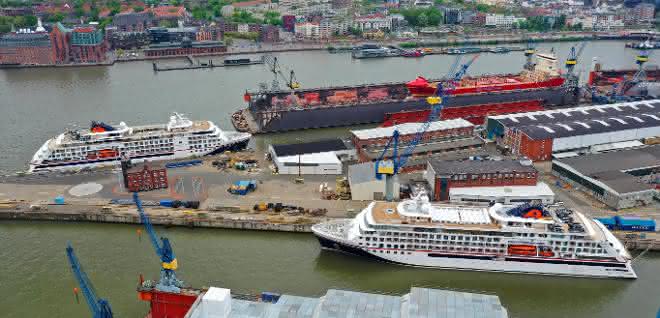
A look at the global order books shows: Shipyards are the big losers of the crisis. Even before corona, the order backlog had fallen to 13 million gross tonnage (2009: 30 million GT). The successful cruise industry in particular is facing turbulent times. MV Werften, which belongs to the Malaysian group Genting, has received €175 million in emergency aid in order to avoid difficulties. The state-owned KfW supported Meyer Werft with 200 million euros. The market leader in the cruise segment is not expecting any new orders until 2023. Current construction projects are being postponed in order to avoid gaps in employment. If it were up to the cruise lines, they would rather reduce their fleets than expand them. "It is very likely that some ships on the market will be scrapped," says Carnival CEO Arnold Donald. For almost four months, the 400 cruise ships worldwide have been on forced vacation. This is costing the industry leader Carnival one billion US dollars per month. The Norwegian shipping company Hurtigruten recently launched its first tentative attempts at excursions - with significantly fewer passengers and a strict hygiene concept. When normal operations
will start again properly is the million-dollar question, says CEO Daniel Skjeldam. Even "Cruises to Nowhere", i.e. voyages without shore leave, are conceivable. One glimmer of hope for the industry is the constant stream of bookings for the next cruise season.
Lack of cooperation between countries
Crews on board merchant and cruise ships around the world are hoping that travel restrictions will be lifted. "In some cases, seafarers have now been detained on ships for months beyond their contracted time. They are directly affected by the
directly affected by the inaction and lack of cooperation of states around the world," criticizes Estelle Brentnall, Head of Maritime at the European Transport Workers' Federation ETF. She demands: "Let them go home!". Shipowners are also working hard to find a solution: "With the help of the International Maritime Organization (IMO), we provided all countries around the world with a detailed procedure weeks ago that allows crew changes to be made safely even in times of coronavirus," says Alfred Hartmann, President of the German Shipowners' Association.
In both private and business life, much is currently done online - but this can hardly replace face-to-face encounters. "You can meet the whole world over the internet, but it's not the same as being at the SMM, where all the members of the shipping community come together
shipping community come together, network and discuss their issues," says BIMCO President Sadan Kaptanoglu. You have to laugh, have fun and celebrate together in order to do business together, says Dirk Lehmann, Managing Director of the Hamburg-based company Becker Marine Systems and Deputy Chairman of SEA Europe.
That's why events like the SMM are so important. Personal contact is the only way to spark new ideas, partnerships and business. The global maritime community is looking forward to coming together in Hamburg from February 2 to 5, 2021. The HMC
is currently developing a concept in cooperation with the responsible authorities and the health & safety experts of selected exhibitors, which is based on the current measures to contain the coronavirus pandemic. The aim is to ensure maximum safety and a successful trade fair. The concept will be presented in October 2020.


You might also be interested in
Business Survey Maritime Economy
Significant recovery in shipbuilding, port industry and shipping
The maritime economy in Germany recovered in the fall compared to spring 2020, but the figures are still below the previous year's level.
 read more...
Self-administration ordered for Flensburger Schiffbau-Gesellschaft
In accordance with the application of Flensburger Schiffbau-Gesellschaft mbH (FSG), the Flensburg Local Court has ordered provisional self-administration.
read more...Largest container ship in the world reaches Bremerhaven
The "MSC Gülsün", currently the largest container ship in the world, called at the MSC Gate Terminal in Bremerhaven for the first time on August 19.
read more...Contargo prepares for the summer of the...
Contargo prepares for low water
June 2019 was the warmest June since weather records began - a possible sign that a long summer with low water levels on the Rhine is imminent, as in 2018. As a precautionary measure, Contargo has therefore commissioned the conversion of four barges...
read more...Conveyor and lifting technology
"Think Big" with the world's largest plastic energy chain from Igus
Energy chains made of high-performance plastics are conquering more and more areas of industry and are continuously replacing metal versions. They score points for their low weight, low maintenance and maximum stability, especially in areas where...
read more...SMM: Leading maritime trade fair focuses on green shipping
From September 4, SMM, the leading international trade fair for the maritime industry, will provide an overview of the state of the art in green shipping and focus on the reduction of emissions and...
read more...Sustainable across the Rhine
The "GAS 95", another innovative ship design from the HGK Shipping Design Center, has been sailing on the Rhine since 8 February: low-emission thanks to diesel-electric propulsion, future-oriented thanks to its "future-fuel-ready" design and...
read more...Germany's first center for remote-controlled ships opened
Seafar, a Belgian technology and service provider for remote-controlled and crew-reduced inland navigation, has set up the first so-called Remote Operations Center in Germany together with its project partners HGK Shipping and Reederei Deymann.
read more...Ole Trumpfheller new Head of Northern Europe at Maersk
Effective May 1, 2024, Ole Trumpfheller will assume the role of Vice President and Managing Director of Maersk's North Europe Continent (NEC) Area, based in Hamburg.
read more...