
Logistics service provider - Aus materialfluss 5/19
Fridays for Future? Logistics for Future!
New route planning software, low-emission vehicles, logistics properties that meet the highest DGNB standard: logistics companies can do a lot to live up to their responsibility for people and the environment. The logistics service provider pfenning logistics counts this form of commitment among the principles of entrepreneurial action.
Thousands of young people have now joined the "Fridays for Future" movement and are campaigning for climate protection worldwide. Greta Thunberg is making waves with her protest and inspiring many people to think. Does it really make a difference whether you get your bread rolls by bike or by car? Yes, absolutely. Everyone has to act responsibly, and logistics companies even more so. Today, a transport and logistics company can no longer afford not to think ecologically. Because the industry is omnipresent. It moves the world. And it doesn't just produce environmentally friendly results.
While large and medium-sized companies are looking into the use of alternative drives and sustainable real estate concepts, smaller companies are often reluctant to take on the challenge of optimizing their use of resources. Where to start? And with what money? When it comes to green logistics, most people think of transportation by plane, ship and truck. How to get freight from A to B in the most environmentally friendly way possible is certainly the primary challenge for the ecological footprint. However, there are many small areas along the supply chain that require targeted action and willpower rather than large investments.
Green logistics: convincing employees
Every company can set its own pace. It doesn't always have to be the most innovative technologies. The important thing is for management to convince employees and for everyone to pull together. Small measures in office organization, such as reducing paper consumption and eliminating coffee capsule machines, are great ways to raise awareness of environmental issues and reorganize logistical relationships. Green logistics is not a product, but a doctrine. It is part of the corporate culture in every conceivable way and is the driver for further action in harmony with nature.
Of course, photovoltaic systems, the latest route planning software, low-emission vehicles and eco-buildings are progressive measures and very important for the development of the industry. But the smaller steps are also crucial for the big picture. A company does not have to equip its transport fleet with LNG vehicles in order to act more ecologically. Well-organized communication between the driver and head office alone can help to avoid traffic jams and noise and select the optimal route. Driver training for environmentally conscious driving is also feasible at any time and results in reduced emissions.
Everyone according to their possibilities
No question, there is still a lot to do. Only one in five German freight forwarders has a certified environmental management system and standards for calculating greenhouse gas emissions. The requirements mostly come from the clients, who want to keep their supply chain green. Immediate benefits are not to be expected from such measures. Ideally, it should be about the long-term effect of many green measures. Of course, inconveniences lurk everywhere during implementation, as habits can sometimes become crippling burdens in companies. But if you want to become greener, you have to break old habits, work pragmatically and protect the environment in all areas of your company.
"Beacons" of the green supply chain
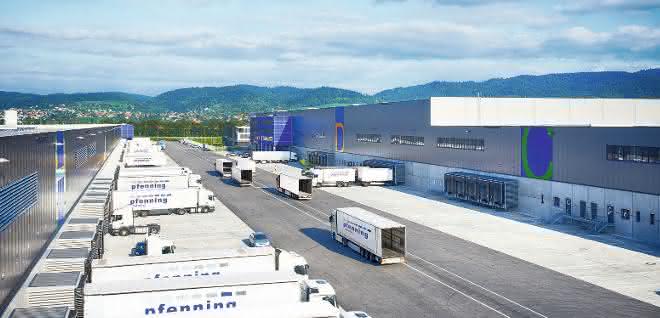
Modern logistics properties have what it takes to become "beacons" of the green supply chain in the logistics landscape. They line our highways and, with their attractively colored façade elements, are an eye-catcher that can be seen from afar, highlighting the creative and environmentally friendly concept of modern logistics that is often hidden behind their façade. With the multi-user concept of the "multicube", pfenning logistics has now set itself high environmental targets at two locations in Germany and invested in a sustainable construction method that pays off from many perspectives. For example, only 100 percent PEFC-certified wood was used in the construction of the new "multicube rheinhessen" in Monsheim and attention was paid to the selection of non-toxic materials. Emission-free and solvent-free products were used to ensure indoor air hygiene. Floor, dust and noise protection meet the highest standards. The quality of the building envelope is evident from the insulation properties: the roof insulation is 140 millimetres thick instead of 80 millimetres, and the façade insulation is 150 millimetres thick instead of 120 millimetres. This also pays off in terms of the ecological balance: it is 40 percent below the requirements of the German Energy Saving Ordinance (EnEV). As with the "multicube rhein-neckar", the company is also aiming for a high DGNB sustainability standard and hopes to win the Logix Award, which recognizes outstanding logistics properties. Pfenning logistics is therefore taking many small steps to get closer to its vision of climate-friendly logistics.


You might also be interested in
TGW Automates Intersport Distribution Center
Intersport France has launched a new, highly automated distribution center in Saint-Vulbas, near Lyon. The facility, built by TGW Logistics, is designed to support the sporting goods retailer’s growth, smooth out seasonal peaks, and make store...
 read more...
Major project in the Korean retail sector
Knapp builds Korea's largest shuttle system
Together with Knapp and Doosan Logistics Solutions, Asung Daiso is building a new highly automated omnichannel logistics center in Yangju, South Korea. The facility is the largest shuttle system ever built by Knapp in South Korea.
read more...Jungheinrich implements automation for...
Fully automated large warehouse launched in Páty
Gebrüder Weiss has put an automated warehouse into operation in Hungary, largely replacing manual processes. The new logistics center near Budapest increases efficiency, capacity and sustainability and at the same time responds to increasing demands...
read more...Highly automated in all product ranges
Richard Kearns knows how his supply chain and his new warehouse in Hernando (Mississippi, USA) are doing because he receives feedback every day.
read more...Hellmann expands cross-border e-commerce
Hellmann is strengthening its e-commerce business with the cross-border product "near", relying on the expertise of Jan Bierewirtz.
read more...Returns logistics: automated, sustainable and future-oriented
Returns have become an integral part of e-commerce - and continue to pose one of the biggest logistical challenges, particularly in the fashion segment. High volumes, short processing times, complex quality requirements and increasing customer...
read more...New CFO at Dachser
Thomas Hiemer has been Chief Financial Officer (CFO) at logistics service provider Dachser since January 1, 2025. As a member of the Executive Board, he is responsible for Finance, Controlling, Tax & Treasury (FCT).
read more...Geis takes over Gras Group
On January 1, 2025, the Geis Group will acquire all shares in the Gras Group, headquartered in Neuwied near Koblenz. This strengthens the company's presence in economically important regions of Germany and expands its role in the IDS Group.
read more...Distribo 3.0: Sustainable and open to technology
With the Distribo 3.0 logistics hall, the transport and logistics service provider Zufall Logistics Group aims to set a new benchmark for sustainable logistics properties. Planned in 2021 under the aspects of process reliability, technological...
read more...