
Sustainability report 2019 published
Daimler plans to change lanes
Daimler AG's 2019 Sustainability Report was published on April 22 under the title "SpurWechsel". The name SpurWechsel says it all. It is about the sustainable transformation of Daimler.
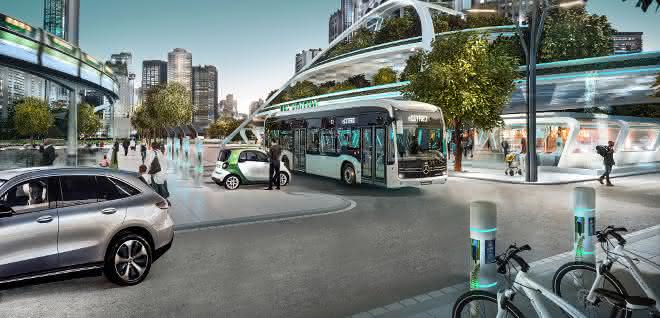
The company focuses on the following aspects of its SpurWechsel:
- CO2-neutral mobility by 2039
- Decoupling resource consumption and growth in business volume
- Innovative mobility and transportation solutions for liveable cities
- More safety in road traffic
- Responsible handling of data
- Responsibility for respecting human rights along the value chain
The lane change also includes entering into green financing, for example through green bonds. Such instruments create new opportunities to finance future investments inCO2-neutral technologies. At the same time, they offer environmentally-oriented investors the opportunity to participate directly in Daimler's ambitious sustainability projects. Daimler is thus supporting the EU's Green Deal, which aims, among other things, to motivate institutional investors to channel more capital into low-carbon and climate-neutral projects.
Ambition 2039:CO2-neutral by 2039
ReducingCO2 emissions is of central importance to Daimler. The Group is therefore aiming for aCO2-neutral fleet of new passenger cars worldwide by 2039. As an important step, Daimler wants to increase the sales figures of passenger cars with plug-in hybrid drive and purely electric drive, to over 50 percent by 2030. All new commercial vehicles in Europe, Japan and North America are also to beCO2-neutral in operation by 2039. The plans at Mercedes-Benz Vans are similar.
Consistent path towards environmental protection
Last year, the Group was able to achieve a number of important sustainability targets in line with the change of direction: In production, for example, the company already achieved its long-termCO2 reduction targets for 2020 in 2019. "Our consistent path towards climate protection was scientifically confirmed to us in 2019 by the Science Based Targets Initiative: OurCO2 targets are in line with the Paris Climate Agreement. We are also motivating our partners and suppliers to set similarly ambitious targets," says Markus Schäfer, Member of the Board of Management of Daimler AG, responsible for Group Research & Mercedes-Benz Cars Development, Purchasing and Supplier Quality and Co-Chairman of the Group Sustainability Board, the highest sustainability management body at Daimler AG.
Daimler has also been able to reduce energy and water consumption as well as the amount of waste to be disposed of in production per vehicle across all divisions in recent years. Mercedes-Benz Cars now produces 25 percent less waste for disposal per vehicle produced than in 2013/2014. Energy consumption fell by ten percent. Sustainability awards from 2019 for the two Mercedes-Benz eCitaro and Citaro hybrid city buses and the TopClass S 531 DT double-decker touring coach from the Group's own Setra bus brand further confirm this course. In December 2019, the Mercedes-Benz eCitaro was also the first all-electric city bus to be awarded the renowned "Blue Angel" eco-label by the German government.
Focus on human rights
Daimler attaches great importance to respecting human rights along the entire supply chain. Among other things, the Group is committed to the UN Guiding Principles on Business and Human Rights and the German government's National Action Plan for Business and Human Rights. In order to live up to its responsibility, the company carries out risk-based due diligence - and subjects supply chains for raw materials such as cobalt to extensive checks right through to the mines.
Renata Jungo Brüngger, Member of the Board of Management of Daimler AG and Mercedes-Benz AG, responsible for Integrity and Legal Affairs and Co-Chair of the Group Sustainability Board: "Sustainability is a constant challenge for us. That is why we have firmly anchored sustainable action in our Code of Conduct. In addition, we are already addressing the strategic issues of tomorrow today. These include, for example, our four principles for artificial intelligence: responsible use, explainability, protection of privacy and the security and reliability of applications."


You might also be interested in
The packaging world looks to Düsseldorf
Hot topics at Interpack 2026
Interpack has been bringing together the global processing and packaging industry in Düsseldorf since May 7, 2026. The focus will be on AI, automation, sustainable materials and new skills requirements.
 read more...
Sustainability needs decisions
To mark Earth Day, Nagarro is calling for a rethink: sustainability should no longer be documented, but actively managed - with artificial intelligence as a central lever. Because AI brings light into the darkness of global supply chains.
read more..."Green logistics is a decisive factor in achieving climate targets"
What trends and developments are there in the industry when it comes to green logistics? Experts provide insights: Stefan Borggreve is CDO and board member at Hellmann Worldwide Logistics.
read more...Route planning for electric, hydrogen and...
"DRivE" project partners complete successful test phase
The "Production Engineering of E-Mobility Components" (PEM) chair at RWTH Aachen University has successfully completed the pilot phase of the "DRivE" research project together with partners. In a two-month field trial, software was tested that is...
read more...On trend: green logistics
What trends and developments are there in the industry when it comes to green logistics? Experts provide insights: Markus Müllerschön is Vice President Sales at Viastore Software.
read more...On the way to green logistics
The topic of green logistics is becoming increasingly popular in the industry. Companies want to reduce the environmental impact of transporting and delivering goods without sacrificing the efficiency of their logistics chain.
read more...Noerpel Group tests hydrogen trucks
On July 25, Noerpel started the test phase with a hydrogen truck at the Heidenheim site. After two weeks, the Noerpel Group draws a positive interim conclusion about the 18-ton truck in terms of performance and driving characteristics, but remains...
read more...Sustainable logistics centers in times of crisis
With its Multicube concept, which the Pfenning Group has been pursuing for over twelve years, the company aims to set standards in terms of sustainable construction methods for logistics properties.
read more...Special land management and special foundation
A logistics park on a former landfill site
CTP, developer, owner and manager of industrial and logistics real estate, has won this year's Brownfield 24 Award in the Best Brownfield Project (Logistics) category with its first German new-build project.
read more...