
Digitization
AI supports ports with car handling
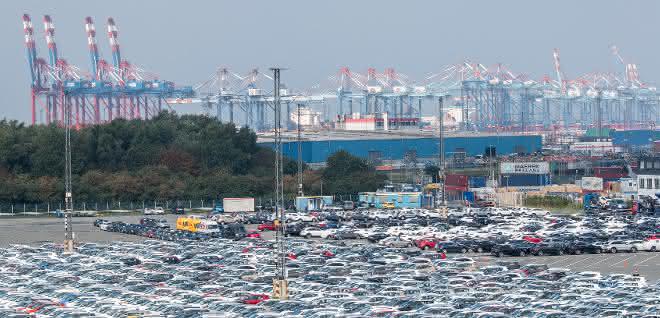
Handling, storage and technical processing: the range of services offered by car ports includes almost all vehicle logistics services. With 2.1 million vehicles in 2019, AutoTerminal Bremerhaven is one of the largest car ports in the world. With Isabella 2.0, the partners BIBA - Bremen Institute for Production and Logistics at the University of Bremen, BLG Logistics and Bremen-based software specialist 28Apps Software focused on process planning and control.
The three-year R&D project Isabella (long title: "Automobile logistics in sea and inland ports: interactive and simulation-based operational planning, dynamic and context-based control of equipment and cargo movements"), which was completed at the end of June, had a total budget of 3.7 million euros, was funded by the Federal Ministry of Transport and Digital Infrastructure (BMVI) in the Innovative Port Technologies (IHATEC) program with 2.6 million euros and was supported by the project sponsor TÜV Rheinland.
The follow-up project Isabella 2.0 has the long title "Automobile logistics in seaports and inland ports: integrated and user-oriented control of equipment and cargo movements using artificial intelligence and a virtual training application". It will also run for three years and is again being supported by TÜV Rheinland. It has a total volume of around 3.6 million euros and is receiving a further 2.5 million euros in funding from the BMVI's IHATEC program.
Rapid adaptation to current conditions
In the Isabella project, an intelligent planning and control system for logistics processing and the movement of cars in seaports and inland ports was developed and tested as a prototype at the BLG AutoTerminal Bremerhaven. An interactive, digital interface supports planning: the terminal site is visualized three-dimensionally via a multi-touch table. All relevant planning information, such as the occupancy of the terminal, can be displayed at various levels of detail. The system offers the option of evaluating different planning scenarios based on simulations and displaying the results on the multi-touch table.
With the help of mobile data acquisition and real-time status messages, the control algorithm enables the individual assignment of transport orders and thus the optimization of routes and rapid adaptation to current conditions. The assignment of orders has been digitized. The assignment of orders for vehicle movements on the terminal depends on the location of the vehicles and drivers. A control algorithm was developed for this purpose and initially tested within a simulation environment that digitally maps the terminal operations. In the real system, communication between the control system and the staff at the car terminal takes place via mobile apps. A separate positioning system was developed to determine the vehicle locations.
Isabella focused on the processes at the terminal, on internal car transfers. Isabella 2.0 is now to integrate the external modes of transport train, ship and truck with their loading and unloading and systematically extend the control system and the simulation environment to all handling processes. This requires data reception in the modes of transport. The project partners want to use the new 5G mobile communications standard or set up a local communication network. For the latter, ad hoc and mesh networks in combination with radio standards such as WLAN, Bluetooth or LoRa (Long Range Wide Area Network) could be considered.
The logistical performance of the system is to be further improved using methods of sensitivity analysis and artificial intelligence. By applying the Taguchi method as well as Critical Neural Networks (CNN) and Support Vector Machines, a situation-specific parameterization of the optimization algorithm is to take place. This means that in future, more criteria relating to the current situation will be incorporated into the optimization, including the terminal fill level, the vehicle mix and the personnel capacity.
Simulations, new data analysis methods and AI will be used to investigate the performance of the control algorithm, taking into account the aforementioned criteria and parameter settings. Relevant process indicators such as the time required for individual process steps or route utilization are systematically derived from operationally acquired data, which increases the predictability and thus the efficiency of operational driving processes.


You might also be interested in
HGK Shipping and Salzgitter cooperate
The companies want to jointly promote and expand sustainable logistics concepts on the waterway in future. Two Salzgitter subsidiaries and HGK Shipping signed a memorandum of understanding to this end on August 10.
 read more...
Settlement projects - done right
How do logistics managers find the right location for a logistics property and how should its sustainability be assessed? Fred-Markus Bohne from Panattoni in conversation with Martin Schrüfer.
read more...The call for innovation rings out
Demand for space in the logistics real estate sector has been increasing for years, with drivers such as e-commerce, the coronavirus pandemic and the expansion of regional stockpiling structures fueling demand.
read more...Port Representative Office: Karin Lengenfelder replaces Jürgen Behrens
After almost 48 years, Jürgen Behrens, Head of the Port of Hamburg Representative Office South, is retiring from logistics.
read more...5G test field planned in the port of Duisburg
With the joint project "5G.Logport Duisburg", duisport, the City of Duisburg and the University of Duisburg-Essen are applying for funding from the state of North Rhine-Westphalia to set up a 5G test field in the Port of Duisburg.
read more...Testing at JadeWeserPort Wilhelmshaven
Fully automatic shunting locomotives are coming
Recently, the JadeWeserPort companies' application for funding for a research project to test the fully automated shunting process in the screening group in the freight village (GVZ) of Germany's only deep-water container port, JadeWeserPort...
read more...3D crane simulator in the Port of Duisburg
The duisport Group has unveiled its own crane simulator in Duisburg's free port: This is not only intended to set new standards in the field of technical development in the logistics industry, but the inland port is also investing in the training...
read more...Interview with port manager Andreas Bullwinkel
JadeWeserPort: Long out of the starting blocks
Andreas Bullwinkel has been Managing Director of Container Terminal Wilhelmshaven JadeWeserPort-Marketing GmbH & Co. KG for five years. In the interview, Bullwinkel also addressed the topics of federalism and transport policy.
read more...NRW Minister President Laschet visits the port of Rotterdam
Rotterdam, 04.10.2017 - Armin Laschet, who was elected Minister President of North Rhine-Westphalia at the end of June this year, visited the port of Rotterdam on his first trip abroad. The CDU politician went on a tour of the...
read more...