
Autonomous driving
"VanAssist": the delivery vehicle of the future?
By 2025, the number of parcels transported in Germany each year is expected to increase by 40 percent to around 5.7 billion. This is why parcel delivery companies such as dpd are actively working on sustainable delivery concepts. As part of the VanAssist cooperation project, an autonomous electric delivery vehicle has been developed. Tests with the VanAssist vehicle in daily road traffic are already planned.
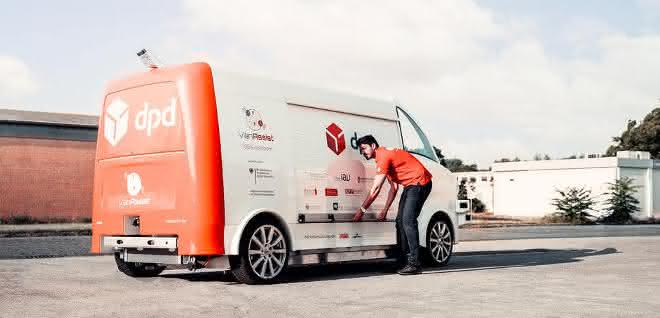
A shortage of skilled workers, increasing traffic density and emissions in conurbations: the VanAssist cooperation project between dpd and partners from science and industry has set itself the goal of helping to solve these problems using autonomous delivery vehicles.
Rethinking route planning
The development of the autonomous vehicle focused on the constantly increasing demands on the last mile of parcel delivery. In particular, the routes and routes of a parcel tour were to be optimized. Thanks to intelligent navigation software, the test vehicle is able to autonomously navigate to stops and react to changes in road traffic in real time. "We have realized that we need to fundamentally rethink our route planning. In future it will not only be relevant to which address we deliver a parcel, but also where we can identify nearby stops for this parcel and store them in the system," explains Gerd Seber, Group Manager City Logistics & Sustainability at DPD Germany.
Rendezvous mode: the delivery driver gets in
The VanAssist test vehicle operates in rendezvous mode: the vehicle should be able to cover the distance from the depot to the delivery area autonomously. The delivery driver only gets into the vehicle at a predefined meeting point. Whenever the delivery person then delivers a parcel, the vehicle automatically heads for the next predefined stop. This means that the van always waits for the delivery person exactly where they need the next parcel or to be taken to the next address. If the planned stopping point is not available, the vehicle uses an eSmartphone app to inform the delivery person at which alternative point it will be waiting for them. The app control also makes it possible to flexibly adapt delivery routes as required. Indoor navigation has also been integrated to guide the delivery driver quickly to the delivery point to be reached in large office or industrial complexes inside the building.
After the test vehicle has so far been used on a university test site, the next step is for it to be used on the road in a practical test.


You might also be interested in
DPD Germany optimizes parcel delivery with Zebra Technologies
DPD Germany's delivery drivers scan up to 1,000 parcels a day with the help of mobile devices from Zebra Technologies. The logistics specialist uses the TC77 all-in-one mobile computer for all data scans in local transport, enabling it to keep pace...
 read more...
GLS and DPD cooperate on out-of-home parcel delivery
The parcel specialists GLS and DPD want to remain competitors, but see advantages in joint out-of-home delivery. They are planning a partner network of around 20,000 contact points by 2027.
read more...Arvato Takes Over European Logistics for Mister Spex
Starting September 1, 2026, Arvato will take over key logistics and fulfillment processes for Mister Spex in five European countries. The partnership is intended to create a scalable supply chain and support the continued growth of the omnichannel...
read more...New Logistics Hub for Panasonic HVAC in Europe
NOSTA Logistics is expanding Ladbergen into a European logistics hub for Panasonic HVAC. To this end, the full-service logistics provider is making 12,000 square meters of space available, where air conditioning, ventilation, and heat pump...
read more...TGW Automates Intersport Distribution Center
Intersport France has launched a new, highly automated distribution center in Saint-Vulbas, near Lyon. The facility, built by TGW Logistics, is designed to support the sporting goods retailer’s growth, smooth out seasonal peaks, and make store...
read more...Major project in the Korean retail sector
Knapp builds Korea's largest shuttle system
Together with Knapp and Doosan Logistics Solutions, Asung Daiso is building a new highly automated omnichannel logistics center in Yangju, South Korea. The facility is the largest shuttle system ever built by Knapp in South Korea.
read more...Kion gets off to a strong start in 2026
Significant increase in incoming orders
The intralogistics company Kion Group records a significant increase in order intake in the first quarter of 2026 and increases profitability and cash flow despite geopolitical uncertainties.
read more...Jungheinrich implements automation for...
Fully automated large warehouse launched in Páty
Gebrüder Weiss has put an automated warehouse into operation in Hungary, largely replacing manual processes. The new logistics center near Budapest increases efficiency, capacity and sustainability and at the same time responds to increasing demands...
read more...Integration of a robotics solution
Lyreco modernizes logistics center in France
Lyreco is pressing ahead with the automation of its central site in Villaines-la-Juhel with an investment volume of over 25 million euros.
read more...