
Floor cleaning
Away with the dust
What goes over the stage - or rather the ramp - at Volkswagen OTLG in Ludwigsburg is logistics in XXL format. Every day, almost 30,000 deliveries are sent on their way to almost 500 car dealerships, which supply almost two million drivers with spare parts. Where so much is moved, there is a lot of dust, which has recently been cleaned up with a Kärcher scrubber-dryer.
The Southwest Sales Center in Ludwigsburg, Swabia, which has been in existence since 1972 and employs a good 400 people, is one of a total of seven VW OTLG locations with which the Volkswagen Group ensures the supply of spare parts for its VW, Audi, Seat, Skoda and VW Commercial Vehicles brands throughout Germany. The car dealerships are supplied twice a day via a sophisticated system. They can also order their workshop equipment - including complete work platforms - from Volkswagen Genuine Parts Logistics (OTLG), as the company is officially known.
At the Ludwigsburg site alone, over 70,000 different items are kept in stock, ready for immediate dispatch. Storage and handling take place in a logistics area of 42,000 m2, which is the size of six soccer pitches. "In order to keep pace with growth, we have repeatedly expanded and modernized our logistics center in four construction phases," says branch manager Michael Machbert.
The mix includes large-dimensioned small parts warehouses as well as tunnel and paternoster systems, which are connected to the outgoing goods area via a two-kilometer-long box conveyor system. A large block warehouse for bulky parts and a huge high-bay warehouse are handled by heavy industrial trucks and forklift trucks. "It is crucial for a smooth process that we have sufficient staging areas where the picked deliveries are waiting to be transported away," says Machbert. "We need precision like Swiss clockwork, otherwise there are real problems. Every one or two months, we completely turn over our warehouse - everything has to fit!"
Cleanliness is very important
Cleanliness is closely linked to the quality standards of the Volkswagen OTLG logistics centers. "We want to send our goods, which often go directly to the end customer in their packaging, to the car dealerships in top condition," emphasizes Machbert. "At the same time, we want to offer our people clean and safe workplaces." This is why clearly structured cleaning plans are in place in Ludwigsburg. "Our biggest challenge is dust," says Jörg Kaltwasser, who as safety officer is also responsible for cleanliness. "Where so many items are moved in such a confined space, dust is automatically an issue." It is whirled up as soon as one of the industrial trucks picks up speed - and is spread across the rows of shelves, storage areas, parking spaces and traffic areas. "Added to this is the abrasion from the crate conveyor system and our forklift trucks, which are constantly on the move," adds Kaltwasser.
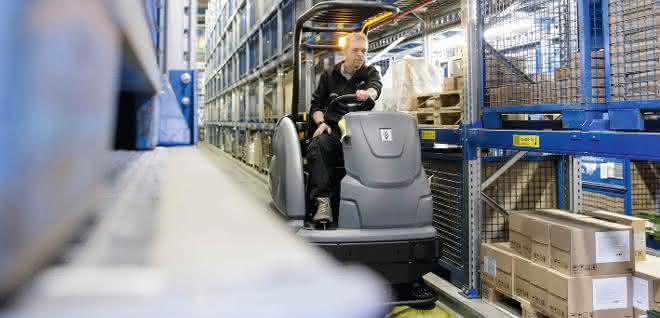
The new flagship of the cleaning fleet, which is used to tackle dust, is a B 250 R ride-on scrubber-drier from Kärcher. With a theoretical area performance of 9,600 m2/h and a fresh and dirty water tank of 250 liters each, the battery-powered machine, which is put to daily marathon use, is predestined for large areas. "The decisive factor in the tender was that with the new machine we wanted to make a system change from pure sweepers to a scrubber-drier, where wet cleaning guarantees a significantly better cleaning result," says Volkswagen OTLG man Kaltwasser. "While classic sweepers only capture 70% of the dust and distribute the rest through the air, the wet mode binds it in the dirty water and ensures that it is largely dust-free."
Individually configured machine
The individual configuration of the B 250 R to suit the actual operating conditions on site was a key factor in the purchase decision. "A typical feature of our commercial scrubber-driers is that they can be configured to fit perfectly," says Michael Germann from the Kärcher field service, who accompanied the Volkswagen OTLG order from A to Z and determined the exact equipment together with the customer during a site visit with a machine demonstration. "The advantage is that the customer gets exactly the machine they actually need". The B 250 R is available ex works with either a disk or roller brush head. "While disk brushes are particularly suitable for smooth, even floors, we specifically opted for the scrubbing head with counter-rotating rollers for Volkswagen OTLG," says Germann. "Absolutely right for Ludwigsburg, where we have to deal with a mix of older concrete screed and modern industrial floors as well as some tricky unevenness at the transitions between new and older halls." Brush heads with rollers work with up to seven times more contact pressure than disc brushes and achieve superior scrubbing performance, especially on uneven floors or joints.
Roller technology was spot on
"We were absolutely right to opt for the rollers," was Kaltwasser's verdict. "The machine is absolutely painless on the different floors and delivers impeccable cleaning results." The Volkswagen OTLG man, who regularly sits behind the wheel of the machine himself, is also impressed by the standard eco-efficiency level. It proves to be a plus, especially during daily maintenance cleaning, which is carried out using the one-step method (wet scrubbing with direct suction of the dirty water). In Eco mode, the B 250 R works with less motor power, contact pressure and water. "Gentle mode is great for daily maintenance," says Kaltwasser. "We work in a more environmentally friendly way and also faster and more economically." In addition to the protective roof with rotating beacon - important for work safety - the "Dose" system developed by Kärcher is also part of the additional equipment. It regulates the precise dosage of cleaning agent, which is added to the water at the brush head. The system, which can be scaled in 0.5 % increments, improves the cleaning process, whereby the dosing parameters can be permanently programmed into the machine control system. This eliminates overdosing and operating errors. "A lot helps a lot! This thinking is still widespread," says Kärcher expert Germann. "But too much cleaning agent can quickly have the opposite effect - for example, it can lead to sticky floors to which dirt adheres even more quickly."
Super easy to operate
Dose" scores particularly well in combination with the clever KIK key and access system. KIK stands for "Kärcher Intelligent Key" and offers protection against operating errors. While the grey foreman key is coded so that it allows team or group leaders to program factors such as contact pressure or detergent dosage, the yellow key only authorizes the operator to start the machine and the programs stored in the control unit. The B 250 R can be operated without lengthy training. This is also ensured by the cockpit, where pictograms show the way and the basic functions can be called up quickly and conveniently via the "Easy Operation Switch".
Fire department operations on the staging areas
The scrubber dryer, which can turn almost on the spot and, with a working width of 1.2 meters, is also suitable for narrow rack aisles, has become a permanent fixture at Volkswagen OTLG. It is on the road for a good eight hours a day, and the battery lasts for the entire period. Pit stops only have to be made three to four times to drain dirty water and fill up with fresh water. In order to spread the cleaning marathon over several shoulders, Volkswagen OTLG has created a pool with a handful of drivers who take turns. Following a clear route plan, the machine makes its daily rounds through the huge logistics center. The special seating position of the driver - right at the front - guarantees a clear view. Collision-free work and slalom maneuvers on narrowly cultivated areas or cleaning close to the edges are no problem. "Maximum flexibility and speed are required when it comes to cleaning the staging areas," says Machbert. "The time windows are extremely small, which is why the machine often has to carry out real fire department operations." The B 250 R is also used for basic cleaning work - for example, when it comes to restoring the shine to floor markings that have been soiled by tire marks or abrasion. Work is carried out in a two-step process - with more contact pressure, a higher roller speed and special cleaning agents. First, the "scrubbing with water and detergent" program is called up - and the cleaning solution is allowed to soak in for five minutes before it is sucked up in the next round. "It's still something of an aha moment when a marking that has almost disappeared becomes a bright yellow safety stripe again," says Kaltwasser.


You might also be interested in
Weightlifters for all industries
In modern logistics processes, pallets are far more than just transport aids. Especially in automated logistics systems or industries with high hygiene requirements, it is worth making a precise comparison.
 read more...
Cooperation agreed for the logistics circular economy
Booxit aims to make logistics processes more efficient and sustainable with intelligently networked reusable boxes. The start-up is receiving support from plastics specialists Haidlmair and Polytec.
read more...Boxes for logistics solutions
Con-Pearl is a manufacturer of environmentally friendly lightweight PP boards. The company has been using this material for years to produce logistics and transport packaging in pallet and half-pallet format, among other things. Con-Pearl now also...
read more...Sustainable and solid transportation
Efficient use of space during transportation and the reusability of packaging are crucial not only for economic but also for ecological reasons. They also protect products from damage during transportation and storage and thus make a significant...
read more...Containers for the future of intralogistics
Solo or in a shelving system
With a focus on sustainability and the circular economy of packaging, Bito-Lagertechnik is coming to Fachpack to present various models and types of returnable load carriers, boxes and transport packaging in different designs for sustainable...
read more...Fachpack: Folding containers made from bioplastics and marine plastics
Söhner Kunststofftechnik is focusing on sustainability and efficiency at Fachpack: the company is presenting sustainable packaging solutions such as large load carriers made of bioplastics and marine plastics and foldable stacking boxes made of...
read more...Unique boxes for unique products
The Walther Faltbox Group is taking a step towards sustainability: instead of recycling folding boxes with individual color gradients as usual, the company is now offering them as unique boxes in the Boxline store.
read more...Nestable reusable pallet made from recycled plastic
The transport and storage technology specialist Kiga from South Westphalia is presenting the Kiganesto plastic pallet at Logimat.
read more...Alternative to the mesh box: Craemer presents Kubo - the plastic box for heavy-duty applications
At this year's Logimat, the internationally active Craemer Group with its headquarters in Herzebrock-Clarholz, East Westphalia, will be exhibiting the new Kubo as well as the hygienic HB3, the extremely robust SB3, the CB1, CB3 and the large-volume...
read more...