
Solution for special load carriers
Optimized conveyor technology for commercial vehicle manufacturers
Torwegge has developed two customized conveyor systems for special load carriers for a leading commercial vehicle manufacturer. These ensure automated, demand-controlled provision of empties for loading with components for axle production. The result: waiting times have been reduced and production efficiency significantly increased.
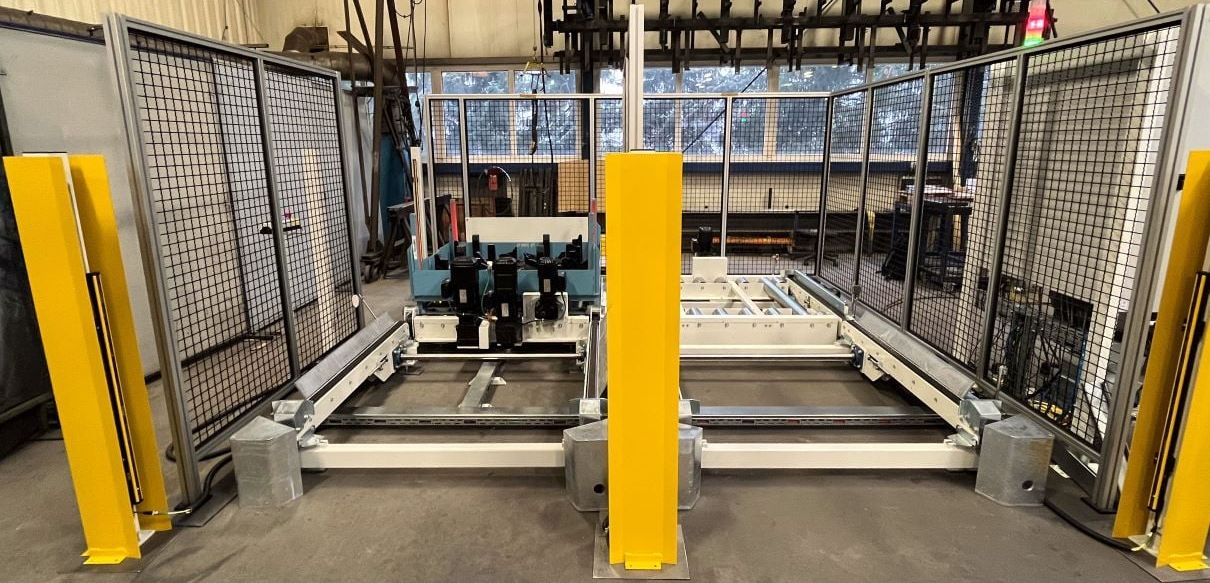
Thanks to the combination of roller and chain conveyors, the load carriers can be moved sideways at a 90-degree angle. The transition to the roller conveyor is made by automatically lowering the chains by releasing the air from a pressure chamber underneath. Torwegge has also equipped one of the systems with a turntable that allows flexible access to the load carriers from all sides.
"Our solution ensures that empty steel containers are continuously available at the stations where they are filled with small parts for axle construction. This allows the process to run smoothly and without interruptions," says Christian Mols, Regional Manager at Torwegge.
Challenges: Space conditions of the customer and special load carriers
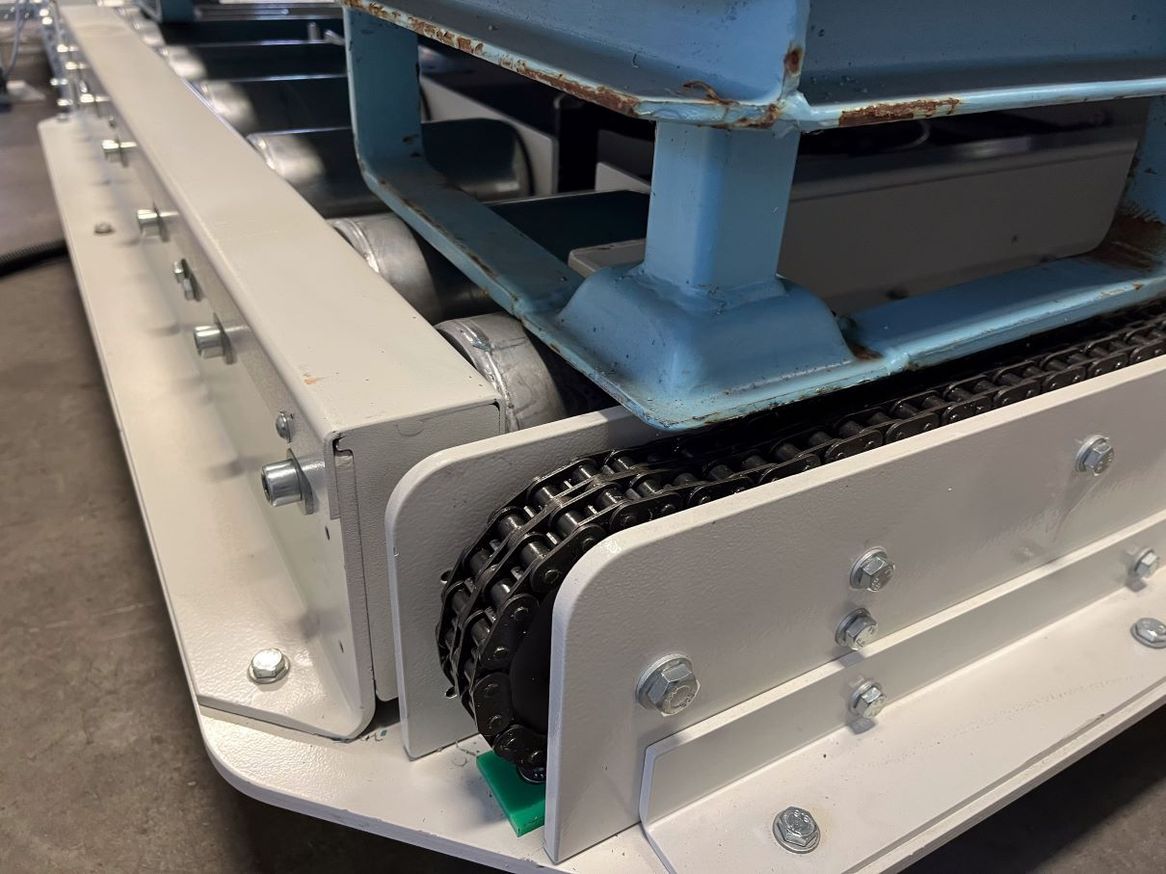
The intralogistics specialist has adapted the conveyor systems precisely to the structural conditions and process-specific requirements of its long-standing customer. The new systems combine chain and roller conveyors: the load carriers first move on the chain conveyor before being transferred to the laterally positioned roller conveyor at a 90-degree angle. "This means that the systems are optimally adapted to the customer's space conditions and the special load carriers equipped with skids," explains Mols, adding: "We worked closely with our long-standing customer to precisely tailor the planning to their individual requirements."
The two systems, measuring 8 x 3.50 m and 4 x 3.50 m respectively, are positioned next to each other so that one employee can work on both in parallel. Depending on the system, different components are loaded for axis assembly. The transition from the chain conveyors to the roller conveyors takes place using pressure chamber technology: the chains lie on a hose filled with air and are lowered by releasing the air. The load carrier is then transferred to the idlers in a controlled manner and conveyed sideways. "Both systems offer four storage locations for steel containers, so that load carriers are always available for feeding, loading and discharging," explains Mols. The special load carriers are placed on the conveyor system by forklift truck, while a traffic light system signals to the forklift drivers when empty steel containers need to be fed in or filled ones picked up. This ensures a seamless material supply - without waiting times or backlogs.
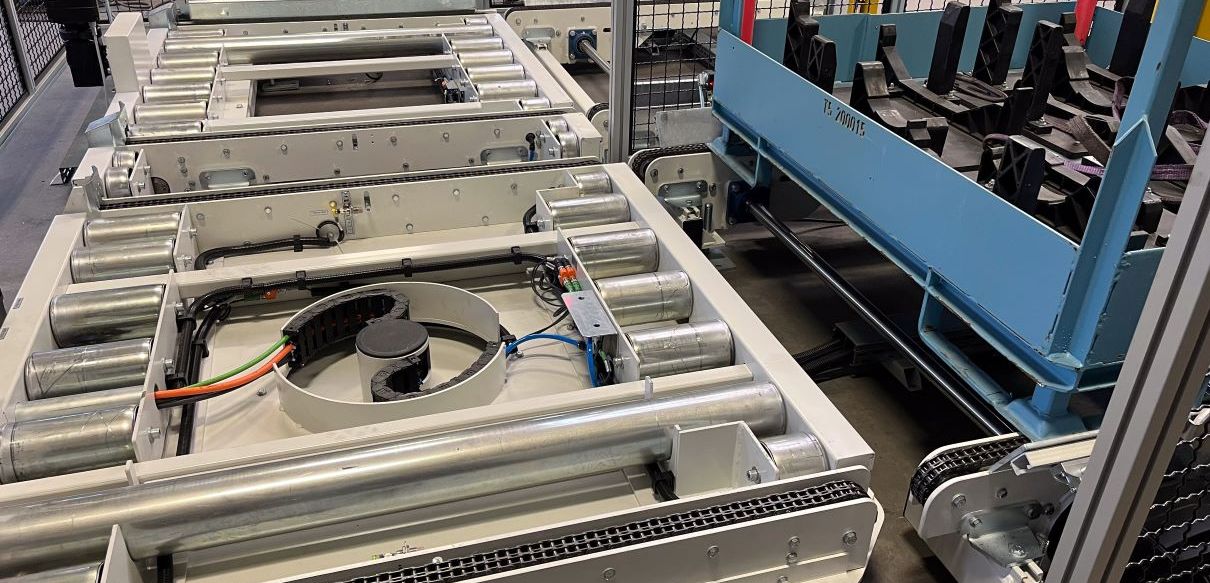
In addition, one of the systems installed by Torwegge is equipped with a turntable that allows the load carrier to rotate 180 degrees. "This allows our customer to first fill the containers from one side, turn them at the touch of a button and then complete the loading process - without having to access the conveyor system from both sides," says Mols.
Focus on occupational safety
To ensure occupational safety, Torwegge equipped the systems with safety nets in the footwell and a safety fence. Installation and commissioning took place over the weekend so that ongoing operations remained undisturbed. The employees then received comprehensive instruction on the technology, processes and control systems to ensure a smooth handover.


You might also be interested in
100+ installations worldwide: Trust through practice
Automation must function reliably, every day, at all times. With more than 100 adapter-based sorting systems from Dürkopp Fördertechnik (DFT) installed worldwide, the technology has proven itself in continuous industrial operation.
 read more...
Automatic sorting with flexible scalability
With the new Push Tray Sorter, Dürkopp Fördertechnik GmbH (DFT) is expanding its portfolio in the field of automated sorting technology. The Bielefeld-based company, part of the Knapp Group since 2010, is now assuming group-wide responsibility for...
read more...Gebhardt Intralogistics strengthens North American business through local production
Gebhardt Intralogistics North America has announced that it will significantly expand its production capacities in North America. This step will allow the company to build up additional manufacturing capacity in the USA. Gebhardt Intralogistics...
read more...Sorting and conveying more efficiently
Orchestra Prémaman is a retail chain offering maternity wear, children's clothing and baby accessories. Founded in 1995, the company employs over 2,500 people and operates around 300 stores, mainly in France, Belgium and Switzerland. In 2020,...
read more...Efficient and zero pressure accumulation pallet conveying
Rollex is a manufacturer of conveyor elements and specializes in components for internal material flow.
read more...Wayzim opens up the German market
Wayzim, a system manufacturer for intelligent logistics equipment, vision systems and industrial sensors based in Wuxi, China, is expanding its activities on the European market.
read more...DHL Asia Pacific Innovation Center introduces Celluveyor technology
DHL has selected Cellumation's Celluveyor technology for display at the DHL Asia Pacific Innovation Center in Singapore. The integrated solution, which combines Cellumation's omnidirectional conveyor belt with a cobot arm, enables the processing and...
read more...TGW surpasses the billion mark in sales
TGW Logistics can look back on a successful financial year 2023/2024: the company increased its turnover to 1.07 billion euros. With an EBIT of 29.6 million euros, TGW Logistics is clearly back in the profit zone.
read more...Overhead conveyor technology for efficient material flow
The FMB trade fair will take place in Bad Salzuflen from November 5 to 7. The Torwegge company will be presenting its latest conveyor technology innovation there: a highly flexible overhead conveyor.
read more...