

From materialfluss 5/19
More flexibility when baking cookies
The easychain system with ten or eleven lines, which is now ensuring more flexible processes and greater productivity at the large Italian confectioner Forno Bonomi in Verona, is the largest 3D plate chain conveyor system ever implemented by the Swiss company Ferag AG. This forms a smoothly functioning bridge between first and second packaging over several stages.
Amarettini, shortbread and ladyfingers are popular all over the world. Not only with coffee or tea, but also as a little treat between meals. Products that have a high recognition value and are based on traditional recipes are particularly popular. This is one of the reasons why Italian manufacturers of fine cookies and sweets have been booming for a number of years.
This also applies to the large confectionery Forno Bonomi, which dates back to 1850 and is still family-owned today. Based in Roveré Veronese, the company specializes in ladyfingers, almond cookies and the butter cookies typical of the region around Verona. The medium-sized company is present in over 85 countries with its products. In view of the constantly increasing demand, Forno Bonomi was forced to expand its production and adapt to global market requirements.
Realization in three project segments
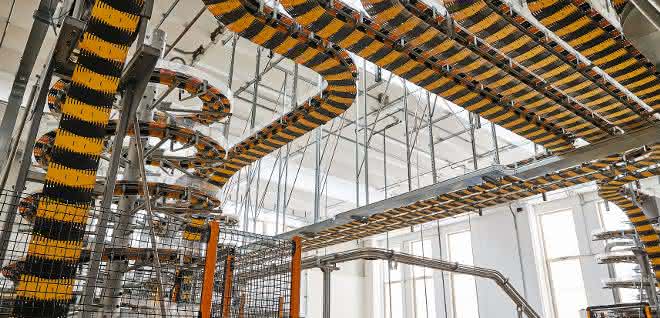
The conveyor technology required to link the individual production and logistics processes was implemented by material handling specialist Ferag in three project segments. The easily scalable easychain system was chosen for several reasons. Firstly, the plate chain conveyor technology from the Swiss company has already established itself at numerous food and luxury food manufacturers for the transfer from first to second packaging - the reference list ranges from Gennari to Mondelez and Nestlé. Secondly, the easychain technology, which is easily identifiable thanks to the black and yellow striped plates, offers a number of unique selling points that played a decisive role for Forno Bonomi.
Low resistance with very smooth running
The starting point for this is the conveyor technology specifically developed by Ferag. The rolling principle based on components with extremely low resistance to movement is not only responsible for reduced friction, but also contributes to the fact that the system requires few drives. Despite the record-breaking chain length of over three kilometers and a total of 20 spirals, only 35 drives with 0.75 kW each are required to set the conveyor technology in motion on the entire system in Roveré Veronese. The Ferag concept enables a virtually maintenance-free system, even with high transport capacities, because the easychain conveyor's support plates made of solid plastic are supported by robust rollers, which are guided safely and with exceptionally smooth running in two stable profile rails. This smooth running is essential for conveyed goods such as easily crumbled baked goods. It enables particularly gentle transportation.
Also of great importance: due to the rolling principle, the moving easychain parts do not require any lubrication with special lubricants, greases or oils. In this respect, the easychain system is predestined for use in the food sector. In addition, an easychain system works extremely energy-efficiently due to these rolling specifics. This means that it requires very little electricity. This aspect was also important for the decision-makers at Forno Bonomi, as the company, which increasingly offers organic products and serves a clientele with pronounced ecological demands, attaches great importance to sustainability and environmental compatibility.
Promoting overhead and gaining space
But these are by no means all the criteria that spoke in favor of the Swiss system in Roverè Veronese. There was another powerful argument: the easychain technology allows very tight curve radii. This aspect always comes into play when - as in Forno Bonomi's main plant - a large part of the conveyor section takes place overhead. The associated goal is to gain space on the floor for other purposes, such as additional storage or traffic areas. This allows the goods to be conveyed first upwards and then back down again via compact spirals. At the Italian confectionery, ten easychain lines take over the cellophane-wrapped confectionery immediately after the first packaging. Immediately after the transfer, the spiral takes each product four meters upwards into the mezzanine area of the production hall, which is equipped with ten ovens. This completes the first stage of the conveyor line.
Focus on flexibility
The owners of Forno Bonomi wanted maximum flexibility. In addition, the Ferag customer wanted to be able to feed the individual types of baked goods back and forth from the infeed lines as required and thus sort and rearrange them conveniently. This is made possible by ten additional easychain lines plus a reserve in the second conveyor section. The selectable packs are directed from the infeed lines to the easychain lines in the second section via a deflector in a targeted but gentle manner. At Forno Bonomi, this area is also known as the first line.
The products roll into the end-of-line area via the first line. There, they turn down a spiral four meters high to a level of 90 centimetres in order to reach one of ten secondary packaging machines. Each of these places several packs into larger cartons. Next step: From there, high-speed pushers designed by Ferag quickly but gently push the large boxes onto a single, 200-metre-long easychain circuit that supplies ten palletizing stations. This is where the easychain technology really comes into its own: As a smoothly functioning conveyor system that can transport up to 75 boxes per minute and only requires three drives for the complete loop, it forms one of the most efficient and flexible interfaces between upstream production and palletizers currently available on the market, according to the company.
Ferag AG, headquartered in Hinwil in the Zurich Oberland region of Switzerland, specializes in conveyor and processing technology. The company claims to be the global market leader in the development, construction and sale of systems for print finishing. At the same time, Ferag is increasingly active in intralogistics. Ferag is part of the WRH Walter Reist Holding AG group of companies.


You might also be interested in
Weightlifters for all industries
In modern logistics processes, pallets are far more than just transport aids. Especially in automated logistics systems or industries with high hygiene requirements, it is worth making a precise comparison.
 read more...
Cooperation agreed for the logistics circular economy
Booxit aims to make logistics processes more efficient and sustainable with intelligently networked reusable boxes. The start-up is receiving support from plastics specialists Haidlmair and Polytec.
read more...Boxes for logistics solutions
Con-Pearl is a manufacturer of environmentally friendly lightweight PP boards. The company has been using this material for years to produce logistics and transport packaging in pallet and half-pallet format, among other things. Con-Pearl now also...
read more...Sustainable and solid transportation
Efficient use of space during transportation and the reusability of packaging are crucial not only for economic but also for ecological reasons. They also protect products from damage during transportation and storage and thus make a significant...
read more...Containers for the future of intralogistics
Solo or in a shelving system
With a focus on sustainability and the circular economy of packaging, Bito-Lagertechnik is coming to Fachpack to present various models and types of returnable load carriers, boxes and transport packaging in different designs for sustainable...
read more...Fachpack: Folding containers made from bioplastics and marine plastics
Söhner Kunststofftechnik is focusing on sustainability and efficiency at Fachpack: the company is presenting sustainable packaging solutions such as large load carriers made of bioplastics and marine plastics and foldable stacking boxes made of...
read more...Unique boxes for unique products
The Walther Faltbox Group is taking a step towards sustainability: instead of recycling folding boxes with individual color gradients as usual, the company is now offering them as unique boxes in the Boxline store.
read more...Nestable reusable pallet made from recycled plastic
The transport and storage technology specialist Kiga from South Westphalia is presenting the Kiganesto plastic pallet at Logimat.
read more...Alternative to the mesh box: Craemer presents Kubo - the plastic box for heavy-duty applications
At this year's Logimat, the internationally active Craemer Group with its headquarters in Herzebrock-Clarholz, East Westphalia, will be exhibiting the new Kubo as well as the hygienic HB3, the extremely robust SB3, the CB1, CB3 and the large-volume...
read more...