
From materialfluss 4/2020
Pallets cross the bridge
HaRo has created a smart logistics solution with suspended conveyor technology at KEB Automation.
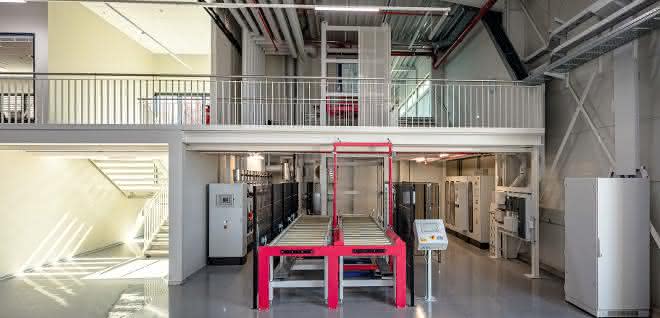
How do you connect an existing hall to a new warehouse, both of which are separated by a fire department access road and whose floor levels are considerably different due to a slope caused by the terrain? How can the product transport be realized together with the buffering between the halls without additional investments in further construction measures? These questions were posed by KEB Automation, developer, manufacturer and system supplier of control and drive technology. HaRo provided an answer with its conveyor technology.
KEB Automation had clearly defined the requirements right from the start: A solution had to be found to connect a new hall with the existing production building using automated logistics. The fact that there was a considerable difference in gradient between the buildings was not the only tricky aspect. The adjacent fire department bypass was also not to be impaired by the linking of the two halls. The solution: a bridge that transports finished and semi-finished products between the two halls without manual intervention and which can also be used by employees and visitors.
Cantilevered connection between the two halls
In collaboration with the future users, HaRo developed a project that would meet all the boundary conditions: On the first floor of the existing building, the goods to be conveyed - in this case Euro pallets - are transferred to the roller conveyor by forklift truck. A contour control system checks for any protrusions on the conveyed goods to prevent pallets that do not correspond to the designed size from colliding later on the roller conveyors or in the vertical conveyor.
In addition, the feed areas on the roller conveyors are equipped with a scale that records, checks and balances the weight of the pallets. This is particularly important to ensure that the maximum total load of the bridge is not exceeded. After all, the bridge is a self-supporting connection between the two halls and its maximum load capacity must not be exceeded. After a pallet has passed the bridge, its weight is finally deducted again so that the current load on the conveyor systems in the bridge can always be called up. This is also important because the roller conveyors also act as a buffer space for products that are not required.
The bridge is therefore an intralogistics concept that does not interfere with the fire department access to the halls. A vertical conveyor is recommended to overcome the height difference between the two halls and to connect several different floors. Fully automated, the HaRo vertical conveyor transports goods of all types, weights and sizes across several levels. As it can be easily connected to existing systems in most cases, it offered an effective way of compensating for the height difference between the new and old halls for the project at KEB Automation.
The conveyed goods can also be transferred to the vertical conveyor in the new warehouse and transported up to the roller conveyor. In this case, the pallets are transported back to the production hall on the parallel track. Two roller conveyor lines allow the goods to be transported in parallel. This avoids waiting loops at the systems.
User supplied the drive technology
For KEB Automation, it was clear that all drive and control components for the conveyor systems would come from the company itself. KEB Automation has also made provisions for the future with the HaRo conveyor system: an expansion of the production and storage areas is planned for the coming years, which can be flexibly connected to existing halls and conveyor systems. The vertical conveyor has already been designed so that it can be connected to a third hall. For this purpose, the vertical conveyor has been equipped with a turning device that enables parts to be transferred from the vertical conveyor to the conveyor systems.


You might also be interested in
Compact motorized castor for pallets and heavy loads
Rulmeca has launched a new motorized roller onto the market. The EPS-AS1 roller motorizes roller conveyors for heavy loads of up to 1,500 kilograms.
 read more...
Torwegge presents new Eco transport trolley
Torwegge has added a new eco transport trolley to its product portfolio. The trolley was developed to facilitate the transportation of heavy loads of up to 250 kilograms in various sectors such as the food industry, retail, catering, healthcare and...
read more...New transport trolley at Logimat
Fetra is also coming to Logimat. The manufacturer of transport equipment for efficient intralogistics processes will be presenting new products and program highlights. Wuppi" will also be there: The aluminum compact trolley is a powerful helper on...
read more...AR Racking equips new Lekkerland logistics centers
The German company, which specializes in consumer goods to go, recently opened two new warehouses in Germany, one in Kerpen and one in Wedemark, which have a storage capacity for 57,459 pallets.
read more...Paper manufacturer with innovative production logistics
Paper manufacturer Franz Veit has made its intralogistics operations much more efficient with the help of Linde Material Handling and Ernst Müller Fördertechnik.
read more...AR Racking equips new Lekkerland logistics centers
Lekkerland is reorganizing its logistics in Germany by 2030 to make it fit for the opportunities and challenges in out-of-home consumption today and tomorrow. As part of this, the storage solutions specialist has supported AR Racking in the opening...
read more...Automated intralogistics system
AMI Förder- und Lagertechnik exhibited an automated intralogistics system at Logimat that covers the entire packaging process right through to shipping.
read more...High-performance electric floor track
Transport system for small load carriers and pallets
Where efficiency and high availability are important, electrically driven floor conveyors are often an alternative to continuous conveyors.
read more...Satellite warehouse turns 40
Westfalia Logistics Solutions celebrated the 40th anniversary of the Satellit load handling device at Logimat. The system is designed for storage on pallets, other loading aids or without pallets.
read more...