
Automation
Maximum flexibility for pallet transport
At the touch of a button and without manual intervention from goods receipt to production? This has been a reality at Schne-frost since last year. From now on, the raw materials are transported between the newly built incoming goods warehouse and production in a fully automated and efficient manner thanks to an integrated conveyor system from HaRo Anlagen- und Fördertechnik GmbH.
However, transportation over a fire department access road using a conveyor bridge is not the only special feature of the new conveyor system at Schne-frost. It has taken less than half a century for the company to turn a simple foodstuff - the potato - into a "superstar". What began in the 1950s as a wholesale business for seed and table potatoes is now an innovative production company for frozen potato and vegetable specialties. From the well-known French fries, croquettes and mashed potatoes to potato dumplings and potato noodles, Schne-frost offers potatoes in all conceivable shapes, sizes and flavors. Since it was founded by Ernst Schnetkamp, an agronomist at the time, the company has grown steadily and today has a factory site covering over 100,000 square meters - equipped with the most modern production technologies in the food industry.
With the same intention and an expansion of its production lines, the company turned to the Sauerland-based conveyor technology manufacturer HaRo in 2019: Schne-frost was looking for a conveyor system to connect its new raw materials warehouse to the production facility, linking the new warehouse with the existing building. The challenge: a fire department bypass between the two buildings could not be impaired for the transportation of the raw materials. A difficulty for which Thorsten Koopmann, sales area manager from intralogistics manufacturer HaRo, developed the right solution concept: two vertical conveyor systems and a section of link conveyors were to overcome the distance and the height differences between the buildings and meet the requirement for automated transport. "The customer also wanted to transport the raw materials not only in one direction - from goods receipt to production - but also in the opposite direction." Finally, the unused raw materials should be transported back to the raw materials warehouse.
Optimal: an articulated belt conveyor
However, as Thorsten Koopmann emphasizes, the goods to be conveyed are not just the usual and standardized pallet designs: "We use a wide variety of pallets from all over the world with very individual dimensions, materials and skid or base designs. This is one reason why a trained and experienced eye is also required when selecting the conveyor system. "These pallets cannot be transported using conventional roller conveyor or chain conveyor applications," says the area manager, who recommended a link belt conveyor to his customer to avoid tedious repalletizing. The link belt conveyor enables flexibility in the conveyed goods and eliminates problem areas that could cause the material flow to come to a standstill if the conveyed goods are not suitable for reliable transportation due to their design or possible damage.
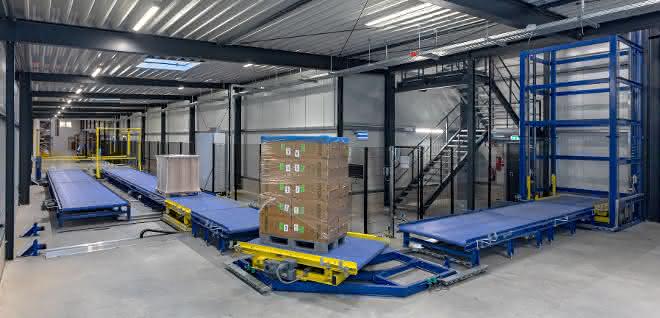
But how do the pallets actually get from goods receipt to production? Thanks to a lift table and link conveyor combination, the goods are fed in at floor level, even with a standard lift truck without a high lift, so that no differences between the lift and the link conveyor need to be overcome. Particularly strong and robust modular belts promise maximum durability - even with uneven conveyed goods. An airlock equipped with two mechanical access barriers guarantees safety for employees working there and prevents them from entering the danger zone.
In addition, a contour check ensures that the maximum protrusion of 200 millimetres per side is not exceeded and that damage to the conveyor systems and the associated interruptions in the material flow can be completely ruled out. The swivel stations for diverting the conveyed goods also have a special feature: "The fact that the swivel station's pivot point is positioned off-center means that the swivel station rotates flush to the front of the link conveyor without any gaps or gaps," says Thorsten Koopmann.
50 pallets per hour, several kilometers per day
The transfer to the vertical conveyor is fully automated: The goods can be transferred directly from the link conveyor to the freight elevator. The vertical conveyor easily overcomes the height difference from the warehouse to the bridge and then transfers the pallets back to the link conveyor in the bridge. Here too, transportation to the second vertical conveyor is fully automated. The second vertical conveyor is then used to transport the goods back to the lower level of production. The same process is also possible in the opposite direction. In this way, around 50 pallets per hour are transported reliably and cost-effectively several kilometers per day in three-shift operation.
A concept that completely convinced the Schne-frost Group. Not only does the HaRo Group offer a comprehensive service - from planning to installation and electrical commissioning - from a single source, the expertise of the conveyor technology manufacturer is also available to the customer after successful installation in the form of spare parts orders and regular maintenance. The conveyor system at Schne-frost can also be flexibly expanded or supplemented at any time, as the individual components offer the special option of being built together. This is an option that the food manufacturer is happy to keep open in the future, as the company premises still offer plenty of potential for expansion.


You might also be interested in
Compact motorized castor for pallets and heavy loads
Rulmeca has launched a new motorized roller onto the market. The EPS-AS1 roller motorizes roller conveyors for heavy loads of up to 1,500 kilograms.
 read more...
Torwegge presents new Eco transport trolley
Torwegge has added a new eco transport trolley to its product portfolio. The trolley was developed to facilitate the transportation of heavy loads of up to 250 kilograms in various sectors such as the food industry, retail, catering, healthcare and...
read more...New transport trolley at Logimat
Fetra is also coming to Logimat. The manufacturer of transport equipment for efficient intralogistics processes will be presenting new products and program highlights. Wuppi" will also be there: The aluminum compact trolley is a powerful helper on...
read more...AR Racking equips new Lekkerland logistics centers
The German company, which specializes in consumer goods to go, recently opened two new warehouses in Germany, one in Kerpen and one in Wedemark, which have a storage capacity for 57,459 pallets.
read more...Paper manufacturer with innovative production logistics
Paper manufacturer Franz Veit has made its intralogistics operations much more efficient with the help of Linde Material Handling and Ernst Müller Fördertechnik.
read more...AR Racking equips new Lekkerland logistics centers
Lekkerland is reorganizing its logistics in Germany by 2030 to make it fit for the opportunities and challenges in out-of-home consumption today and tomorrow. As part of this, the storage solutions specialist has supported AR Racking in the opening...
read more...Automated intralogistics system
AMI Förder- und Lagertechnik exhibited an automated intralogistics system at Logimat that covers the entire packaging process right through to shipping.
read more...High-performance electric floor track
Transport system for small load carriers and pallets
Where efficiency and high availability are important, electrically driven floor conveyors are often an alternative to continuous conveyors.
read more...Satellite warehouse turns 40
Westfalia Logistics Solutions celebrated the 40th anniversary of the Satellit load handling device at Logimat. The system is designed for storage on pallets, other loading aids or without pallets.
read more...