
Beverage bottling industry
Intelligent rejection systems for conveyor systems
Are rejection systems for containers, such as bottles or cans, or those for cartons or crates in intralogistics already "exhausted"? No! There are sectors with the highest performance and reliability requirements, such as the beverage bottling industry. 50,000 containers per hour or 7,000 collective containers per hour, each with very close spacing between them, must be safely guided through the lines 24/7. Corresponding expertise could also be very useful in other fields of application. Syscona in Freudenberg, a well-known company in the food and beverage industry, has developed appropriate technology, including rejection systems with intelligent high-performance control. This article provides a brief overview of this.
Passive 2- and 3-way rejection system
The containers and packs to be conveyed in bottling plants, both on the empties and the solids side, have their own characteristics: they vary greatly in weight, sometimes run mixed and can exhibit a certain degree of instability due to their mass distribution and shape. The transport speeds can reach 2 m/s. A passive 2- and 3-way rejection system has been developed for empty and full crates, in which pneumatically actuated guide paddles descend and are also retracted again at maximum speed as soon as a subsequent crate is to pass without rejection (see Fig. 1). If pneumatic energy is not an option or the performance requirements are even higher, this system is also available with a cascade of modern linear motors. Many large beverage manufacturers and logistics companies use this system.
Modern switch for high transport capacities
A modern diverter was developed for packaging lines in which a certain number of full containers are to be fed in several rows to a collective container, for example a crate or carton, also with linear motors with an integrated absolute measuring system, whose kinematics are freely programmable to achieve high transport capacities and maximum functional reliability, especially for unstable containers such as slim, tall bottles. During the distribution process, container groups are guided through a distribution track and finally released by a flank retraction system.
For containers that are particularly susceptible to tumbling or falling, such as returnable empty bottles, there are active rejection systems in which containers to be deflected are gently pushed to the side at a synchronized transport speed. This is typically carried out by a large number of pushers that rotate with a chain or toothed belt. A rejection signal triggers the retraction of pusher pins into an inclined groove, along which the pusher(s) extend and retract again via a counter groove. Thanks to the particularly slim design of the slides, even very small container distances can be handled without any problems. However, the disadvantage of such rejection systems is the relatively large amount of space required and the heavy-duty mechanics with the corresponding maintenance requirements.
Drainage with linear technology
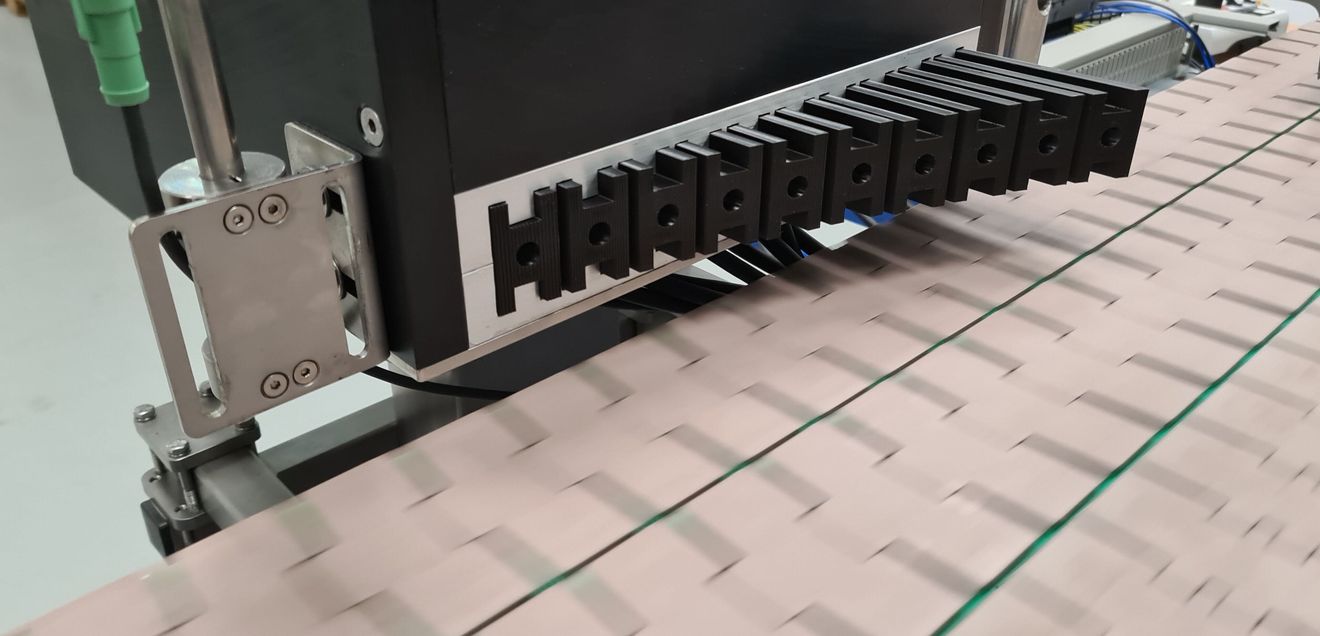
The question now was: How can the space requirement be reduced while maintaining the same functional quality? And how can maintenance requirements and noise emissions be minimized? So-called segment diverters are known, which form a deflector railing with mostly pneumatically straight or swiveling sequentially extendable "fingers" with a slanted end, on which the objects standing on a conveyor are deflected sideways. However, such deflectors have a passive effect, i.e. the sideways movement results solely from the forward movement of the objects on the conveyor. A key factor here is the consistency of the traction between the container and the conveyor belt or chain.
When touching the extended "railing", braking frictional forces act, which can lead to tumbling movements and even falls, especially at higher speeds and with unstable containers. This can be countered technically, as described above, by active deflection systems. However, their flat deflection angle is fixed. The aim was therefore to create a system that can be automatically adapted to the transport speed, container properties and diverting tasks in a highly flexible manner, which at least partially overcomes the disadvantages of conventional segment diverters and enables long-term savings in operating costs. Once again, state-of-the-art linear motor technology was used as the basis. Syscona opted for corresponding components from Linmot and collaborated with this company throughout the development process.
In a special, patent-pending variant, the entire "finger cascade" can be swiveled using a servomotor. The deflection angle of the deflection curve can thus be adjusted and the deflection width of objects can be regulated. This makes it possible to react automatically and at lightning speed to the influence of different transport speeds, object properties and friction conditions. In addition to the design of the individual fingers and the deflection curve formed by them, special effort was put into the intelligent control of both the lifting drives and the actuator for the swivel angle. But what does that mean?
The free programmability of the lifting movement of each rejection element, finger, enables the individual lifting movements to be triggered and parameterized depending on the conveyor belt speed. Speed data can influence the lifting kinematics as well as the positioning angle of the finger cascade. The movement of the objects and the deflection width can therefore be set very precisely and kept constant in terms of control technology. The swivel capability of the finger cascade can also be used to reduce the number of lifting drives. In certain cases, finger lifts can also be "omitted" or coupled, which allows very close container or object spacing even at high transport capacities.
Thanks to the potential of the linear motor technology used in conjunction with a segmented deflection curve, the combination of passive and active deflection has been realized for the first time and a patent has been applied for: A small portion of the stroke of a finger is used for active sideways movement, while an object glides gently past. The finger then becomes a "pusher" on a millimeter stroke scale. Of course, every incoming container is detected with pinpoint accuracy. In the system, this is achieved with a special light barrier arrangement in the infeed. A rejection rate of 50,000 pieces per hour is specified for typical 0.33 glass bottles. The minimum distance between containers or objects is specified as an average of 5 millimetres.
Gentle container guidance
The capabilities of the newly developed Syscona diverter called "ProfiCurve" offer new perspectives in conveyor system construction. Syscona uses Linmot high-performance linear drives with a width of around 25 millimetres and a stroke of 100 millimetres as standard. Thanks to the modular design, the number of active linear actuators can be tailored to the individual case. Depending on the requirements from the range of objects, the transport capacities and the intralogistics function, it can be just five or significantly more, for example. The associated motor controllers offer a wide range of programming and control options. The container is guided gently by an almost tangential rejection with a subsequently curved path curve. In close succession, further rejection units can form a very space-saving distribution system on x lanes.
In addition to the small space requirement of segment switches, the comparatively very low and cost-saving energy consumption (electricity instead of compressed air) and the very low noise emissions should also be mentioned. Reduced noise at workstations is a not insignificant measure and investment for progressive companies, as high employee satisfaction means that skilled workers remain loyal to the company. A disadvantage is the comparatively higher investment cost, which depends on the number of linear actuators used. However, without any special effort, an intralogistics function module becomes a component of fully networked production and packaging lines for piece goods.
This closes gaps in performance and fault monitoring. A contribution to Industry 4.0. In current customer projects, the benefits will also have to prove themselves in practice. Users expect particularly high reliability, durability and functional stability as well as minimal maintenance costs. As the low operating costs are included in dynamic profitability calculations and high availability (OEE) of the line can be supported, advantageous profitability figures are achieved despite slightly higher procurement costs.


You might also be interested in
Automated systems for parcel opening
Automatic parcel openers save time, prevent the risk of injury and reduce damage to goods that can be caused by conventional opening methods. The Grünwald-based company ALS Automatic Logistic Solutions specializes in the development and production...
 read more...
New material for pallet packaging
Packaging specialist Smurfit Westrock has developed a 100% paper-based alternative to the polyethylene stretch film commonly used to stabilize pallet loads during transport.
read more...Fachpack: Folding containers made from bioplastics and marine plastics
Söhner Kunststofftechnik is focusing on sustainability and efficiency at Fachpack: the company is presenting sustainable packaging solutions such as large load carriers made of bioplastics and marine plastics and foldable stacking boxes made of...
read more...RFID labeling as a key technology
Logopak Systeme is a provider of digital labeling solutions and will be exhibiting labelling systems in Nuremberg that support compliance with the new EU packaging regulation PPWR and promote the circular economy.
read more...Bag with speed
The packaging machine manufacturers Hastamat and Loeschpack, subsidiaries of the Piepenbrock Group, are jointly presenting new technologies and their broad portfolio.
read more...Tailor-made packaging in e-commerce
The air is out here
Many online retailers still rely on conventional packaging methods and use standardized box sizes. This means that goods are often shipped in packages that are far too large or in plastic bags. Automated packaging solutions from Sparck Technologies...
read more...100th anniversary of Sparck Technologies
On June 20, 2024, Sparck Technologies, provider of automated packaging solutions, celebrates its 100th anniversary.
read more...ratioform and kaiserkraft become one
Since May 2024, ratioform has been operating on the market under the kaiserkraft brand umbrella. This is the logical consequence of the past few months, during which ratioform and kaiserkraft have intensified their cooperation and explored synergies.
read more...Next-Generation Cold Storage Facility
Lineage Relying on Automation from TGW Logistics in Texas
Lineage is relying on TGW Logistics’ automation expertise to build one of the world’s largest temperature-controlled distribution centers in Texas. The highly automated cold storage and frozen food warehouse is scheduled to begin operations in late...
read more...