
Growing popularity
Frozen food logistics: Corona drives warehouse automation forward
During the coronavirus pandemic, intralogistics specialist TGW received an increasing number of inquiries about the automation of deep-freeze warehouses. However, the growing popularity of frozen food and the trend towards home cooking are not the main reasons why companies are initiating automation projects. Above all, they are suffering from a shortage of labor.
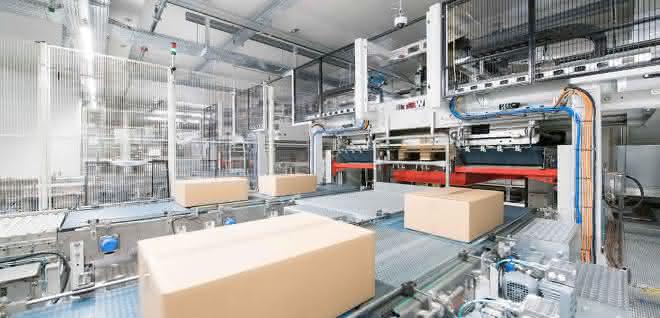
The consequences of the pandemic are prompting food retailers and logistics service providers to think more about the automation of deep-freeze warehouses - and to plan specific projects. TGW Logistics Group has experienced this in recent months. "The growing consumer appetite for frozen vegetables or pizza and the fact that more people are cooking for themselves during lockdowns than before are trends that are increasing throughput. However, the most important reason for automation projects is the worsening shortage of labor in this logistics sector," emphasizes Michael Schedlbauer, Industry Manager for the food sector at TGW. According to TGW, sustainability goals, rising energy costs and digitalization are also at the top of the list of the most important arguments put forward by companies.
Both in the USA and in Europe, refrigerated warehouses are currently well filled. The Association of German Cold Storage and Refrigerated Logistics Companies (VDKL), for example, reports that the cold storage facilities of its members were 1.3% fuller in 2020 than in 2019 (80.1%), with an average total capacity utilization of 81.4% - and overall as full as they were 18 years ago.
Labor shortage as a driver of automation
The biggest challenge in the industry is the harsh working conditions at -25 degrees Celsius or colder. Warehouse workers prefer jobs in non-refrigerated distribution centers, although in many countries they not only receive regular warm-up breaks, but also legally regulated bonuses for their work. "There are now plants in Western Europe that almost exclusively employ people from Ukraine or other Eastern European countries," explains Schedlbauer. Finding, training and retaining new employees costs companies a lot of time and money. The business case for a manual refrigerated warehouse is therefore worse compared to a non-refrigerated facility. "This is why investments in automation projects are even more profitable in this logistics sector than in others," emphasizes retail expert Schedlbauer.
Save up to two thirds of energy costs
Investments in automated systems are put into perspective when companies consider the total cost of ownership. An automated warehouse, which is designed to be much more compact than a manual solution, can save up to two thirds of energy costs. Data from TGW shows that productivity can also be almost doubled and process quality significantly improved.
High energy savings and emission reductions can also be achieved when companies centralize several distribution centers. TGW customer COOP in Switzerland, for example, merged three distribution centers into a single facility in Schafisheim. The result: the Swiss company saves up to 10,000 tons of carbon dioxide per year with its optimized supply chain. "As many companies have set themselves ambitious sustainability targets, they cannot avoid automation. Logistics insourcing and centralization are also sure to remain two important future trends," says Schedlbauer.
More demanding customer expectations are also driving both retailers and their contract logistics service providers to automate and digitize. More and more consumers want to know where the products on offer come from and what the supply chain looks like. Food producers and retailers are therefore offering to digitally track the entire supply chain. "Seamless traceability is also made possible by the software solutions used in automated warehouses," explains Schedlbauer.
Long-term investments in automated warehouse structures
TGW assumes that even more companies and investors will invest in automated deep-freeze warehouses in the future. One example of this is TGW customer NewCold. "On the one hand, the cost of capital is currently low. On the other hand, even under pandemic conditions, the saying goes: there is always food and drink. That's why long-term investments in new, automated storage structures also promise a secure return," concludes retail expert Schedlbauer.
The article appeared in materialfluss 1-2/22.


You might also be interested in
TGW Automates Intersport Distribution Center
Intersport France has launched a new, highly automated distribution center in Saint-Vulbas, near Lyon. The facility, built by TGW Logistics, is designed to support the sporting goods retailer’s growth, smooth out seasonal peaks, and make store...
 read more...
Next-Generation Cold Storage Facility
Lineage Relying on Automation from TGW Logistics in Texas
Lineage is relying on TGW Logistics’ automation expertise to build one of the world’s largest temperature-controlled distribution centers in Texas. The highly automated cold storage and frozen food warehouse is scheduled to begin operations in late...
read more...Conveyor technology without control cabinet
New materials, more efficient components and digital control concepts are increasingly changing traditional conveyor technology. The focus of many developments is primarily on one goal: reducing overall costs. Considerable expenses are often...
read more...Vectura systems create capacity for peak loads
Swisslog gets high-bay warehouse for Lebkuchen-Schmidt on track
Swisslog has successfully completed the installation of six Vectura storage and retrieval machines in Lebkuchen-Schmidt's new central logistics hub in Nuremberg. The project has thus reached a milestone on the way to the planned commissioning of the...
read more...mk expands conveyor technology portfolio
Intelligent intralogistics from the modular system
The mk Technology Group is expanding its intralogistics portfolio with the new RBF 2000 roller conveyor system. The fully modular system combines flexible conveyor technology with intelligent control architecture and is suitable for transport,...
read more...Pocket sorter: goods transported autonomously to their destination
TGW Logistics installs a SmartPocket system for the mail order company Personalshop in Polling, Tyrol.
read more..."Dancing with Robots"
With a live performance under the motto "Dancing with Robots", Trapo will be presenting intelligent automation and robotics solutions for the packaging industry at Interpack 2026.
read more...100+ installations worldwide: Trust through practice
Automation must function reliably, every day, at all times. With more than 100 adapter-based sorting systems from Dürkopp Fördertechnik (DFT) installed worldwide, the technology has proven itself in continuous industrial operation.
read more...Bonfiglioli focuses on modularity and automation
Bonfiglioli had two stands at Logimat: in Hall 9 with forklift trucks and warehouse machines and in Hall 3 for materials handling technology and industrial automation. In the area of industrial trucks, the company presented complete drive solutions,...
read more...