
Automation
Store logistics becomes omnichannel logistics
lan Penhale, Supply Chain Director at Boots, is responsible for supplying over 2,300 stores in the UK and the Republic of Ireland. But since the coronavirus pandemic, his colleagues have also been picking for the health and beauty retailer's online business. Within just three weeks, Boots worked with Witron to convert the processes in the automated central warehouse from pure store logistics to the e-commerce business.
Corona changed everything. As customers mainly ordered online during the lockdown, Boots recorded over 150% more orders in its e-commerce business during the months of the pandemic. Although the British company operates its own e-commerce logistics center alongside the SSC, the challenge was to adapt very quickly to the increasing number of orders. A solution had to be found, not in a few years, but immediately.
Part of the solution was the Store Service Center (SSC) in Nottingham, which was planned and implemented by Witron. "We still had logistics capacity available here. At the beginning of the pandemic, customers were still shopping in the stores, but during the lockdown, e-commerce figures rose while in-store footfall fell." Penhale and his colleagues ship beauty products, cosmetics, fragrances, care products and even Coca Cola; there are now over 37,000 items.
"Boots needed a creative solution in spring 2020," reports Jack Kuypers, Vice President North-West Europe at Witron. Boots and Witron have been working together successfully for more than ten years. The leading pharmaceutical and cosmetics wholesaler is one of the largest retailers in the UK and the teams have worked together in the past to optimize processes for the stores. "But we've never experienced anything like this before - converting a logistics center originally designed exclusively for store deliveries into an omnichannel logistics center at record speed," admits Kuypers.
Store or online customer
In the past, many customers ordered their goods online but picked them up in-store, often even picking them up in the store. The Click + Collect business was the solution during the pandemic. Boots has been using an order management system above the warehouse management system for several months now. The IT managers "simply" redefined the SSC as a store - admittedly a huge business with a lot of storage capacity. "The software doesn't care whether employees pick the goods manually in the store in London or with the Dynamic Picking System (DPS)," laughs Penhale.
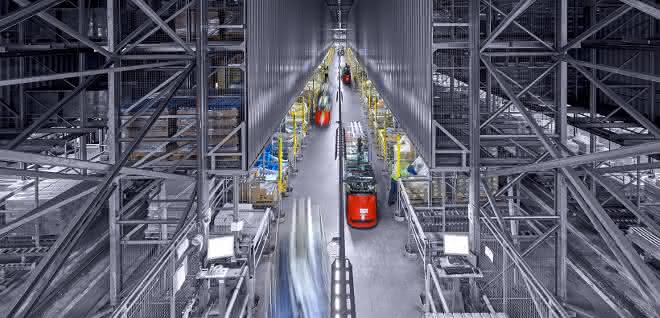
The heart of the system is and remains the DPS with 252 workstations. Highly dynamic and automatic picking of small parts takes place in the DPS, supported by a pick-by-light system. The DPS works according to the goods-to-man / man-to-goods principle. Depending on the order structure, the articles are permanently or as required in the picking front, which means that this is always optimized. DPS supports different picking variants: from container to container, from pallet to container, from container to shipping carton, and others. Regardless of the type of picking, the picker is guided by a pick-by-light system in all variants. Large-volume items from the Boots range are picked onto roll containers in the SSC by the semi-automated Car Picking System (CPS) with radio data transmission support and route optimization. In total, the Boots employees in Nottingham pick almost three million units on a peak day. "Our colleagues don't even know whether they are picking for the e-commerce customer or for the store," reports Penhale. However, the Witron and Boots teams still had to make some physical changes to the SSC. The logistics specialists built a new shipping area for the e-commerce orders. "At the moment, this area is still being supplied manually. But we want to establish automation here too in the near future," explains the Supply Chain Director.
Within three weeks, the store logistics center was transformed into an omnichannel warehouse. Did that come as a surprise? "No, we have been working very well with Witron for more than ten years and are always coming up with new, creative processes. I was surprised that we managed to send over 6,000 online orders per day straight away. What we have achieved together during the crisis is top class," says Penhale.
The pandemic is not over yet, but Penhale dares to look to the future. "Yes, people are shopping in stores again, but e-commerce will continue to grow. Economical and flexible omnichannel processes and supplying different distribution channels from one logistics center will become a "must have". All logistics processes in the supply chain must be aligned "end-to-end" with a holistic omnichannel structure. We are working on this together with Witron."
This article appeared in materialfluss SPEKTRUM 2021.


You might also be interested in
Highly automated in all product ranges
Richard Kearns knows how his supply chain and his new warehouse in Hernando (Mississippi, USA) are doing because he receives feedback every day.
 read more...
UK discounter commissions further...
TJ Morris and Witron expand cooperation
TJ Morris commissioned the Witron Group with the planning and realization of an approx. 92,900 square meter distribution center for food and non-food products.
read more...Retrofit: Gebhardt Boosts Plant Performance at Zschimmer & Schwarz
The Gebhardt Intralogistics Group is modernizing the existing pallet conveyor system in Zschimmer & Schwarz’s high-bay warehouse at its headquarters in Lahnstein.
read more...Visual Guidance for More Efficient Picking
Kardex announces the launch of the Intuitive Picking Assistant for the Kardex Shuttle. The new solution supports operators with intuitive visual guidance and is designed to make order picking even easier. The solution was unveiled for the first time...
read more...Efficiently Modernizing Loading Stations
Redesigning loading stations is a challenging task. Variations in pit dimensions and conditions make it difficult to replace loading bridges.
read more...Shelving Systems for Dynamic Environments
In modern production and logistics environments, modular shelving systems do much more than simply serve as storage solutions. They improve material flow, reduce travel times, and support processes in line with lean management principles....
read more...Robot-Controlled Packaging of Rolls
Koch Robotersysteme, a company specializing in the integration of robotic systems, has developed a complete, automated packaging line for packaging rolls based on Tentoma's RoRo StretchPack packaging machine.
read more...Weightlifters for all industries
In modern logistics processes, pallets are far more than just transport aids. Especially in automated logistics systems or industries with high hygiene requirements, it is worth making a precise comparison.
read more...Containers for safe processes and smart picking
With the special solution from Bekuplast, Rossmann is increasing process reliability and efficiency in its central warehouse in Landsberg and its e-commerce warehouse in Burgwedel.
read more...