
Warehouse-/Picking technology
Small steps, big impact
Optimal logistics can be planned! Throughput and capacities can be calculated and dimensioned according to company requirements. Theoretically! In practice, however, logistics often does not achieve the expected performance. Arne Pierau has ideas on how to change this.
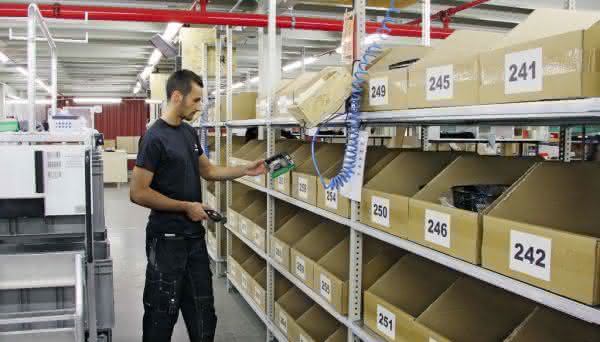
It is instinctive to assume that complex, fully automated systems and their components are particularly susceptible to performance failures. However, there are also friction losses in non-automated processes, as employees set the pace here. The reasons why simple tasks become performance brakes are difficult to track down, as actual and target processing times for manual activities can only be determined using time recording methods.
Man-to-goods picking is a good example of how processes that are suitably dimensioned on paper can reach their performance limits prematurely despite being well staffed and technically equipped. It would be too easy to blame the employees for this. They focus exclusively on the individual picking orders. Obstacles, disruptive factors and impracticalities are generally circumvented, but not fundamentally eliminated.
An objective view from the outside reveals the performance sinks and it becomes clear which "little things" are slowing down order picking. The following recommendations for action are based on practical experience. They require no IT adjustments, no additional personnel, hardly any additional hardware and yet contribute to performance improvements.
Remove obstacle course
It sounds simple: for order pickers to work efficiently, walkways and routes must be clear. Goods temporarily stored in aisles, old cardboard boxes and parked work equipment act as chicanes. They slow them down and increase the effort required to move the picking trolleys due to the steering required. Strategically positioned containers for disposing of used cardboard help to keep the paths clear. For temporary storage, areas marked by floor markings can be provided outside the aisles. Keeping the aisles clear makes it easier for employees to avoid each other. Aisles, shelves and compartments must not only be freely accessible, but also clearly marked. The numbering must follow comprehensible rules so that even new or temporary employees can quickly grasp the system. Employees who first have to find their way around are not only hesitant to move, they also slow down their colleagues in case of doubt. Therefore, even with warehouse structures that have grown over time and whose numbering concept leaves no room for expansion, you should consider whether the benefits of renumbering quickly justify the expected initial difficulties.
More item positions per meter
The size and structure of the warehouse should also be checked at regular intervals. Work can only be carried out effectively if the total storage area allows for structured storage. In addition, the location and storage bin size of the individual items must be carefully considered. Storage locations that are too large for the complete storage of an item stock mean long distances. Storage locations that are too small, on the other hand, lead to replenishment processes. The storage location is also relevant: Even in systems without complex IT, an ABC structure of the articles can be derived from article and shipping data - or from the experience of the employees.

"More technology and investment are not the only things needed to improve performance in order picking."Arne Pierau Managing Partner Pierau Planung
A further increase in efficiency is achieved by introducing suitable picking trolleys. Although these should be large, they should not be too heavy when loaded so as not to overburden employees. Picking trolleys made of aluminum have proven themselves in practice.
Employees are the linchpin of smooth order picking. Long-serving employees who know every detail of the warehouse and processes are worth their weight in gold. However, a certain amount of fluctuation cannot be avoided and, especially during seasonal peak periods, staffing levels often have to be increased with temporary staff. Dividing the tasks involved in order picking into levels of difficulty allows employees to be deployed as productively as possible according to their respective experience. Simple processes and clear rules with a low learning curve are defined for new or temporary staff. Experienced employees have internalized the rhythm of order picking and notice cycle errors quickly. If they are put in charge of the team, all colleagues have a contact person directly on site. To make it easy to find the team leader in logistics, these employees should ideally wear a color-coded garment. In addition, team leaders can take on error handling and other tasks - and the greater responsibility and the associated recognition binds them to the company.
More technology and investment are not the only things needed to improve performance in order picking. Performance values can often be significantly increased with simple means - what is important is the willingness to take an objective look at the actual situation. Even if it becomes apparent that the existing system will be expanded by introducing multiple levels and using more technology, the tips summarized above should be checked for applicability in your own warehouse in order to optimally exploit potential.


You might also be interested in
Sixth AutoStore project for New Wave
Element Logic is implementing its sixth joint project with the New Wave Group: a future-proof AutoStore system for the logistics center in Geiselwind.
 read more...
Everything is in its place
Vet-Concept produces and sells high-quality dry and wet food. The company sells almost exclusively online and also has its own small store in Föhren for customers to collect their own products. BITO-Lagertechnik has supported the company since its...
read more...Designing crisis-proof warehouse technology
Geopolitical tensions, rising costs and increasing protectionism have fundamentally changed the economy. The days when goods were simply stored are long gone - today it's all about remaining flexible, reacting quickly and finding ever smarter...
read more...Sustainable logistics - a sustainable approach
In recent years, environmental protection has become a fundamental concern of society. Sustainable logistics focuses on minimizing the environmental impact of logistics activities without compromising the economic efficiency of companies.
read more...Shelving specialist Elvedi celebrates its 40th anniversary
The shelving system provider Elvedi is celebrating its big anniversary in 2024. The shelving manufacturer intends to continue on this growth path in the future and is planning to expand its sales territory in Europe.
read more...Drill core storage for the Mont Terri rock laboratory
The plant and racking specialist Stöcklin received the order for an unusual racking system in an unusual location and found an unusual solution for it.
read more...MS Motorservice International relies on Kardex Mlog
MS Motorservice International, the sales organization for Rheinmetall's global aftermarket activities, has commissioned Kardex Mlog as general contractor to build a four-aisle high-bay warehouse at its Neuenstadt site. The high-bay warehouse will be...
read more...Warehouse concept from Schulte impresses at Liebherr-Logistics
Liebherr-Logistics built a new warehouse at the Oberopfingen site. Schulte equipped this with a complete package: Within a short space of time, pallet, cantilever and shelving racks were installed in all three sections of the new building.
read more...Mayr-Melnhof Packaging optimizes logistics operations with AR racks
The Chilean subsidiary of the European group for the production and distribution of paper and cardboard packaging has carried out a comprehensive logistics optimization project at its distribution center in Santiago, Chile.
read more...