
Warehouse-/Picking technology
Optimum protection, around the clock
320 wire harnesses per hour, around the clock, every day - Imperial Automotive Logistics GmbH supplies four assembly lines of a car manufacturer with wire harnesses from a fully automated just-in-sequence warehouse in northern Germany. The company opted for an active oxygen reduction system from Wagner as its fire protection solution.
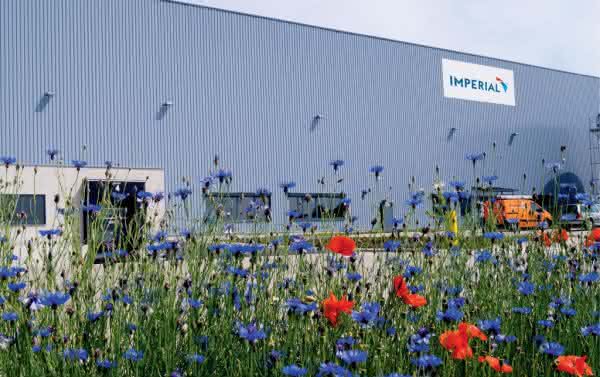
In August 2014, Imperial Automotive Logistics GmbH relocated its logistics center from Hattorf to nearby Flechtorf near Wolfsburg. The capacity limit had been reached at the previous location and new storage facilities were needed. The company built an automated small parts warehouse (AKL) in a 10,000 square meter hall on a site measuring around 22,500 square meters. The small parts warehouse has space for around 54,000 bin storage locations for the production supply of various vehicle models for a major car manufacturer.
Just in Sequence
Delivered directly to the assembly lines, the cable harnesses are installed in engines and interiors. To ensure that 160 vehicles of different types can be supplied with 320 cable harnesses every hour of the day, a highly redundant, largely fully automated and well thought-out solution is required. Imperial deliberately dispenses with robots and relies on sequencers (one per assembly line) and container stackers. Delivery of the parts on large load carriers, storage in the mini-load warehouse, transfer to the high-availability area, retrieval, truck loading and transportation to the plant are optimally coordinated in terms of process and data technology, so that downtime can be ruled out as far as possible. An interruption in delivery would not only be a disaster for the logistics provider, but also for the car manufacturer, who would be unable to meet its production targets.
The best possible solution was also to be found when it came to safety for the new warehouse: in the form of a new fire protection solution that can be individually adapted to the special conditions and challenges of automated high-bay warehouses. Above all, the risk of a fire developing was to be prevented from the outset so as not to jeopardize the company's ability to deliver.
The risk analysis
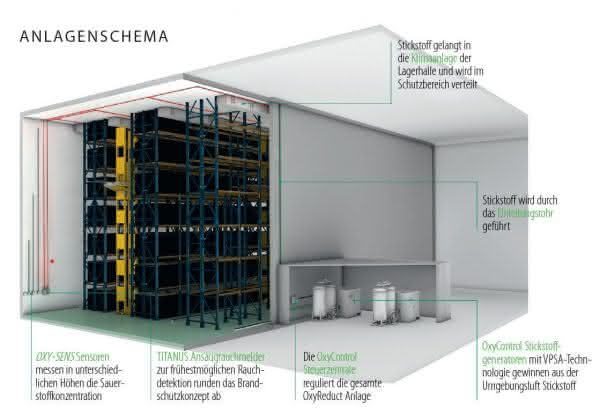
Possible cable fires caused by overheating on conveyor motors or technical system defects are statistically the most common cause of fire in automated high-bay warehouses. Once a fire has broken out, the extent of the damage is influenced by the design and the materials stored in the warehouse. The height and nature of the warehouse itself is a fire protection challenge: high racks and narrow spaces mean that a fire can quickly spread to below the warehouse ceiling, making it difficult to extinguish the fire using conventional methods such as foam or water. Added to this are the large quantities of highly flammable and combustible storage materials such as paper, cardboard or plastic, which encourage the fire to spread and spread uncontrollably.
Small load carriers burn like gasoline
In Imperial's small parts warehouse, wire harnesses for the automotive industry are stored in small load carriers (KLT). These are standardized polypropylene plastic boxes that are used in various sizes for storage and transport purposes. From a fire protection point of view, both the small load carriers and the cable harnesses are problematic. There are two main problems when KLT and plastics are used: One is the very good flammability of the material. Polypropylene and polyethylene behave like flammable liquids in a fire and release heat comparable to gasoline. If a certain pre-burning time is given, i.e. if sufficient material has liquefied, there is a so-called pool fire below the storage constellation. The burning dripping material ignites all neighboring materials, while the high heat energy continues to fuel the fire. A second problem is that such a fire is difficult to extinguish, as water is difficult to apply to plastic surfaces. The water simply runs off.
The solution
The high degree of automation of the small parts warehouse and the delivery obligation and dependence on the car manufacturer's just-in-sequence processes do not allow any fire-related interruption to the delivery capability. Imperial Automotive Logistics GmbH therefore opted for highly sensitive early fire detection using Titanus Pro Sens aspirating smoke detectors in order to be able to detect even the smallest smoke particles in the very early stages of a potential fire. As a further preventive measure, the operator relies on active fire protection by means of oxygen reduction. This drastically reduces the risk of a fire starting and spreading and creates a protective atmosphere in which staff can still move around without restriction. The OxyReduct fire prevention system from Wagner was chosen.


You might also be interested in
Sixth AutoStore project for New Wave
Element Logic is implementing its sixth joint project with the New Wave Group: a future-proof AutoStore system for the logistics center in Geiselwind.
 read more...
Everything is in its place
Vet-Concept produces and sells high-quality dry and wet food. The company sells almost exclusively online and also has its own small store in Föhren for customers to collect their own products. BITO-Lagertechnik has supported the company since its...
read more...Designing crisis-proof warehouse technology
Geopolitical tensions, rising costs and increasing protectionism have fundamentally changed the economy. The days when goods were simply stored are long gone - today it's all about remaining flexible, reacting quickly and finding ever smarter...
read more...Sustainable logistics - a sustainable approach
In recent years, environmental protection has become a fundamental concern of society. Sustainable logistics focuses on minimizing the environmental impact of logistics activities without compromising the economic efficiency of companies.
read more...Shelving specialist Elvedi celebrates its 40th anniversary
The shelving system provider Elvedi is celebrating its big anniversary in 2024. The shelving manufacturer intends to continue on this growth path in the future and is planning to expand its sales territory in Europe.
read more...Drill core storage for the Mont Terri rock laboratory
The plant and racking specialist Stöcklin received the order for an unusual racking system in an unusual location and found an unusual solution for it.
read more...MS Motorservice International relies on Kardex Mlog
MS Motorservice International, the sales organization for Rheinmetall's global aftermarket activities, has commissioned Kardex Mlog as general contractor to build a four-aisle high-bay warehouse at its Neuenstadt site. The high-bay warehouse will be...
read more...Warehouse concept from Schulte impresses at Liebherr-Logistics
Liebherr-Logistics built a new warehouse at the Oberopfingen site. Schulte equipped this with a complete package: Within a short space of time, pallet, cantilever and shelving racks were installed in all three sections of the new building.
read more...Mayr-Melnhof Packaging optimizes logistics operations with AR racks
The Chilean subsidiary of the European group for the production and distribution of paper and cardboard packaging has carried out a comprehensive logistics optimization project at its distribution center in Santiago, Chile.
read more...