
Warehouse-/Picking technology
No more sloping storage areas
The floor in Rittal's high-bay warehouse had settled by an average of 50 millimeters. The settlement was caused by the soft subsoil drying out. With the help of the FloorLift method, however, it was possible to restore an even floor level.
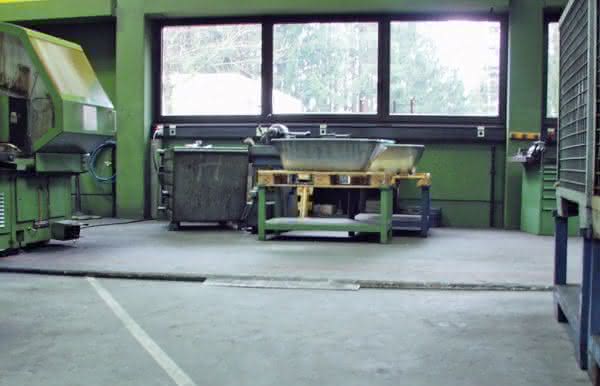
Rittal manufactures enclosure systems for the electrical and IT sectors, which are waiting to be delivered from the company's own high-bay warehouse in Bietigheim-Bissingen. Recently, however, it was discovered that some of the racks were no longer standing on very stable legs. The cause was quickly found: The floor had sunk over the entire area, a whopping 460 square meters, in places by as much as 96 millimeters.
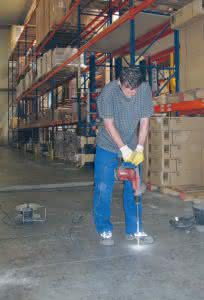
While the load-bearing components of the hall are deeply founded on piles, the floor construction, which is around 20 centimetres thick, rests on a 1.50 to 2.00 meter thick layer of gravel. Below this is cohesive, soft, possibly humus-rich soil. The subsidence was therefore probably caused by the reduction of the water content in the peat, the cohesive soils and the two-meter-thick gravel backfill. According to the soil expert, however, the subsidence had already largely subsided.
Resin helps lifting
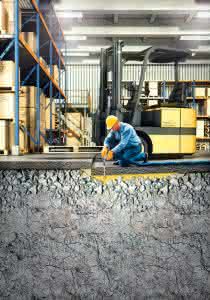
A sensible solution was to first fill any existing cavities under the floor using the Uretek FloorLift method and at the same time raise the floor back to the surrounding or existing edge level. The two-component expansion resin was injected directly under the floor in liquid form and under controlled pressure through 12 millimeter drill holes at intervals of around 1.20 to 1.50 meters. The increase in volume of the resins and the resulting expansion force of up to 200 kN/m2 caused the existing cavities to be filled and the existing subsoil to be compacted until the floor slab rested fully and firmly on the substructure. By adding further material, the sagging floor could be raised back to the original level with targeted injections. Thanks to the short reaction time of the resins and millimeter-precise monitoring by the levelling lasers, the process could be precisely monitored and controlled.
So that everything runs smoothly
Trouble-free business processes require an appropriate structural framework - broken joints in concrete floors, rattling slab edges, sagging industrial floors or foundations have a significant impact on operational processes. But what should you look out for and what can you do in the event of damage? Production facilities in industrial companies should always be up to date. This is not only in the interests of the company, but above all of the employees. Ensuring occupational health and safety and operational safety means adapting the production conditions to the constantly increasing requirements, for example when new systems are installed and the existing floors cannot cope with these loads.In a construction and operating system, operational safety must be guaranteed 100 percent in every "life phase". The owner or operator can be overwhelmed by this permanent task if, among other things, changes occur over time at the system boundary between the subsoil and the foundation that lead to stresses in the supporting structure or even to visible deformations in the supporting structures. In the case of buildings for logistics facilities, for example, different settlements of foundations or slabs resting on the ground can have a negative impact on the general safety of people and property, as well as the susceptibility of systems to faults. Every plant manager should therefore periodically go through the following checklist with their planner:
Building structure, floor slabs and installations
When analyzing such findings, the cause may be found in the area of force transmission into the load-bearing subsoil. Particularly in the case of old buildings or buildings on difficult subsoil, uneven settlements or inadequate building positions can lead to the problems mentioned. There is also a corresponding need for action if a new use is imminent or if operational safety is generally called into question. Experience has shown that old buildings are often converted for logistics operations and in some cases fitted with equipment and systems that require increased requirements in terms of floor accuracy and load-bearing capacity. If new local additional loads then act on the subsoil, this can quickly lead to subsidence if the affected components and the subsoil have not been adapted or reinforced.
- Are major cracks visible on concrete or masonry load-bearing structures?
- Are building supports or load-bearing walls no longer exactly vertical or even bent?
- Is there any concrete spalling in the area of the transitions from columns to ceilings?
- Is a height offset noticeable at floor slab dilatation joints when forklifts drive over them, i.e. exactly when changing loads from one slab to the other?
- Are vertical displacements of several millimeters or gaps already visible at dilatation joints or at joints to the outer/bearing walls or to building supports?
- Do floor panels show cracks of greater length going into the depths?
- Are shelves no longer exactly vertical in both main axes?
- Are block storage towers gaping threateningly towards the top or towards each other?
- Have there been any recent malfunctions in storage systems, conveyor systems or mobile racking, for example, which could be caused by building deformations?
But what should be done if the problems lie in the subsoil, i.e. under the foundations? How can such buildings and foundations be renovated in a sustainable way? How can the load-bearing capacity of the soil or foundations be increased without the risk of longer interruptions to operations or loss of use? First of all, a precise root cause analysis helps. To do this, a historical investigation should be carried out from the construction files. The connection between the possible causes in the subsoil and the damage pattern should be plausible. The experts at Uretek can also help here.


You might also be interested in
Sixth AutoStore project for New Wave
Element Logic is implementing its sixth joint project with the New Wave Group: a future-proof AutoStore system for the logistics center in Geiselwind.
 read more...
Everything is in its place
Vet-Concept produces and sells high-quality dry and wet food. The company sells almost exclusively online and also has its own small store in Föhren for customers to collect their own products. BITO-Lagertechnik has supported the company since its...
read more...Designing crisis-proof warehouse technology
Geopolitical tensions, rising costs and increasing protectionism have fundamentally changed the economy. The days when goods were simply stored are long gone - today it's all about remaining flexible, reacting quickly and finding ever smarter...
read more...Sustainable logistics - a sustainable approach
In recent years, environmental protection has become a fundamental concern of society. Sustainable logistics focuses on minimizing the environmental impact of logistics activities without compromising the economic efficiency of companies.
read more...Shelving specialist Elvedi celebrates its 40th anniversary
The shelving system provider Elvedi is celebrating its big anniversary in 2024. The shelving manufacturer intends to continue on this growth path in the future and is planning to expand its sales territory in Europe.
read more...Drill core storage for the Mont Terri rock laboratory
The plant and racking specialist Stöcklin received the order for an unusual racking system in an unusual location and found an unusual solution for it.
read more...MS Motorservice International relies on Kardex Mlog
MS Motorservice International, the sales organization for Rheinmetall's global aftermarket activities, has commissioned Kardex Mlog as general contractor to build a four-aisle high-bay warehouse at its Neuenstadt site. The high-bay warehouse will be...
read more...Warehouse concept from Schulte impresses at Liebherr-Logistics
Liebherr-Logistics built a new warehouse at the Oberopfingen site. Schulte equipped this with a complete package: Within a short space of time, pallet, cantilever and shelving racks were installed in all three sections of the new building.
read more...Mayr-Melnhof Packaging optimizes logistics operations with AR racks
The Chilean subsidiary of the European group for the production and distribution of paper and cardboard packaging has carried out a comprehensive logistics optimization project at its distribution center in Santiago, Chile.
read more...