
Warehouse-/Picking technology
BMW presents: The logistics of the future
At a press event on 17 November at the BMW vehicle preparation facility in Garching near Munich, the BMW Group provided information about its digitalization projects and presented its innovations such as the driverless transport vehicle - the Smart Transport Robot.
30 million parts per day
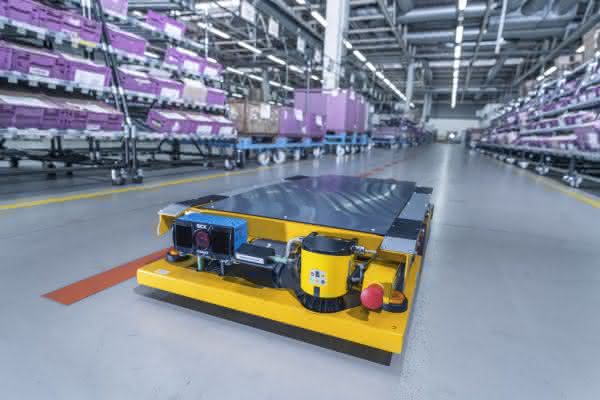
In the future, the BMW Group will increasingly focus on innovation, digitalization and sustainability in logistics. The complete networking of the supply chain, the use of autonomous transport robots and the use of existing vehicle information during delivery will make logistics even more flexible and efficient. After all, 30 million parts have to arrive at the right place at the right time every day so that around 9,000 new vehicles can be produced at 31 BMW Group production sites. "Logistics is at the heart of the BMW production system. This makes the use of innovative and digital technologies a key factor within the complex logistics processes," says Jürgen Maidl, Head of Logistics in the BMW Group Production Network. He continues: "At the same time, sustainable and resource-saving solutions are important to us. We are already testing tomorrow's technologies today with a whole series of pilot projects." From augmented reality glasses and autonomous transportation systems to electric trucks, the BMW Group is testing a wide range of technologies and innovations. Marco Prüglmeier, Project Manager Innovation and Industry 4.0 in BMW Group Inbound Logistics: "We have a clear vision of the future and are addressing the technologies of tomorrow at an early stage. We have identified potential for innovation in all phases of the logistics process, from the delivery of components to our plants to the delivery of new vehicles to dealers all over the world".
First fleet of autonomous transport robots in everyday operation
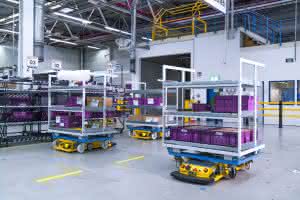
Autonomous driving is also very important in logistics. The first fleet of ten self-driving Smart Transport Robots (STR) in Wackersdorf transports components through logistics. The special feature: the self-driving transport robot does not require induction loops installed in the floor for navigation, but instead moves freely through the logistics hall. In doing so, it continues to use batteries from the BMW i3 sustainably and can transport containers weighing up to 500 kilograms. By measuring the distance to radio transmitters, the STR calculates the exact position and route. It uses sensors to detect and react to critical situations and shares the route with people and other vehicles. After five months of prototype operation, the project is moving on to pre-series production. The ten STRs are used in everyday operations for the first time and carry out transport jobs independently. In the next stage of development, a 3D camera system will ensure even more precise navigation. The BMW Group launched the project together with the Fraunhofer Institute IML in Dortmund.
Connected supply chain: complete data transparency
The BMW Group's supply chain consists of a globally distributed supplier network and close cooperation with a wide range of logistics service providers. In the future, complete data transparency in the supply chain will make it possible to determine at any time which goods are where and whether they will arrive on time. This knowledge will make it possible to react immediately to possible delays. If, for example, a truck is involved in an accident, the connected supply chain automatically calculates alternative courses of action and initiates appropriate measures.
At the same time, sensors monitor the condition of process-critical parts (condition monitoring). This makes it possible to determine at an early stage whether parts are damaged and whether a replacement delivery is necessary. In this way, costly special trips or alternative processes are reduced and faults in the process can be rectified more quickly.
Autonomous tugger trains in assembly
Autonomous tugger trains are operating in the halls of the BMW Group plant in Dingolfing as part of a pilot project. The autonomously navigating tugger trains are used for supply in assembly logistics - especially for journeys over longer distances between individual warehouses and assembly areas. Technically, the autonomous control and navigation of the tugger trains works via laser signals. By evaluating the reflections, the tugger train creates a digital 2D spatial profile in real time and is therefore able to maneuver independently through the assembly hall and logistics areas on certain routes.
Electric trucks: emission-free on short journeys
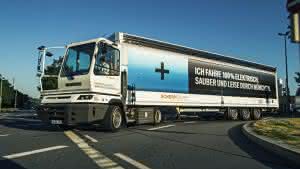
In cooperation with logistics service providers, the BMW Group is already using all-electric trucks in Munich and Leipzig for deliveries close to its plants. The initial aim is to get to know different drive technologies and gain experience. In the long term, the BMW Group is aiming for the cost-efficient use of alternative drive technologies.
Connected Distribution: More transparency in vehicle delivery
On delivery from the factory to the dealer, the vehicle will in future become an intelligent sensor and send or receive important information. When parked, the vehicle transmits its current geolocation and status to the logistics center via a mobile phone connection. This information helps to increase adherence to delivery dates and reduce throughput times. In a second development stage, the vehicle display inside the vehicle is used to transmit messages or confirm necessary work steps in the transport chain to the dealer. For example, route information is displayed directly in the vehicle, making delivery more efficient overall.


You might also be interested in
Dematic and Hai Robotics launch partnership for flexible AMR solutions
Dematic and Hai Robotics have recently agreed a Europe-wide partnership to work together as integration partners in the field of warehouse automation. Through this cooperation, the provider of automation solutions for supply chains and the...
 read more...
The market for service robots
A recent report from IDTechEx analyzes the global market for service robots and examines key applications for delivery and logistics robots, cleaning and disinfection robots, social robots and more.
read more...Application phase for Innovation Award 2026 begins
How can robotics help to make packaging more sustainable? Kuka is looking for creative and innovative ideas in the new round of the Innovation Award.
read more...Exoskeleton with AI power
Robotics company German Bionic presents its most advanced exoskeleton model to date, called 'Exia', which is fully controlled by augmented AI.
read more...Strategic partnership for the promotion of AI
Jungheinrich and Merantix have announced a strategic partnership. The aim of the cooperation is to promote applications based on artificial intelligence (AI) in the industry.
read more...New robotics organization founded
Omron has announced the establishment of a global robotics organization effective April 1, 2025. It will operate in parallel with Omron's automation business so that both areas can complement and support each other.
read more...No-code tool for programming robot user interfaces
ABB provides 'AppStudio', a software tool that allows users of all skill levels to quickly and easily create customized, graphical user interfaces for robots.
read more...SLAM navigation in real time
'Freestyle Localize', 'Trailer Find' and 'Scanner Switch' are three new features of Sigmatek's real-time location software forcontour-based navigation 'SlamLoc'.
read more...Robotic solution: Aiming high under your own steam
The Skypod system is now used in more than 100 order picking warehouses worldwide by companies in all kinds of industries. The autonomous Skypod robots are able to overcome height differences of up to 12 meters.
read more...