
Logistics center
20 years of cooperation between SPAR-Austria and Witron
SPAR Austria first invested in an automated logistics center 20 years ago. The Austrians were pilot customers for Witron technologies and new service models, and after three expansion stages, old and new technology continue to work together efficiently. Growth is forcing logistics companies to decide on further expansion, with smart data playing an important role.
The meeting room is sober, white and gray. Process steps are drawn on a flipchart. Bernhard Thallinger, Head of Logistics, Organization and Goods Flow at the SPAR Austria central warehouse, can't stay in his chair. He urges us to hurry: "Come and take a look at our logistics center." He stands at a huge pane of glass and looks out of the meeting room at his processes, into his high-bay warehouse. This perspective is a highlight in meetings. He is proud of his team, his logistics center, the company he has worked for for 29 years. Standing next to him is Ulrich Schlosser from Witron, the authorized signatory and key account manager responsible for the customer SPAR. Schlosser and Thallinger have been working together for more than 20 years, optimizing the processes in the SPAR central warehouse in Wels - Schlosser and his team as a general contractor for warehouse technology / IT and as a service provider who also helps to control and operate the logistics center and keep the processes and components permanently available. "My predecessors already had the foresight 20 years ago to place the management of the mechanics and software in the hands of a Witron service team based directly on site. They are still right with this decision today," explains Thallinger, who makes the decisions in Wels as the site manager.
"Either this works or we're out"
Back then, between 1996 and 1998, when the first construction phase of the central warehouse was realized, Thallinger was a new member of the management team and part of the SPAR / Witron project team, which was responsible for the new warehouse construction with Witron. Over a weekend in Parkstein, on the terrace of Witron founder Walter Winkler, the teams finalized the plans. The goal: to automate the new central warehouse. A completely new approach to logistics for SPAR. Among other things, double-digit market growth forced the SPAR logistics experts to take this step. "Either this works or we're all out," Thallinger sums up the mood in the car on the drive home to Austria today. The Austrians spent 470 million schillings - around 36 million euros. It worked, confidence grew. The heart of the system was the Dynamic Picking System (DPS), which is still in operation today. Here, storage and retrieval machines take over the order-based provision of the storage containers in the pick front. These are provided there statically or dynamically as required, depending on the order structure. At the ergonomically designed picking station, the SPAR employee picks the items indicated by a pick-by-light system and places them in the customer bin. Additional scanning of the EAN code and an integrated weight check prevent picking errors. The conveyor system transports the full crates to an Order Consolidation Buffer (OCB), which is responsible for sorting according to customer, store and tour requirements. The containers are then discharged from the OCB "just-in-time" for delivery, stacked into container towers, palletized and then transported to goods issue. The figures from back then: wholesale sales units (LSU) per day: 67,000, 7,000 items and in shift operation for around 1,500 SPAR stores. "Our logistics must bring benefits to the SPAR stores. That is important to us," Thallinger emphasizes repeatedly. So was and is the Wels site a warehouse for slow-moving items? Bernhard Thallinger no longer wants to hear about the "slow-moving warehouse". "The central warehouse was planned or referred to as such in the first project meetings 20 years ago, but the reality quickly changed," explains the warehouse manager. "We don't classically divide our range and our articles into A, B and C, but into volumes based on the total delivery quantities." In addition to slow-moving products, the Upper Austrians also deliver fast-moving products.
Fully automated order picking
In 2002, four years after construction, the Austrians put the second construction phase into operation: 12,000 articles and 120,000 LU. In terms of technology, the focus was on the DPS solution and EPP (Ergonomic Pallet Picking) and SPAR introduced its red dolly as a load carrier, which reduced the proportion of unpacked goods to below 15 percent. The DPS area has a total of 40 picking workstations and 20 rack aisles, which are served by 40 storage and retrieval machines and offer space for more than 93,000 containers. The EPP area comprises 5,500 pallet storage locations and 1,100 picking lanes for pallets, which are automatically supplied with replenishment by three storage and retrieval machines. With the commissioning of the second construction phase, the daily delivery volume of the central warehouse was increased from around 67,000 to 120,000 LU per day in two-shift operation. This roughly corresponds to an outgoing goods volume of 25,000 to 30,000 containers and 900 to 1,300 pallets. Today, it is 200,000 LU on an average day and even 300,000 LU on a peak day - thanks to the customers, but also thanks to the OPM (Order Picking Machinery) - the fully automated storage and picking system that went live in 2016. "We now have a partially and fully automated central warehouse for a large number of items in the dry range," explains Thallinger. Around 4,000 items, primarily the larger-volume products in the central warehouse, were moved from the DPS container warehouse to the new OPM warehouse section, where they were picked onto roll containers by eight COM machines in line with store requirements. The special feature: After receiving the goods order, the system calculates the arrangement of the items on the roll container based on the size and weight of the packaging unit and then arranges them according to an optimized sizing pattern with as few gaps as possible. The OPM system also consolidates containers with customer orders already picked in the DPS and large-volume retail units for the same customer on a roll container. This optimization and precise consolidation allows more goods per roll container to leave the warehouse. Every day, up to 66,000 shipping units are additionally picked in the third construction phase of the central warehouse in Wels using the OPM system and sent on their way to SPAR stores of various sizes throughout Austria and also to neighboring countries. Thanks to the new storage logic for the goods in the new and old warehouse sections, the fill level per crate in these warehouse sections can be significantly increased. This increases the outgoing goods performance in this area by an additional 20 percent. "We now have the right storage and picking area for each item with its individual properties and delivery quantity. Witron is the Lego system of intralogistics. All components, old and new, can be connected relatively easily with conveyor technology and yet each part is autonomous and designed for a specific purpose," praises the warehouse manager. Another advantage: SPAR can separate and sort product groups on the transportation aids.
The warehouse controls truck loading
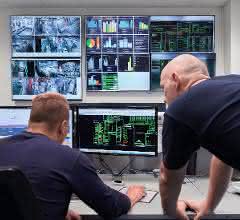
While Thallinger and Schlosser are still looking into the high-bay warehouse and following the operations of the storage and retrieval machines, two floors below, a mechanic from the Witron OnSite team is working underneath the conveyor technology and handling his tools. He is replacing a wearing part. As with the integration of the DPS system, SPAR was also the first Witron customer to rely on a Witron OnSite team for the service and maintenance of its system. In the meantime, this holistic maintenance option has developed into a separate business unit at Witron. Currently, over 40 teams in eleven countries with a total of more than 1,500 employees are already keeping logistics systems on site at a permanently high level of availability. "With the warehouse, we deliver a logistics service, a promised availability that the customer pays for and that we have to guarantee," explains Schlosser. Witron now has over 60 employees on site - in 1998 there were six technicians. They are responsible for service and maintenance, but also process planners and machine operators and link old and new warehouse structures. "It's not just about maintenance or updates from S5 to S7 - it's about investment protection, value retention and securing the location - our material flow knowledge and industry expertise is required to offer customers an optimum system over the entire life cycle," adds Schlosser. This also includes data. "Forecasts are important, but we go one step further," explains Schlosser. In the future, the Witron system could also be used to control truck loading or the load carriers could assign themselves positions on the trailer to enable faster unloading. "That sounds exciting, for EKAER numbers to Hungary it is certainly a solution that we are looking at," says Thallinger. In Hungary, all goods transports to and from Hungary must be reported to the authorities. The electronic road transport control system (EKAER) is used to declare goods. Thanks to the Witron solution, the freight forwarder always knows which pallet is where on his truck, what it contains and who the addressee is. Smart data in the logistics center is not a vision of the day after tomorrow; the Witron team in the warehouse is already working on it today. "Expanding a logistics center today no longer just promises more space and throughput, but also a high level of intelligence and networking in the processes. Performance data is recorded, analyzed and used as recommendations for action. Physics and information technology are increasingly merging," explains Schlosser. "That's it. We simply fit together well, the corporate structures, the people, the technology and the forward-looking approach," praises Thallinger. "This year, we will already be delivering volumes that we wouldn't have expected for another five years," reports Thallinger. That translates into 30 percent more throughput. Is he relying on Witron's "Lego" technology again? "Without going too far out on a limb, it will all come down to a construction stage 4 with Witron." And what developments would the customer like to see? "I don't know of anything beyond a fully automated warehouse at the moment, but I'm happy to be surprised by Witron - perhaps more smart data applications." This is new homework for Witron, Ulrich Schlosser and his team.


You might also be interested in
Circular load carriers for more sustainable supply chains
With the planned Industrial Accelerator Act, the European Union wants to accelerate the transformation of industry towards low-carbon production processes and resource-efficient supply chains. Logistics and transportation are also increasingly...
 read more...
Integration of a robotics solution
Lyreco modernizes logistics center in France
Lyreco is pressing ahead with the automation of its central site in Villaines-la-Juhel with an investment volume of over 25 million euros.
read more...Dragsbæk halves pallet area
By using automated pallet solutions from Palomat, Dragsbæk has halved the space required for pallets, optimized processes and sustainably improved working conditions.
read more...Pixels instead of paper
With the solutions from Logistikbude, Bekuplast, manufacturer of plastic containers, keeps an eye on its load carriers, saves costs and can work more efficiently with forwarding partners.
read more...Flexibility in saving space
Purus Plastics has developed a new retail range. The company operates a processing plant for plastics; recycling creates new products from secondary raw materials, including pallets.
read more...Solutions for the food industry
At Werit, the focus is on customer-specific solutions, sustainable recycling and pooling systems and products made from recyclate. The stand concept is divided into four areas: Products and innovations in the food sector, customer solutions,...
read more...Pallets with QR code
At the Epal Germany stand, visitors can gain an insight into the reusable system propagated by Epal, the life cycle of an Epal pallet and the newly developed QR pallet.
read more...The path of the Euro pallet into the IoT
With the introduction of the EPAL Euro Pallet QR in 2024, the European Pallet Association (EPAL) aims to set a new standard for the classic Euro pallet, which has been used successfully for over 60 years, and pave the way for ecologically...
read more...Retail range: flexibility to save space
Purus Plastics has developed a new retail range that is designed to attract the interest of retailers in particular. The company operates a modern plastics processing plant in Arzberg, Bavaria; new products are created from secondary raw materials...
read more...