material flow EXCLUSIVE
"The key to success is a carefree customer"
Dematic, a global manufacturer of integrated automation technology, constantly strives to improve the efficiency of its customers and offer high-quality services through customized consulting and the use of new technologies.
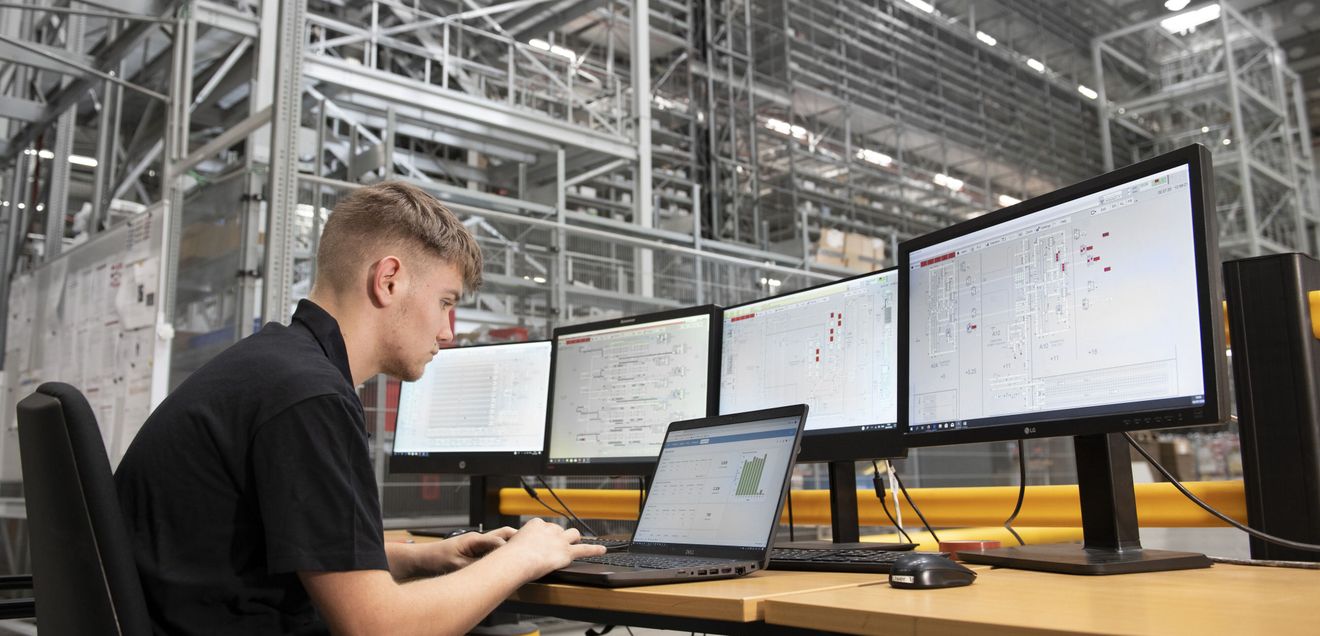
But what characterizes outstanding service in the industry? In an exclusive interview with materialfluss, Dematic experts Alberto Rostagno, Vice President Customer Service EMEA, and René Sickler, Senior Director Customer Services, talk about the importance of service and consulting in the industry and provide insights into current trends, challenges and innovative solutions from Dematic.
What can customers expect from Dematic in terms of service?
Alberto Rostagno:
The most important thing we offer customers with our service is peace of mind. When companies choose a Dematic solution, they can concentrate fully on their core business while we take care of the optimal performance of the automated system. Maximum availability, performance and cost control - these three elements form the basis for a strong service performance.
René Sickler:
We also support you throughout the entire service life of your systems. If changes are made to their business model, we adapt equipment, processes or the entire installation accordingly. This ensures that the customer always meets current market requirements and can respond to new trends.
Rostagno:
This is exactly where our consulting role comes into play. Instead of letting customers think everything through themselves, we proactively suggest suitable solutions to improve efficiency and cost-effectiveness. We not only provide advice before a project begins, but also support the customer during implementation and take responsibility for the results.
How does a consultation typically work?
Rostagno:
As a rule, everything starts with a problem: the customer needs technical or operational support. We then develop a suitable solution based on the initial discussions. The business relationship can then develop in different directions and open up further opportunities. With some customers we focus on specific problems or technical issues, for others we try things out and sometimes develop innovative solutions that go beyond the expected.
Sickler:
It may also be the case that requirements change and the customer feels that their existing system is not operating optimally. In this case, our job is to adapt, improve or modernize the system.
One term that is being used more and more frequently in the industry is lifecycle management. Where does this concept come from and how do you use it?
Sickler:
The concept of lifecycle management has been around for 20 or 30 years. Initially, the focus was on maintaining the technical availability of the system. In other words, keeping the system running. In the last five to six years, however, the business areas of many companies have changed fundamentally. As a result, the focus of the service business has shifted from simply maintaining the status quo to actively developing the system and improving its efficiency.
Rostagno:
This has to do in particular with the booming e-commerce sector, which is now a priority for many companies. As a result, requirements have changed, which requires regular adaptation of processes. At the same time, technology cycles are becoming shorter and shorter. What is considered new equipment today may soon be obsolete. It is therefore important to continuously develop the customer's equipment to ensure maximum efficiency and performance.
How does Dematic maintain its good reputation in Europe?
Sickler:
Our customers rely heavily on us to support their performance. Support is essential, especially for high-tech systems. Even customers who have their own technical staff often rely on our hotline. We usually offer hotline contracts as insurance for smooth operation. With our large team of around 1,100 employees in Europe, we can provide very good support for our 1,100 to 1,200 installations. We even support very old installations from the 70s. We support 12 different types of warehouse management software and work with several generations of shuttles, cranes and other equipment. Our service team is extremely professional and is very familiar with devices and software versions of all generations.
What are the current trends and challenges in the service sector?
Rostagno:
One of the biggest challenges here is also the shortage of skilled workers. There are few available technicians on the market, so there is a risk of not always having the right skills on site. One solution we are turning to is centralized expert groups that provide remote support to a site by carrying out modifications, upgrades or software controls without having to be on site in person. As the density of technology in warehouse facilities increases, it is also becoming increasingly difficult for employees to access the equipment physically. Drones can be helpful here, for example for measuring temperatures or inspecting areas that are difficult to access. Like the use of augmented reality, this enables faster reactions and creates a safer working environment.
Sickler:
Thanks to advancing digitalization, we are in the comfortable position of being able to obtain more sensor data and information from the system. This gives us a glimpse into the future and we can find out when problems might occur, for example. In addition, as Alberto mentioned, we can now offer many services remotely and move more in the direction of predictive maintenance and predictive operations.
What new solutions does Dematic offer for services?
Sickler:
We use a variety of technologies to detect changes in warehouse conditions at an early stage. Last year, we introduced a drone service for the visual inspection of intralogistics systems. We are also working on automated flying drones with HoloLens support. This allows work processes to be optimized and made more efficient, for example by providing technicians with instructions and information in real time as they carry out their tasks.
Rostagno:
By networking sites, we can also generate more data, which then flows into our AI solution in the cloud. This allows us to extract more information from key performance indicators and dashboards. We also use gadgets to electronically monitor chains, cables and cranes as well as power consumption. Significant deviations from normal operation, such as increasing energy consumption, can indicate potential problems. Another service is thermography. This allows thermal images to be created that can be used to identify problems in the system.
Mr. Sickler, Mr. Rostagno, thank you very much for the informative and exciting interview!


You might also be interested in
Dematic and Hai Robotics launch partnership for flexible AMR solutions
Dematic and Hai Robotics have recently agreed a Europe-wide partnership to work together as integration partners in the field of warehouse automation. Through this cooperation, the provider of automation solutions for supply chains and the...
 read more...
Dynamic buffer for the retail sector
Dematic is automating the new distribution center of the Turkish retail chain Eren Perakende in Istanbul. The solution supports the company in sustainably increasing operational efficiency and meeting increasing market requirements with modern...
read more...Retrofit: Gebhardt Boosts Plant Performance at Zschimmer & Schwarz
The Gebhardt Intralogistics Group is modernizing the existing pallet conveyor system in Zschimmer & Schwarz’s high-bay warehouse at its headquarters in Lahnstein.
read more...Visual Guidance for More Efficient Picking
Kardex announces the launch of the Intuitive Picking Assistant for the Kardex Shuttle. The new solution supports operators with intuitive visual guidance and is designed to make order picking even easier. The solution was unveiled for the first time...
read more...Efficiently Modernizing Loading Stations
Redesigning loading stations is a challenging task. Variations in pit dimensions and conditions make it difficult to replace loading bridges.
read more...Shelving Systems for Dynamic Environments
In modern production and logistics environments, modular shelving systems do much more than simply serve as storage solutions. They improve material flow, reduce travel times, and support processes in line with lean management principles....
read more...Robot-Controlled Packaging of Rolls
Koch Robotersysteme, a company specializing in the integration of robotic systems, has developed a complete, automated packaging line for packaging rolls based on Tentoma's RoRo StretchPack packaging machine.
read more...Weightlifters for all industries
In modern logistics processes, pallets are far more than just transport aids. Especially in automated logistics systems or industries with high hygiene requirements, it is worth making a precise comparison.
read more...Containers for safe processes and smart picking
With the special solution from Bekuplast, Rossmann is increasing process reliability and efficiency in its central warehouse in Landsberg and its e-commerce warehouse in Burgwedel.
read more...