
Modern container depot
Anita: Autonomous travel at Terminal 4.0
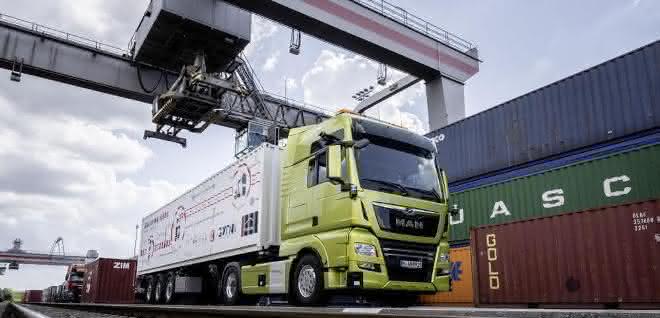
The goal of the project partners Deutsche Bahn, MAN Truck & Bus, Fresenius University of Applied Sciences and Götting KG is clear: as part of the Anita (Autonomous Innovation in Terminal Operations) project, automated trucks should be moving autonomously at the DB Intermodal Services container depot and the DUSS terminal in Ulm-Dornstadt by 2023 at the latest.
The circuit diagram required for the project has recently been completed. This translates the procedures and processes at the terminal universally for all systems involved. With this "mission planning", vehicle development is now entering the decisive phase. "Thanks to the good groundwork done by Fresenius University of Applied Sciences and the creation of the mission planning, we can now initiate the next development steps for our Anita truck. This brings us ever closer to our common goal of using the autonomous truck in container handling. These project test drives will also provide us as MAN with further insights for the development of future autonomous driving in hub-to-hub traffic on fixed routes between logistics terminals," says MAN project manager Amelie Jacquemart-Purson on the milestone that has now been reached.
Common language as the key
Fresenius University of Applied Sciences presented its analysis results back in summer 2021 after the scientists led by Prof. Dr. Christian T. Haas, in cooperation with MAN Truck & Bus, analyzed the processes and behaviours of people and machines on site. After all, for a truck to be able to drive fully automatically at the container and DUSS terminals (Deutsche Umschlaggesellschaft Schiene-Straße mbH) in Ulm in future, it must be able to communicate with the infrastructure. Together with its partner Deon Digital, Fresenius University of Applied Sciences has now transferred these findings into a digital set of rules and programmed various modules based on a common language. "We used the CSL Contract Specification Language from Deon Digital as a common language to ensure a clear and complete communication chain," explains Haas. "This means that all processes are set up as individual contracts."
The result is a complete mission planning system that connects both the vehicle and the two different IT systems of the container and DUSS terminals. Like a universal interpreter, the solution speaks the languages of all heterogeneous systems and guides the automated truck through the container handling process. The project partners MAN Truck & Bus and Götting can now incorporate this software, which is constantly being optimized, into the development of the autonomous vehicle. The first test drives with the prototype truck are expected to take place in Ulm-Dornstadt at the end of 2022. In the future, digitalization and automation will also be driven forward at other DB container terminals in Germany - along a roadmap that will lead to the future Terminal 4.0.
Focus on efficiency and sustainability
"Automated transfer of loading units between our transhipment terminal and the container depot means that combined transport can be handled even more efficiently and sustainably," explains Thomas Wünsch, IT and Processes Project Manager at DUSS. "DB Intermodal Services' container depot also benefits from the innovation project. By integrating the autonomous truck into the real terminal processes, we are gaining valuable experience for our operations," adds Jens Pröse, Head of Process Organization at DB IS.
This article appeared in materialfluss 3/22.


You might also be interested in
Autonomous truck sets course for the highway:
ATLAS-L4 project from MAN Trucks on course for success
Thanks to MAN Trucks, the plan to bring autonomous trucks onto Germany's highways is moving ever closer to reality.
 read more...
Autonomous driving in the warehouse takes shape
The European research project IMOCO (Intelligent Motion Control) aims to bring the vision of autonomous transport vehicles in production halls and warehouses within reach.
read more...Automated pick-up and delivery service from...
From station to station with the Sally Courier
DS Automotion presented the SALLY courier at med.Logistica 2019. This is an innovative solution for the fast, secure and fully documented transportation of small consignments of goods within medical facilities.
read more...AGV to robot: supplies are on the way!
At LogiMAT, Bosch Rexroth will be presenting the ActiveShuttle, the next generation of intelligent autonomous transportation systems (Automated Guided Vehicle, AGV for short).
read more...Autonomous driving - Bosch relies on three pillars
The precise localization of automated vehicles is critical to safety. This is why Bosch relies on a combination of hardware, software and services when it comes to safe, automated driving.
read more...Volvo Trucks delivers fully autonomous transportation solution to customers
Volvo Trucks and the Norwegian company Brønnøy Kalk AS have signed an agreement under which Volvo Trucks will transport limestone from an open pit mine to a port facility using a commercial autonomous transport solution.
read more...DB Schenker: First autonomous electric truck "T-Pod" in commercial operation
DB Schenker and Einride have launched the first commercial use of a fully electric, autonomous truck - the so-called "T-Pod". The e-truck will transport goods fully autonomously on DB Schenker's premises in Jönköping, Sweden.
read more...Autonomous driving - driverless happiness?
The topic of autonomous driving has been the focus of attention in the transportation industry in recent years. The question arises as to where the complex technology actually brings benefits. LTM author Oliver Willms investigated the question.
read more...MAN helps Ukrainians in need
Willingness to donate and support across all MAN Truck & Bus sites and national companies: employees of the commercial vehicle manufacturer have been helping people in need since the outbreak of the war in Ukraine.
read more...