
Storage- and racking systems
Perfect for contract manufacturing
Jörg Schneider Edelstahlverarbeitung manufactures hygiene-sensitive factory equipment - right down to batch size one. The high number of variants is a mammoth task: 4,000 to 6,000 parts are in circulation in production. To simplify the processes in raw material supply and order picking, the company invested in an automated storage system of the Uniline type from Kasto.
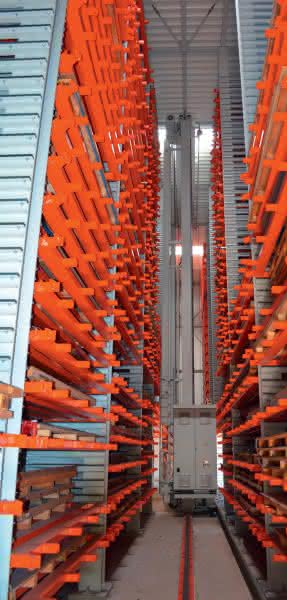
From commercial kitchens to the food and pharmaceutical industries to microelectronics and mechanical engineering: the products of Jörg Schneider Edelstahlverarbeitung e.K. are used in a wide range of industries. Founded in 1991, the owner-managed company specializes in hygiene-sensitive stainless steel factory equipment.
Wide range of services, enormous diversity of variants
The Weimar-based company now employs 40 people and has a production area of around 4,000 square meters. One major challenge is the wide range of variants: "We produce around 800 assemblies a month, most of them in batch size one," explains Jörg Schneider. "Depending on the order situation, up to 6,000 different sheet metal parts are in circulation." Efficient processes are therefore of central importance - especially as the entire production is timed just-in-time for delivery. "This means that every part has to be in the right place at exactly the right time," explains Schneider. But that's not all: "We mostly work on a project basis, and in around 20 to 30 percent of cases, customers postpone deadlines. This makes order picking even more difficult for us."
Manual cantilever support reached its limits
To store the raw materials, the company used to rely on a manually operated cantilever rack in which the goods were stored chaotically. A second manual warehouse was available for picking the prefabricated individual parts for component assembly. However, this system was no longer able to cope with the complexity and production throughput. So Schneider turned to Kasto. The company specializes in semi-automatic and fully automatic storage systems as well as automated handling equipment for metal long goods, sheet metal and blanks. "Kasto really took a lot of time for us and analyzed our current situation in detail," praises Schneider. Together, they finally decided on the Uniline longitudinal storage system.
Plenty of space in a small area
Kasto built the warehouse as a silo construction with roof and wall cladding directly adjacent to one of the existing production halls. With a system height of 14.5 meters, it offers up to 750 storage locations for long goods, flat and bulky goods with lengths of up to six meters and a maximum height of one meter on a compact footprint. Three types of system pallets with load capacities of up to 5,000 kg are used as load carriers. The longitudinal warehouse has three retrieval stations in the hall and two storage stations outside, which are approached via a stacker crane. Schneider stores up to 10,000 different items in the warehouse - from raw materials to complete assemblies.
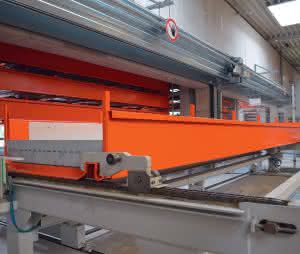
Operation is simple: each transfer station has a computer terminal that the user can use to enter storage and retrieval commands. The system pallets are transported to and from the storage locations fully automatically by stacker crane. This is extremely dynamic with a lifting speed of up to 24 meters per minute and a longitudinal travel speed of up to 60 meters per minute. At the transfer stations, cross carriages and chain conveyors bring the load carriers into the warehouse - and out again. The employees remove the material by hand or with a forklift. The retrieval stations are also equipped with storage racks. "We can use these to pick items from a pallet, for example, while another storage or retrieval process is running in parallel," explains Schneider.
Intelligent control for more space in the warehouse
The system is controlled via the Kastologic WMS. This coordinates all the movements of the stacker crane and the stations and also enables permanent inventory management. The system pallets are equipped with barcodes. Another advantage is the dynamic compartment height management: this allows load carriers with different support heights to be stored. The system records the height of the pallet and automatically searches for a suitable location in the warehouse. If the pallet thus occupies several storage compartments, these are blocked and are no longer available for other load carriers. "In this way, we can make optimum use of the available storage space without any collisions," says Schneider happily. Kasto also integrated the warehouse management system into its own production planning and control system (PPS). Kastologic takes orders for storage and retrieval or picking directly from the PPS. The Uniline warehouse system has now been in use since the end of 2013 - and with success: "We were able to significantly increase our capacities, make the routes in our production shorter and more efficient and noticeably increase stock transparency," says Schneider happily.


You might also be interested in
Industrial trucks for luxury cars
Optimized logistics for super sports cars
Automobili Lamborghini manufactures exclusive luxury and super sports cars. Founded in 1963 by Ferruccio Lamborghini, the company is still based at its traditional headquarters in Sant'Agata Bolognese.
 read more...
Explosion-proof forklift trucks for production and warehouses
Sherwin-Williams (legal entity Inver) from Dresden produces industrial coatings for various industries. In order to create a safe working environment, the company has purchased a fleet of Linde explosion-proof forklift trucks. The industrial trucks...
read more...High-voltage forklift trucks for all weather conditions
EP Equipment presented the EFL 10T high-voltage forklift truck at the IFOY Award 2025 Test Camp in Dortmund. The EFL-HV series, including the EFL 10T, is designed to combine the performance of traditional combustion engine equipment with the modern...
read more...Hub for spare parts: KION Regional Distribution Center Central Europe opened
In order to further shorten delivery times and ensure delivery availability of almost 100 percent in the future, Linde Material Handling has built a new, larger spare parts distribution center equipped with modern technology at its existing site in...
read more...Spare parts efficiently brought to the track
The distribution center and spare parts warehouse of an automotive manufacturer in Wallersdorf, which opened in 2016, covers an area of around 235,000 square meters. Customers all over the world are supplied with spare parts and accessories from...
read more...Flexible for indoors and outdoors: New Toyota MH series
Toyota Material Handling has launched the latest generation of its electric counterbalance trucks - the Toyota Traigo48 series. This is intended to impress in terms of performance and design as well as with a comprehensive package of functions.
read more...Hubtex Group takes over Genkinger GmbH
The Hubtex Group has acquired 100 percent of the shares in Genkinger GmbH, based in Münsingen. The aim of this acquisition is to further strengthen the individual brands internationally and to utilize synergies across locations.
read more...Still invests in Hamburg headquarters: 50 million euros for new mechatronics center
On February 19, intralogistics expert Still and Mercurius Industrial Properties officially broke ground for the Still "Centre of Competence Mechatronics" in Hamburg. Still has also announced further site developments in the Hanseatic city: The...
read more...Lift trucks, stackers and order pickers from a single source
Colorbaby distributes toys, outdoor leisure products and household goods from its warehouse in Ibi, Alicante, Spain. The company previously used a fleet of industrial trucks from various manufacturers. After more than five years of good experience...
read more...