
Storage- and racking systems
Metamorphosis: From furniture factory to finished goods warehouse
The automotive supplier Mubea has transformed the former production facility of an office furniture manufacturer in Weißensee, Thuringia, into a central finished goods warehouse. Mubea was able to implement its ideas for an efficient intralogistics infrastructure in the existing hall. This also applies to the shelving. They were supplied by the international shelving specialist Nedcon.
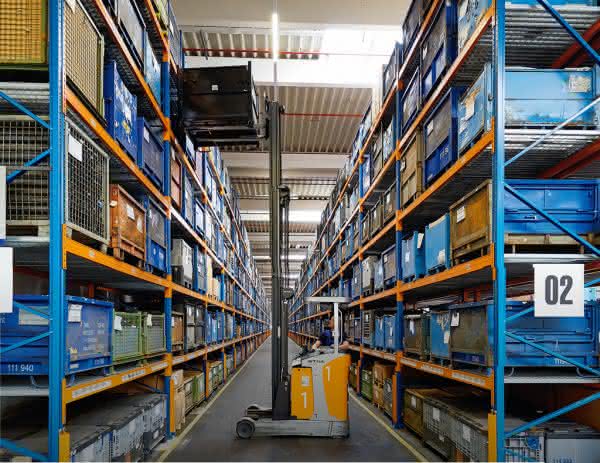
As you approach the small town of Weißensee from Erfurt, you can't miss the Mubea Fahrwerksfedern GmbH plant. The automotive supplier Muhr und Bender has been producing stabilizers and axle springs here in Thuringia since 1992. The warehouse is located right next to the production facility. The building, which today fits seamlessly into the company premises, used to be used to produce office furniture. When the manufacturer withdrew, this hall suddenly became vacant: 20,000 square meters, less than 500 meters from the Mubea production facility. Ideally located for a central finished goods warehouse. The tugger trains from production can reach it without leaving the company premises.
"Not a high-bay warehouse, but a high pallet warehouse"
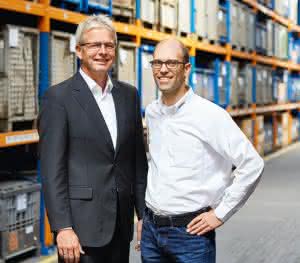
As ideal as the location was, the conditions were uncertain. "We first had to find out whether the former production hall was even suitable for our purposes," recalls Philip Uszkurat (Mubea Corporate Logistics). After all, the intralogistics experts had an impressive facility in mind, which, according to Uszkurat, "was not to be a high-bay warehouse, but certainly a very high pallet warehouse." The 105-metre-long and eight-metre-high racks, 14 rows in total, create 7,300 storage locations. They are filled with both internal and OEM load carriers. The plant packs the finished parts into around 30 different containers, which are arranged chaotically in the racking. Each container weighs between 500 and 800 kilograms.
Nedcon involved at an early stage
The racking manufacturer Nedcon was involved at an early planning stage. The subsidiary of the Voestalpine steel group designs and implements systems for fully and semi-automatic warehouses as well as manual racking with integrated system platforms.
U-profiles reduce point loads on the floor
As there was no expert opinion, core drillings had to be carried out to clarify whether the floor under the hall flooring could support the heavy shelving. To be on the safe side, Nedcon suggested placing the shelving on load distributors. "The punctual pressure that conventional rack feet exert on the floor would have been too great," explains Nedcon customer consultant Bart Pulles. That's why all the shelves stand on steel U-profiles that connect the opposite feet on the narrow side.
Narrow aisle width thanks to reach trucks
There are 16 columns in the hall that support the roof. "Nedcon has developed an idea for integrating the columns into the racking," says Uszkurat. "The advantage of this is that they don't get in the way of our forklift trucks during storage and retrieval." Mubea opted for reach trucks for the industrial trucks in question. In contrast to conventional front loaders, they have a working aisle width of three meters. A real plus for the usable space. After all, the aim was to create as much storage capacity as possible. Nobody needs extra-wide aisles.
Inlaid gratings as shelves
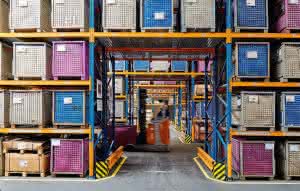
The transport containers specified by the OEMs proved to be a further challenge for the planners. This is because some of them have small feet that resemble the heels of high heels and place a corresponding load on the standard floor. Mubea did not want to be restricted in its freedom to use the warehouse by such peculiarities. The requirement was to design and lay out the racking in such a way that Mubea could occupy every storage space with every OEM load carrier. This applied to different pallets, mesh boxes and other reusable loading equipment, regardless of format and weight. You could also say that the automotive supplier wanted chaotic warehousing in its purest form. "Mubea did not allow any exceptions or compromises for any square meter of the racking system," says Pulles, emphasizing his customer's loyalty to the concept. Only solid gratings are used as shelves. Each of these can accommodate all load carriers. To make better use of the height of the individual shelf spaces, Mubea opted for inlaid gratings. This makes the shelving more stable.
"Don't just tear everything down"
Mubea and Nedcon have succeeded in making the most of the available space. The result is a highly functional finished goods warehouse whose racking system forms the logistical hub. Today, 800 containers go in and out of the warehouse every day. Nothing reminds us that office furniture used to be produced here. What remains is the hall and a certain respect for the twenty-five-year-old building fabric. "You can't just tear everything down and put it up again," says Uszkurat.
Andreas Pietsch


You might also be interested in
Sixth AutoStore project for New Wave
Element Logic is implementing its sixth joint project with the New Wave Group: a future-proof AutoStore system for the logistics center in Geiselwind.
 read more...
Everything is in its place
Vet-Concept produces and sells high-quality dry and wet food. The company sells almost exclusively online and also has its own small store in Föhren for customers to collect their own products. BITO-Lagertechnik has supported the company since its...
read more...Designing crisis-proof warehouse technology
Geopolitical tensions, rising costs and increasing protectionism have fundamentally changed the economy. The days when goods were simply stored are long gone - today it's all about remaining flexible, reacting quickly and finding ever smarter...
read more...Sustainable logistics - a sustainable approach
In recent years, environmental protection has become a fundamental concern of society. Sustainable logistics focuses on minimizing the environmental impact of logistics activities without compromising the economic efficiency of companies.
read more...Shelving specialist Elvedi celebrates its 40th anniversary
The shelving system provider Elvedi is celebrating its big anniversary in 2024. The shelving manufacturer intends to continue on this growth path in the future and is planning to expand its sales territory in Europe.
read more...Drill core storage for the Mont Terri rock laboratory
The plant and racking specialist Stöcklin received the order for an unusual racking system in an unusual location and found an unusual solution for it.
read more...MS Motorservice International relies on Kardex Mlog
MS Motorservice International, the sales organization for Rheinmetall's global aftermarket activities, has commissioned Kardex Mlog as general contractor to build a four-aisle high-bay warehouse at its Neuenstadt site. The high-bay warehouse will be...
read more...Warehouse concept from Schulte impresses at Liebherr-Logistics
Liebherr-Logistics built a new warehouse at the Oberopfingen site. Schulte equipped this with a complete package: Within a short space of time, pallet, cantilever and shelving racks were installed in all three sections of the new building.
read more...Mayr-Melnhof Packaging optimizes logistics operations with AR racks
The Chilean subsidiary of the European group for the production and distribution of paper and cardboard packaging has carried out a comprehensive logistics optimization project at its distribution center in Santiago, Chile.
read more...