
Software
AI as a partner in inventory management
In a market environment characterized by volatile demand and fragile supply chains, traditional manual inventory management is increasingly reaching its limits. How can companies master the balancing act between maximum delivery capability and minimized capital commitment through the targeted use of artificial intelligence?
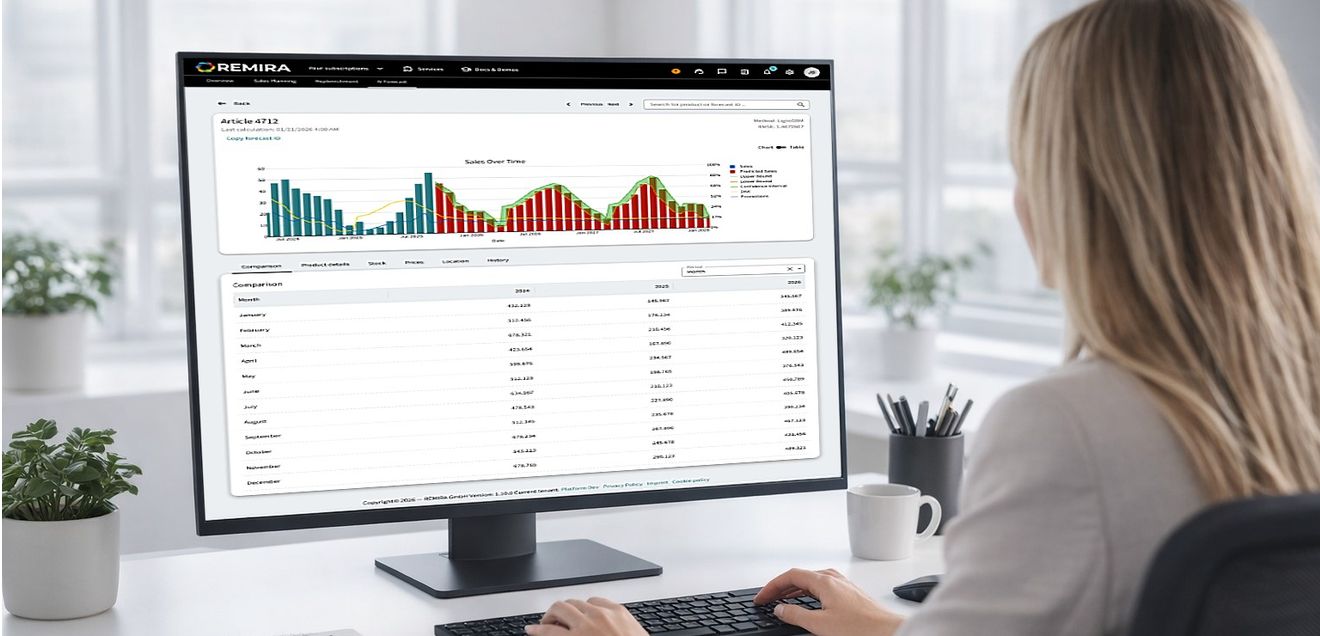
In times of global uncertainty and increasing economic pressure, companies are faced with the challenge of managing their inventories efficiently without jeopardizing their ability to deliver. Artificial intelligence has evolved from a trend topic to a competitive factor. But not all AI is the same - the technological evolution ranges from simple, rule-based systems to autonomous agents that take over complex decision-making processes independently. A look at the development stages shows how companies today can secure their liquidity and massively increase efficiency in scheduling.
Companies today operate in an environment characterized by disrupted supply chains, volatile markets and high cost pressure. In this context, value creation in inventory management means one thing above all: keeping capital commitments as low as possible while ensuring maximum delivery capability. AI acts as a partner in this area of conflict by providing precise forecasts and automating routine activities. AI-supported forecasts allow inventories to be reduced by up to 30 percent while maintaining availability.
Avoid safety surcharges "on instinct"
Traditional demand planning reaches its limits where human capacity ends. An MRP controller who manages thousands of items can hardly calculate the optimum order quantity for each item on a daily basis, taking into account seasonality, trends and promotions. Practice shows that manual planning is often reactive. The result is safety surcharges "based on instinct", which may soothe the conscience, but fill warehouses and tie up liquidity unnecessarily.
This is where AI-supported systems come in. They act as an assistant that analyzes huge amounts of data in real time. The focus is shifting away from pure data management towards strategic control.
How AI develops: Four key stages of development
In order to fully exploit the potential of AI, it is necessary to understand the various stages of technological development. Remira, an expert in intelligent software solutions, divides this evolution into four key areas:
Rule-Based Static AI: This is the classic form in which software decisions are made on the basis of static, unchanging parameters. Simple mean value calculations are often used here. The AI acts within rigid rules that are specified by employees.
Dynamic Rule-Based AI: In this stage, the company still sets the limits of the rules, but the AI determines the optimal parameters within this framework independently. Such systems already recognize seasonality and changes in demand behaviour.
Multi Time Series AI: Here, the technology moves away from traditional forecasting methods and into the field of machine learning. It no longer just looks at individual time series, but includes a large number of external influencing factors in the calculation, which leads to a significantly higher forecast quality.
Agentic AI: The highest evolutionary stage is marked by the use of autonomous agents. These small programs take over the behavior of employees completely autonomously. An agent is triggered by an event and independently runs through a defined process to deliver a valid result - without manual intervention.
Measurable business impact and process optimization
The use of intelligent systems leads to a significant reduction in the workload of employees. In practice, it has sometimes been shown that manual scheduling work can be reduced by up to 75 percent through automation. This frees up valuable time for specialists to focus on strategic tasks. According to Remira, another significant advantage is the reduction of out-of-stock situations by 30 to 50 percent. The improved availability of goods combined with optimized inventories frees up working capital, which directly improves the company's liquidity.
AI should be particularly effective for companies with several locations or warehouse levels: Inventory levels can be reduced by an additional 10 to 15 percent through cross-location optimization. The AI reacts dynamically to changes in delivery routes or demand and continuously adapts the parameters to current market developments.
The path to AI-supported inventory management
Despite the clear advantages, according to a recent Remira survey of customers and interested parties, around 64 percent of companies still do not use AI in their inventory management. The reasons? Skepticism or a lack of internal know-how. But getting started doesn't have to be complex. It is important to determine your own status quo and find the right AI solution for your individual requirements. Whether it's the automation of routines or precise demand planning - AI is no longer a "nice-to-have", but the basis for a resilient and value-adding supply chain.
Optimization down to item level
The analysis of the technological development stages makes it clear that AI in inventory management is already a tool with a direct impact on the balance sheet. One advantage lies in its scalability and precision: while human planners inevitably have to prioritize in the flood of data and articles, AI ensures seamless optimization down to article level - around the clock.


You might also be interested in
A Centralized View of Complex Processes
Today, medium-sized logistics companies must manage an increasingly diverse range of operations efficiently and reliably. Different modes of transport, customized customer solutions, and established workflows can hardly be accommodated by...
 read more...
Robotics Integration for Greater Efficiency in Inbound Goods Processing
Infios is helping Kellner & Kunz, a specialist in tooling and C-parts, expand its automation strategy. The next step in this long-standing partnership is the integration of robotics into inbound logistics.
read more...Flying warehouse robot impresses the jury
The Swiss deep-tech company Verity has been awarded the 2026 IERA Award for its autonomous indoor drone system. The flying robots monitor inventory levels autonomously, operate without GPS, and are already in use in approximately 200 warehouses...
read more...The Right Warehousing Solution for Every Logistics Need
Whether it’s an S/4HANA implementation, the urgently needed replacement of the traditional SAP WM, or the growing demands for digitalization and automation—many companies are faced with the question of which warehouse management system will best...
read more...Digital processes shorten delivery times
trans-o-flex makes delivery times easier to plan
trans-o-flex ThermoMed Austria is optimizing its delivery processes with new scheduling software and a digital self-handling module for drivers.
read more...Route planning and optimization solution
Jumbo backs Greenspan
The Dutch supermarket chain Jumbo has realigned its e-commerce logistics with Greenplan, the intelligent route planning and optimization solution from the Ehrhardt Partner Group.
read more...New version of Röhlig Realtime
Röhlig Logistics presents the enhanced version of "Röhlig Realtime". The company is supplementing its digital service portfolio with a central platform that ensures greater transparency and networking throughout supply chain management.
read more...Strategic route planning reorganized
Strategic route planning is one of the key success factors for retail companies. It structures routes and areas, reduces costs, ensures optimal use of resources and increases customer satisfaction.
read more...German Innovation Award for IGZ
Autonomous AI control station for logistics centers wins award
The autonomous AI control center "Smart Logistics Cockpit" from IGZ was awarded the German Innovation Award 2026 in gold. The solution automates central control station activities in logistics centers and is designed to significantly increase...
read more...