
Telekom study
Logistics remains a digitalization pioneer
The logistics sector is once again leading the way when it comes to digitalization. This is the result of the study "Digitalization Index for SMEs 2021/2022". Companies are now focusing primarily on IT security.
Many logistics companies continued to suffer from the pandemic and international delivery difficulties in 2021. Nevertheless, the sector remains the leader among German SMEs in terms of digitalization. This is the conclusion of the representative study "Digitalization Index for SMEs 2021/2022". Deutsche Telekom and the analyst firm Techconsult conducted the survey for the sixth time. However, the economic restrictions in logistics have slowed down the high pace of digitalization from the previous year: the index value fell by one point. However, at 65 out of a possible 100 points, it is still well above the cross-industry average of 59 points. After investing comparatively little in IT security and data protection in 2020, companies are now expanding this area significantly.
Increasing complexity requires digitalization
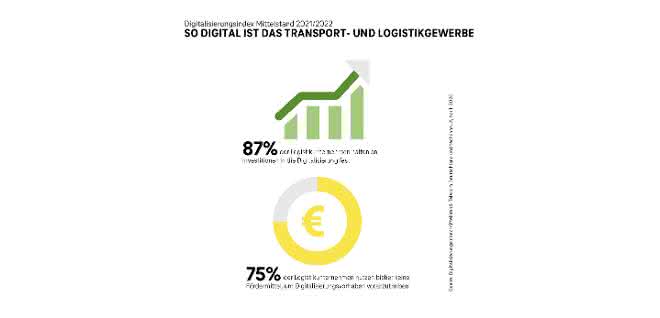
"87% of companies in the logistics sector want to continue investing in digitalization in the future. The need to react faster and faster while complexity is increasing, whether due to Covid-19 lockdowns, container congestion or changes in purchasing behaviour, makes digitalization more necessary than ever. Holistic supply chain management solutions including real-time monitoring and evaluations, such as track & trace of containers or networked pads in the fleet service area, help here," says Thomas Spreitzer. He is responsible for business customer sales at Telekom Deutschland. "One thing is certain: the industry will continue to be a digital pioneer in the future. It is already demonstrating how versatile digital technologies can be".
Arrived in all areas of work
Whether in the warehouse, during transportation or at the desk: the logistics sector is now using digital technologies in almost all areas of activity or plans to do so within the next twelve months. Warehouse management systems (62%) and digital fleet management tools (61%), for example, are particularly popular. The same applies to digital signatures, which electronically document the transfer of goods with a certificate (26%). Digital solutions also support remote work in the area of administration and organization: communication technologies for smooth collaboration on the computer will be part of everyday working life for more than three quarters of companies after the pandemic.
Advantages for sustainability
Messenger services and video conferencing mean that logistics companies are also increasingly giving their employees the freedom to work from home (62%). The proportion of time spent working from home is expected to increase after the pandemic - by ten percent. This can have a positive impact on companies' carbon footprint. It eliminates the need to travel to work. Overall, environmental sustainability plays an important role for 70% of companies. With digital solutions, sustainability and profitability go hand in hand: they can reduce costs, speed up transportation and increase efficiency. A quarter of companies use their existing IoT solutions for predictive maintenance and servicing of machines. This can increase their longevity and thus save resources. Logistics is one of the first industries to exploit the potential of IoT.
Subsidies hardly strengthen investments
Investments in IoT applications are not the top priority. First and foremost, the industry wants to focus more on digital tools for collaboration and ensure greater IT security. Cybersecurity will remain a priority for almost three quarters of companies in 2022. To top up their budgets, companies could fall back on public funding. Only a quarter have used this option to date; 42% are unaware of this possibility. Companies that are aware of them but do not make use of them complain above all about a lack of orientation when selecting funding programs (31%). They also criticize the high level of bureaucracy involved. The programme is also often not a good fit for their own digitization project (22% each). Just under a quarter (22%) also need external support to find and apply for the right funding program.
The article appeared in materialfluss 6/22.


You might also be interested in
Identification technology and RFID
Networked container terminals: 5G campus networks for Eurogate
Deutsche Telekom is equipping port terminals in Hamburg, Bremerhaven and Wilhelmshaven with local 5G networks by spring 2024.
 read more...
A Centralized View of Complex Processes
Today, medium-sized logistics companies must manage an increasingly diverse range of operations efficiently and reliably. Different modes of transport, customized customer solutions, and established workflows can hardly be accommodated by...
read more...Robotics Integration for Greater Efficiency in Inbound Goods Processing
Infios is helping Kellner & Kunz, a specialist in tooling and C-parts, expand its automation strategy. The next step in this long-standing partnership is the integration of robotics into inbound logistics.
read more...Flying warehouse robot impresses the jury
The Swiss deep-tech company Verity has been awarded the 2026 IERA Award for its autonomous indoor drone system. The flying robots monitor inventory levels autonomously, operate without GPS, and are already in use in approximately 200 warehouses...
read more...The Right Warehousing Solution for Every Logistics Need
Whether it’s an S/4HANA implementation, the urgently needed replacement of the traditional SAP WM, or the growing demands for digitalization and automation—many companies are faced with the question of which warehouse management system will best...
read more...Digital processes shorten delivery times
trans-o-flex makes delivery times easier to plan
trans-o-flex ThermoMed Austria is optimizing its delivery processes with new scheduling software and a digital self-handling module for drivers.
read more...Route planning and optimization solution
Jumbo backs Greenspan
The Dutch supermarket chain Jumbo has realigned its e-commerce logistics with Greenplan, the intelligent route planning and optimization solution from the Ehrhardt Partner Group.
read more...New version of Röhlig Realtime
Röhlig Logistics presents the enhanced version of "Röhlig Realtime". The company is supplementing its digital service portfolio with a central platform that ensures greater transparency and networking throughout supply chain management.
read more...Strategic route planning reorganized
Strategic route planning is one of the key success factors for retail companies. It structures routes and areas, reduces costs, ensures optimal use of resources and increases customer satisfaction.
read more...