
Port evening of the North German seaports
German North Sea ports - Together towards the future
Closer cooperation between the German North Sea ports is possible. This was one of the results of the first joint port evening of the North German seaports in Berlin. More than 100 participants followed the exciting discussions chaired by DVV Publishing Director Oliver Detje.
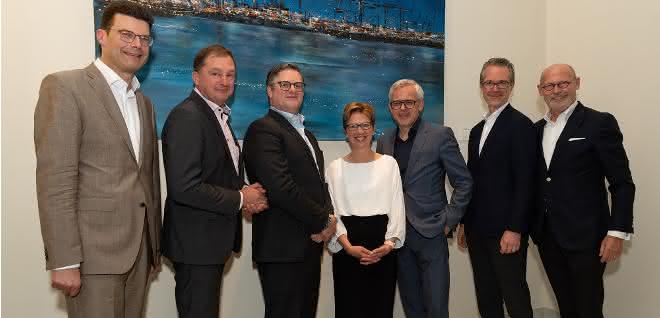
"German North Sea ports - Together towards the future" was the heading under which business representatives and the heads of the ministries responsible for ports discussed the future positioning of the German North Sea ports. This is because port policy is not only being considered at federal level; new port development plans are also currently being drawn up in Bremen and Hamburg. In Lower Saxony, a paper describing the ports' prospects for the coming decade was recently drawn up.
In all federal states, the discussions are characterized by the same objectives: it is about competitiveness, especially compared to the nationally strongly supported locations in Belgium, the Netherlands and France, and it is about expanding the infrastructure. It became clear at the event that the major future topics of energy security, climate neutrality, digitalization and automation are also becoming key areas of port policy.
In order to master these tasks, the National Ports Strategy must offer significantly more support for the ports. At the same time, the port locations are required to work closely together to master the challenges ahead.
Against this backdrop, the port locations will provide additional impetus for close port cooperation with further joint event formats.
"The development of a new national port strategy is absolutely necessary in the current situation. Only if the federal and state governments, as well as the port and transport industry, work closely together can the ports ensure Germany's security of supply and energy independence. Bremen and the other coastal states will continue to live up to their responsibility and invest in port infrastructure. At the same time, we expect the federal government to make an appropriate contribution," says Dr. Claudia Schilling, Senator for Science and Ports.
Michael Westhagemann, Senator for Economics and Innovation: "We have to become faster. The framework conditions must be right. Only then will we all develop the future of the ports together. And only then will our ports become energy hubs and only then will we succeed in achieving climate neutrality."
Dr. Berend Lindner, State Secretary of Lower Saxony's Ministry of Economic Affairs, Labour, Transport and Digitalization: "An efficient transport network and well-developed infrastructure are essential for the ports of northern Germany. In order to strengthen the competitiveness of our seaports in comparison to the western ports, infrastructure projects must be further accelerated. The current example of the planning and realization of the LNG jetty in Wilhelmshaven clearly shows that it is possible to implement major projects in a timely manner. The Federal LNG Acceleration Act provides the decisive legal framework for this."


You might also be interested in
Maersk and Hapag-Lloyd agree on joint operational cooperation
Hapag-Lloyd and Maersk have signed an agreement for a new, long-term operational cooperation called "Gemini Cooperation", which will start in February 2025. The aim is to create a flexible and interconnected service network in maritime...
 read more...
Successful 2023 - subdued prospects for 2024 in Bremen
As part of the 11th Project Logistics Forum, BHV-Bremische Hafen- und Logistikvertretung presented the initial results of its survey for the current "BHV Project Logistics Monitor".
read more...New rail transshipment facility in Bremen
Rhenus Weserport Bremen is building a fully automated new rail transshipment facility for loading aluminum hydroxide and aluminum oxide at Terminal 4 of Bremen's industrial port.
read more...Rising demand for nearshoring
The trend towards nearshoring is continuing even after the coronavirus pandemic, according to Munich-based international freight forwarder Robert Kukla. The intermodal service provider is seeing continued growth in transport from Turkey and the...
read more...Doubled storage space in Allermöhe
Nagel-Group is launching an extensive expansion and modernization project at its Hamburg site. Germany's largest food logistics company will completely restructure the site in the Allermöhe industrial estate.
read more...Port of Hamburg handles 58.2 million tons
Both the tense economic situation in Europe, and in Germany in particular, and the geopolitical conditions continue to have an impact on handling in the Port of Hamburg.
read more...Port of Hamburg suffers from loss of Russian business
The difficult economic development of the global economy is affecting the handling figures of the Port of Hamburg. As in other ports in Northern Europe, seaborne cargo throughput in Hamburg is declining, although individual trade lanes are...
read more...Green logistics facility for Mercedes-Benz
The largest photovoltaic system on an industrial building in Germany to date is the hallmark of the new "C3 Bremen" logistics center in the Freight Village of the Free Hanseatic City.
read more...Challenging year - positive outlook
Hamburger Hafen und Logistik AG (HHLA) performed successfully in the 2022 financial year despite challenging conditions.
read more...