
Order-picking technology
Pick-by vision on the rise: Easier into the future
It was only four years ago when the introduction of Google Glass failed on a broad front. The technology was not fully developed and there was also a lack of acceptance, both in the private and especially in the industrial sector. However, development has progressed rapidly since then. materialfluss provides an overview of the current state of affairs and the strategies of three key providers.
Data glasses are already available on the market today that can process a significantly higher volume of data, have a longer battery life and are much more comfortable to wear thanks to their significantly reduced weight," says Holger Häring, Head of Sales at logistics specialist IGZ. Smart glasses can therefore be worn for much longer today without signs of fatigue or headaches creeping in. IGZ has already successfully implemented data glasses and SAP EWM (SAP Extended Warehouse Management) in pilot projects, especially for order picking. Picavi also shares the optimism: "Data glasses are absolutely ready for use in intralogistics and are winning over more and more customers. Now it's a matter of acquiring even more customers on the one hand and further developing our ecosystem on the other. The latter refers to the hardware and software surrounding the smart glasses, i.e. the specific Picavi approach to pick-by-vision," explains Johanna Bellenberg, Director Marketing and Communications.

Niche technology - or panacea?
At topsystem Systemhaus, they are a little more cautious. "Pick-by-vision is currently still a niche technology. Pick-by-vision solutions currently only meet the basic requirements of the logistics industry, such as the robustness of the hardware and support for multi-shift operation, to a limited extent," says Managing Director Tim Just. He sees the solution in the combination of pick-by-vision and pick-by-voice technology: "Process control is completely intuitive using voice. The frequency of visual overlays, which employees have to concentrate on when using a pure vision solution, is significantly reduced. We are convinced that Pick-by-Vision pays off, especially as an assistance system."
In general, however, all three providers believe that pick-by-vision is a good thing. One reason for this is that augmented reality is finding its way into intralogistics. This has its advantages: cumbersome handling, for example with slips of paper or mobile data collection devices, is no longer necessary. In addition, expensive warehouse technology is saved, information is provided in a targeted manner and the mental effort required during work is also reduced. Data glasses also help to prevent accidents, for example when operating forklift trucks, thanks to the ability to visualize warnings and safety instructions. "Hands-free technology is ideal for medium-sized product ranges with a medium data throughput. Particularly in online retail, where end-to-end process automation at intralogistics level is far from the norm, smart glasses can compensate for deficits that arise during time-consuming and error-prone manual handling," says IGZ expert Holger Häring.
Picavi sees the advantage in the coordination between people and technology: "Pick-by-Vision is perfectly tailored to people, who receive 80 percent of their sensory impressions each day through their eyes, and their working methods in the warehouse. The secondary field of vision provides workers with all the relevant information they need to complete their tasks in the warehouse quickly and accurately. In increasingly complex logistics environments, the pick-by-vision solution with its assisted reality approach is the ideal complement to human cognitive intelligence and flexibility. We think that pick-by-light will also continue to be used in niches in some projects," says Johanna Bellenberg.

"We are certain that pick-by-vision will be the picking technology of the future."Johanna Bellenberg Director Marketing and Communications Picavi GmbH
Pick-by-vision therefore always comes into its own when it comes to a wide range of articles. "This applies in most cases in e-commerce, for example in the fashion industry. Customers expect their orders to be delivered quickly and reliably - the quality of order processing must be correspondingly high," explains Tim Just from topsystem. This is one of the decisive competitive requirements in e-commerce. If a customer receives the wrong item, this leads to an increased returns rate and dissatisfaction. Pick-by-vision can provide support here and significantly increase delivery quality by providing additional visual information, such as product images on the display of a smart watch or in the order picker's field of vision when using data glasses.
Data glasses weighing just 40 g
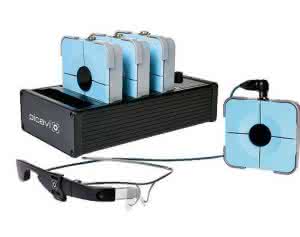
And which of these beautiful new things can the logistics manager buy and why should he do so? When implementing customer solutions, IGZ currently favors weight-balanced data glasses such as the Vuzix M300 or Epson Moverio BT-300, which can be connected directly to SAP without any middleware and, according to the company, are easy and flexible to use. At 40 grams, the weight of these smart glasses is extremely low, the company is convinced. Picavi's in-house development is continuing at a rapid pace. "In the first half of 2018, we presented a new user interface at the LogiMAT, CeMAT and Modex trade fairs, among others, as well as some hardware improvements, which mainly concerned the cable connection between the glasses and Picavi Power Control," explains Johanna Bellenberg. With this battery and control element, the glasses can be operated using five large buttons. The more robust cable connection has further improved everyday usability. The updated interface shows the operator even more clearly which tasks are pending and how to complete them in the best possible way.

"Just like Pick-by-Vision, Pick-by-Voice utilizes a central, cognitive ability of humans."Tim Just Managing Director of topsystem Systemhaus GmbH
In contrast, topsystem proudly points to the Lydia Smart Assistant, with which process and article information can be shown on any smart device with a display. This makes it possible, for example, to attach tablets to means of transport (trolleys, forklifts, etc.) as an additional source of information. Important article and order information is displayed visually on the screen and can easily be called up as required. In addition to this innovation in the vision area, topsystem has also made some changes within the Lydia Voice Suite as a whole: in Release 8, speech recognition has been placed on a completely new technological basis, giving users even more options for future-proof voice warehousing. The technology works with neural networks for speech recognition and thus takes a decisive step towards artificial intelligence. The impression remains that Pick-by-Vision - whether used in combination with Pick-by-Voice or on its own - is an order picking technology with a great deal of development potential on the technical side.
Martin Schrüfer


You might also be interested in
Industrial trucks for luxury cars
Optimized logistics for super sports cars
Automobili Lamborghini manufactures exclusive luxury and super sports cars. Founded in 1963 by Ferruccio Lamborghini, the company is still based at its traditional headquarters in Sant'Agata Bolognese.
 read more...
Explosion-proof forklift trucks for production and warehouses
Sherwin-Williams (legal entity Inver) from Dresden produces industrial coatings for various industries. In order to create a safe working environment, the company has purchased a fleet of Linde explosion-proof forklift trucks. The industrial trucks...
read more...High-voltage forklift trucks for all weather conditions
EP Equipment presented the EFL 10T high-voltage forklift truck at the IFOY Award 2025 Test Camp in Dortmund. The EFL-HV series, including the EFL 10T, is designed to combine the performance of traditional combustion engine equipment with the modern...
read more...Hub for spare parts: KION Regional Distribution Center Central Europe opened
In order to further shorten delivery times and ensure delivery availability of almost 100 percent in the future, Linde Material Handling has built a new, larger spare parts distribution center equipped with modern technology at its existing site in...
read more...Spare parts efficiently brought to the track
The distribution center and spare parts warehouse of an automotive manufacturer in Wallersdorf, which opened in 2016, covers an area of around 235,000 square meters. Customers all over the world are supplied with spare parts and accessories from...
read more...Flexible for indoors and outdoors: New Toyota MH series
Toyota Material Handling has launched the latest generation of its electric counterbalance trucks - the Toyota Traigo48 series. This is intended to impress in terms of performance and design as well as with a comprehensive package of functions.
read more...Hubtex Group takes over Genkinger GmbH
The Hubtex Group has acquired 100 percent of the shares in Genkinger GmbH, based in Münsingen. The aim of this acquisition is to further strengthen the individual brands internationally and to utilize synergies across locations.
read more...Still invests in Hamburg headquarters: 50 million euros for new mechatronics center
On February 19, intralogistics expert Still and Mercurius Industrial Properties officially broke ground for the Still "Centre of Competence Mechatronics" in Hamburg. Still has also announced further site developments in the Hanseatic city: The...
read more...Lift trucks, stackers and order pickers from a single source
Colorbaby distributes toys, outdoor leisure products and household goods from its warehouse in Ibi, Alicante, Spain. The company previously used a fleet of industrial trucks from various manufacturers. After more than five years of good experience...
read more...