
Logistics industry in the digital transformation
What will the work of the future look like?
Flexible and agile working - more and more employees want this in their day-to-day work. There is a great desire for flexible working time models, especially where routine activities can be digitized. This is particularly true in the logistics sector.
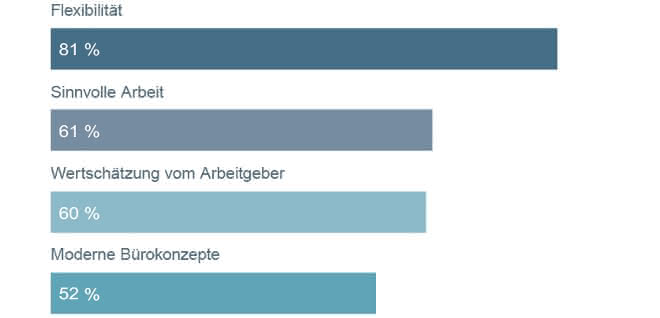
A recent study by Inform with 172 participants from the logistics sector confirms that companies are aware of this change and are already responding to it. Around 82% of those surveyed believe that their workplace is being influenced by the digital transformation. 86% also confirmed that their company is already implementing measures such as working from home, flexible working hours and flat hierarchies. Nevertheless, there are still deficits in implementation.
Management Main initiator of flexible working models
In 68% of cases, the modernization of working models is initiated by top management, but in almost a third of cases it is also initiated by employees themselves. Those surveyed see the implementation of modern working models as an opportunity to work more agilely and efficiently. The fact that this point has not yet been reached is shown by the great desire for more flexibility (81%) and meaningful work (61%).
Automation of routine activities desired
IT plays a central role in this area: around 93% of respondents believe that choosing the right software to support operational work is the be-all and end-all. Above all, employees benefit from the automation of routine activities. Peter Frerichs, Head of the Inventory & Supply Chain division at INFORM GmbH and spokesperson for the study, also views this positively: "In our projects, we often experience a real 'sigh of relief' among employees when the new inventory management software takes over a large part of the work independently, because it involves routine orders from suppliers, for example. Our customers appreciate the use of IT when they can deal with strategic issues or finally have more freedom to maintain supplier relationships."
Feasibility depends on the business unit
However, the participants in the survey do not believe that a more flexible working environment can be implemented in every area: "The survey confirmed that alternative concepts are easy to implement and accepted wherever knowledge work is carried out that is not location-dependent," says Dr. Jörg Herbers, Head of Workforce Management at Inform GmbH. "In areas such as production or warehousing, implementation is more difficult, as work is often carried out in shift models and personal presence is essential," he explains.
According to Frerichs, the relevance of the topic is set to increase even further in the future: "More and more areas will not be able to avoid digitalization and modernization of work concepts. Using the right IT and software systems here can be an important support for companies and increase competitiveness as well as employee satisfaction."


You might also be interested in
Arvato Takes Over European Logistics for Mister Spex
Starting September 1, 2026, Arvato will take over key logistics and fulfillment processes for Mister Spex in five European countries. The partnership is intended to create a scalable supply chain and support the continued growth of the omnichannel...
 read more...
New Logistics Hub for Panasonic HVAC in Europe
NOSTA Logistics is expanding Ladbergen into a European logistics hub for Panasonic HVAC. To this end, the full-service logistics provider is making 12,000 square meters of space available, where air conditioning, ventilation, and heat pump...
read more...TGW Automates Intersport Distribution Center
Intersport France has launched a new, highly automated distribution center in Saint-Vulbas, near Lyon. The facility, built by TGW Logistics, is designed to support the sporting goods retailer’s growth, smooth out seasonal peaks, and make store...
read more...Major project in the Korean retail sector
Knapp builds Korea's largest shuttle system
Together with Knapp and Doosan Logistics Solutions, Asung Daiso is building a new highly automated omnichannel logistics center in Yangju, South Korea. The facility is the largest shuttle system ever built by Knapp in South Korea.
read more...Kion gets off to a strong start in 2026
Significant increase in incoming orders
The intralogistics company Kion Group records a significant increase in order intake in the first quarter of 2026 and increases profitability and cash flow despite geopolitical uncertainties.
read more...Jungheinrich implements automation for...
Fully automated large warehouse launched in Páty
Gebrüder Weiss has put an automated warehouse into operation in Hungary, largely replacing manual processes. The new logistics center near Budapest increases efficiency, capacity and sustainability and at the same time responds to increasing demands...
read more...Integration of a robotics solution
Lyreco modernizes logistics center in France
Lyreco is pressing ahead with the automation of its central site in Villaines-la-Juhel with an investment volume of over 25 million euros.
read more...Unitechnik modernizes Hela logistics
Retrofit and new build closely linked
Hela Gewürzwerk Hermann Laue has laid the foundations for further growth at its Ahrensburg site by comprehensively modernizing its logistics. Together with Unitechnik Systems, a logistics center was created that combines new and existing structures.
read more...Fiege builds new logistics center in Hesse
The Fiege Group began construction work on its new logistics center in Hessisch Lichtenau in October. The property, which is scheduled for completion in autumn 2026, will have almost 52,000 square meters of logistics space spread across five bays as...
read more...