
Feasibility study
Micro-depots in cities: Less congestion, faster delivery?
Urban infrastructures are overloaded in many places, and delivery traffic is playing its part, driven by growing online trade. Micro-depots could counteract this. In a feasibility study, the Fraunhofer Institute for Material Flow and Logistics IML and agiplan GmbH have investigated how these could be implemented in the future.
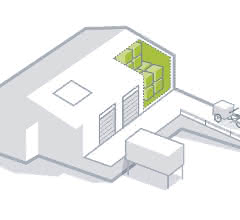
Micro-depots are intended to serve as a common logistics base for all CEP service providers. From there, they can cover the last mile to the customer with small delivery vehicles such as cargo bikes. This should avoid traffic jams and enable faster deliveries. Fraunhofer IML and agiplan have conducted a study using the cities of Mönchengladbach, Neuss and Krefeld as examples to investigate whether and how these depots can be implemented.
Reducing traffic volume and congestion
The study was commissioned by the Chamber of Industry and Commerce (IHK) Mittlerer Niederrhein. The Ministry of Transport of the state of North Rhine-Westphalia provided financial support for the project. According to the authors, micro-depot vehicles - i.e. cargo bikes, small vehicles or transport aids such as sack trucks - can reduce the problems caused by high traffic volumes: firstly, there would be fewer traffic jams caused by vehicles parked in the "second row", and secondly, the emission-free bikes or sack trucks would contribute to climate protection. Although traditional delivery vehicles could not be completely replaced in practice, CEP service providers could significantly increase their efficiency with micro-depots, enabling companies to make same-day deliveries.
Sustainable and fit for the future
"Micro-depots have the potential to contribute to less truck traffic and reduced emissions in city centers. With our study, we have laid the foundations for supporting local authorities in their transport policy decisions. This enables them to equalize inner-city traffic and thus make it more sustainable and future-proof," emphasizes Prof. Uwe Clausen, Institute Director at Fraunhofer IML.


You might also be interested in
Arvato Takes Over European Logistics for Mister Spex
Starting September 1, 2026, Arvato will take over key logistics and fulfillment processes for Mister Spex in five European countries. The partnership is intended to create a scalable supply chain and support the continued growth of the omnichannel...
 read more...
New Logistics Hub for Panasonic HVAC in Europe
NOSTA Logistics is expanding Ladbergen into a European logistics hub for Panasonic HVAC. To this end, the full-service logistics provider is making 12,000 square meters of space available, where air conditioning, ventilation, and heat pump...
read more...TGW Automates Intersport Distribution Center
Intersport France has launched a new, highly automated distribution center in Saint-Vulbas, near Lyon. The facility, built by TGW Logistics, is designed to support the sporting goods retailer’s growth, smooth out seasonal peaks, and make store...
read more...Major project in the Korean retail sector
Knapp builds Korea's largest shuttle system
Together with Knapp and Doosan Logistics Solutions, Asung Daiso is building a new highly automated omnichannel logistics center in Yangju, South Korea. The facility is the largest shuttle system ever built by Knapp in South Korea.
read more...Kion gets off to a strong start in 2026
Significant increase in incoming orders
The intralogistics company Kion Group records a significant increase in order intake in the first quarter of 2026 and increases profitability and cash flow despite geopolitical uncertainties.
read more...Jungheinrich implements automation for...
Fully automated large warehouse launched in Páty
Gebrüder Weiss has put an automated warehouse into operation in Hungary, largely replacing manual processes. The new logistics center near Budapest increases efficiency, capacity and sustainability and at the same time responds to increasing demands...
read more...Integration of a robotics solution
Lyreco modernizes logistics center in France
Lyreco is pressing ahead with the automation of its central site in Villaines-la-Juhel with an investment volume of over 25 million euros.
read more...Unitechnik modernizes Hela logistics
Retrofit and new build closely linked
Hela Gewürzwerk Hermann Laue has laid the foundations for further growth at its Ahrensburg site by comprehensively modernizing its logistics. Together with Unitechnik Systems, a logistics center was created that combines new and existing structures.
read more...Fiege builds new logistics center in Hesse
The Fiege Group began construction work on its new logistics center in Hessisch Lichtenau in October. The property, which is scheduled for completion in autumn 2026, will have almost 52,000 square meters of logistics space spread across five bays as...
read more...