
Ten-year contract
Major order: DB Cargo invests for steel giant ArcelorMittal
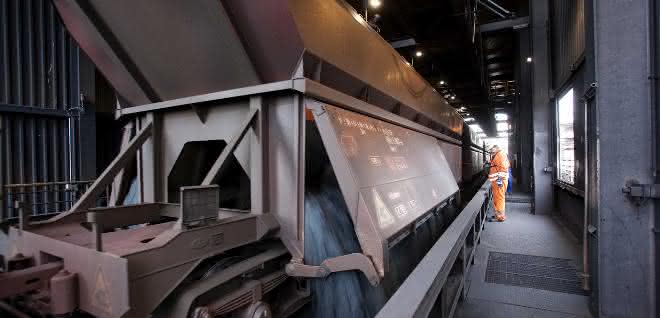
DB Cargo concludes a ten-year contract with ArcelorMittal, the world's largest steel manufacturer and Europe's largest steel producer, to supply the blast furnace in Eisenhüttenstadt. DB Cargo is thus securing the supply of raw materials for one of Germany's largest steel locations until 2031.
DB Cargo is investing in cutting-edge logistics for its customer: the rail freight operator is purchasing 352 multifunctional double wagons with a total of 1,408 special containers for the transport of ore, coke and limestone by next summer. The logistics provider Innofreight has designed them specifically for transporting these raw materials and optimized their loading volume. DB Cargo is also having its partner build two semi-automated unloading facilities at the Eisenhüttenstadt plant by summer 2021 and will operate them itself. The new transports will start immediately afterwards. A total of up to 4.2 million tons of raw materials can then be transported annually.
"As the backbone of the German economy, we have been supplying ArcelorMittal with raw materials for many years and transporting the steel produced to customers, particularly for the automotive industry and plant construction. We are now investing a lot of money in this long-standing and proven collaboration: our new wagons for ArcelorMittal are characterized by a durable substructure, while the removable superstructure is flexibly designed for frequent replacement. The highlight: we can adapt the superstructure individually to changing requirements," explains Pierre Timmermans, Member of the DB Cargo Management Board responsible for Sales.
"ArcelorMittal Eisenhüttenstadt is implementing one of the most modern raw materials logistics systems in Europe here," says Sybille Klipstein, Lead Buyer Rail at ArcelorMittal. "By using special container types optimized for the different properties of ore, coke and limestone, we can increase the net load per train by around 20 percent and therefore require significantly fewer trains. This protects the environment and reduces our shunting effort at the plant. In addition, automated unloading offers employees a low-dust and noise-protected workplace. We are thus setting new standards in terms of efficiency, environmental protection and occupational safety."


You might also be interested in
Arvato Takes Over European Logistics for Mister Spex
Starting September 1, 2026, Arvato will take over key logistics and fulfillment processes for Mister Spex in five European countries. The partnership is intended to create a scalable supply chain and support the continued growth of the omnichannel...
 read more...
New Logistics Hub for Panasonic HVAC in Europe
NOSTA Logistics is expanding Ladbergen into a European logistics hub for Panasonic HVAC. To this end, the full-service logistics provider is making 12,000 square meters of space available, where air conditioning, ventilation, and heat pump...
read more...TGW Automates Intersport Distribution Center
Intersport France has launched a new, highly automated distribution center in Saint-Vulbas, near Lyon. The facility, built by TGW Logistics, is designed to support the sporting goods retailer’s growth, smooth out seasonal peaks, and make store...
read more...Major project in the Korean retail sector
Knapp builds Korea's largest shuttle system
Together with Knapp and Doosan Logistics Solutions, Asung Daiso is building a new highly automated omnichannel logistics center in Yangju, South Korea. The facility is the largest shuttle system ever built by Knapp in South Korea.
read more...Kion gets off to a strong start in 2026
Significant increase in incoming orders
The intralogistics company Kion Group records a significant increase in order intake in the first quarter of 2026 and increases profitability and cash flow despite geopolitical uncertainties.
read more...Jungheinrich implements automation for...
Fully automated large warehouse launched in Páty
Gebrüder Weiss has put an automated warehouse into operation in Hungary, largely replacing manual processes. The new logistics center near Budapest increases efficiency, capacity and sustainability and at the same time responds to increasing demands...
read more...Integration of a robotics solution
Lyreco modernizes logistics center in France
Lyreco is pressing ahead with the automation of its central site in Villaines-la-Juhel with an investment volume of over 25 million euros.
read more...Unitechnik modernizes Hela logistics
Retrofit and new build closely linked
Hela Gewürzwerk Hermann Laue has laid the foundations for further growth at its Ahrensburg site by comprehensively modernizing its logistics. Together with Unitechnik Systems, a logistics center was created that combines new and existing structures.
read more...Fiege builds new logistics center in Hesse
The Fiege Group began construction work on its new logistics center in Hessisch Lichtenau in October. The property, which is scheduled for completion in autumn 2026, will have almost 52,000 square meters of logistics space spread across five bays as...
read more...