
Logistics service providers
Innovation management: Smart glasses tested for 100 days
Rear-view mirrors, door handles, steering wheels - BLG Logistics packs these and other car parts in one of its Bremen logistics centers. For 100 days, data glasses accompanied the employees in their work, the first use of such "smart glasses" in the company. BLG Logistics has been testing ideas like these for 20 months in its 100-day projects.
BLG Logistics manages 300,000 square meters of warehouse space in Bremen for car parts logistics alone. Every year, over 40,000 containers are filled with vehicle parts and delivered just-in-time to the plants in Asia, America and Africa. "Puzzling" is the name given to the development of packaging solutions in this operational business. In addition to cost-optimized packaging and optimal handling, ensuring the quality of the parts is the top priority in this work," explains Jakub Piotrowski, Head of Innovation Management at BLG. Detailed instructions show how the various parts should be packed, how many and how they should be arranged in a package - previously as a page-long explanation on paper. When employees have been preparing for their shift in recent months, data glasses have been part of their work equipment. They show step-by-step instructions on how to pack correctly. "In the first phase of the project, the individual steps can be navigated forwards and backwards through the work instructions by tapping on the glasses," explains Piotrowski. "On the one hand, employees have their hands free for packing, and on the other hand, the use of smart glasses also reduces the training time for new employees. This is because they are guided step by step through their work."
100 days from the idea to deployment
BLG Logistics tests ideas like these in its 100-day projects - there are only 100 days from the idea to its actual implementation. But how do ideas come about and, above all, what happens to them in the company? "The decisive factor is not so much the trigger, but rather what happens to the idea later," emphasizes Jakub Piotrowski. "Because only when ideas are channeled, evaluated and made feasible can a company benefit from them - and an idea can become an innovation."
At BLG Logistics, too, ideas are generated throughout the company, but the five-person BLG innovation team is a linchpin. "Until now, innovation has largely been decentralized," says Piotrowski. "In a company as large as BLG, with so many business areas and locations, good ideas should benefit everyone." This is why the innovation team meets every week. Beforehand, the innovation community, made up of representatives from BLG's business and specialist departments, has already taken a look at the ideas. The innovation team then examines the proposals in detail. Promising technologies are then quickly tested as trial models. "We are very strict about this, 100 days and not a day more," assures Piotrowski. The reason: "With digital topics, the speed of implementation plays an important role - what use is the best idea if it is outdated?"

"The speed of implementation plays an important role in digital topics - what good is the best idea if it is outdated?"Jakub Piotrowski Head of Innovation Management BLG Logistics
Cooperation with start-ups
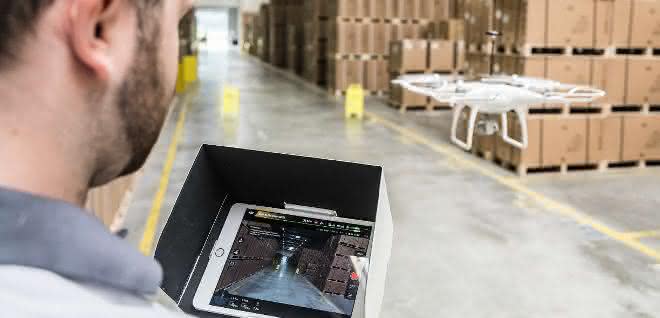
The use of drones for operational support shows how an idea became an innovation at BLG. Since 2016, drones have been supporting inventory and weekly shelf checks at the BLG Emmerich logistics center during the year. Previously, in the block storage area, where there is constant movement, a forklift had to move the boxes apart and set the pallets down. An employee then drove up with a pallet truck to check a box - an effort that has been reduced by using a drone. Four employees were trained as drone pilots. This project was also the first in which BLG worked closely with a start-up, the flying robot start-up "Sitebots". "This cooperation is very important to us," says Piotrowski. "In order for us to be creative, we need certain prerequisites such as openness, curiosity and unconventionality. Young companies are naturally predestined for this."
Paperless transportation
In addition to the 100-day projects, BLG Logistics is also working on other logistics solutions using digital technologies If an idea seems promising, the BLG team sets up a research project, as was the case with "
- Paperless transportation". Piotrowski: "A truck transport can take quite a long time. But the distance is not the main problem. What costs time and nerves above all are the complex formalities that all parties involved have to deal with." Together with Daimler Trucks, BLG Logistics has developed a cloud-based platform that displays all order data in real time. This means that everyone involved always has access to the current status via an app.
100-day projects
With the help of a 3D printer in the Bremen training workshop, the apprentices can bring drawings and models to life. Printing spare parts is another possible application. BLG is also developing an exoskeleton together with the German Institute for AI and Youse GmbH. In addition to the research project, there is also a 100-day project.
Further research projects
The "Isabella" project is developing IT tools for planning and controlling the BLG AutoTerminal Bremerhaven. IRiS" is a prototype for the automatic unloading of cardboard boxes from containers and swap bodies. The "Kali" team is working on using exoskeletons to reduce the workload of employees. "Isabella", "IRiS" and "Kali" are funded by the German Federal Ministry of Transport and Digital Infrastructure (BMVI).


You might also be interested in
Industrial trucks for luxury cars
Optimized logistics for super sports cars
Automobili Lamborghini manufactures exclusive luxury and super sports cars. Founded in 1963 by Ferruccio Lamborghini, the company is still based at its traditional headquarters in Sant'Agata Bolognese.
 read more...
Explosion-proof forklift trucks for production and warehouses
Sherwin-Williams (legal entity Inver) from Dresden produces industrial coatings for various industries. In order to create a safe working environment, the company has purchased a fleet of Linde explosion-proof forklift trucks. The industrial trucks...
read more...High-voltage forklift trucks for all weather conditions
EP Equipment presented the EFL 10T high-voltage forklift truck at the IFOY Award 2025 Test Camp in Dortmund. The EFL-HV series, including the EFL 10T, is designed to combine the performance of traditional combustion engine equipment with the modern...
read more...Hub for spare parts: KION Regional Distribution Center Central Europe opened
In order to further shorten delivery times and ensure delivery availability of almost 100 percent in the future, Linde Material Handling has built a new, larger spare parts distribution center equipped with modern technology at its existing site in...
read more...Spare parts efficiently brought to the track
The distribution center and spare parts warehouse of an automotive manufacturer in Wallersdorf, which opened in 2016, covers an area of around 235,000 square meters. Customers all over the world are supplied with spare parts and accessories from...
read more...Flexible for indoors and outdoors: New Toyota MH series
Toyota Material Handling has launched the latest generation of its electric counterbalance trucks - the Toyota Traigo48 series. This is intended to impress in terms of performance and design as well as with a comprehensive package of functions.
read more...Hubtex Group takes over Genkinger GmbH
The Hubtex Group has acquired 100 percent of the shares in Genkinger GmbH, based in Münsingen. The aim of this acquisition is to further strengthen the individual brands internationally and to utilize synergies across locations.
read more...Still invests in Hamburg headquarters: 50 million euros for new mechatronics center
On February 19, intralogistics expert Still and Mercurius Industrial Properties officially broke ground for the Still "Centre of Competence Mechatronics" in Hamburg. Still has also announced further site developments in the Hanseatic city: The...
read more...Lift trucks, stackers and order pickers from a single source
Colorbaby distributes toys, outdoor leisure products and household goods from its warehouse in Ibi, Alicante, Spain. The company previously used a fleet of industrial trucks from various manufacturers. After more than five years of good experience...
read more...