
Test of Mercedes-Benz Vans, DPD and what3words
Addressing solution makes parcel delivery 15 percent more efficient
The 15 percent increase in efficiency for the driver when using what3words compared to a conventional navigation system with a street address was impressive.
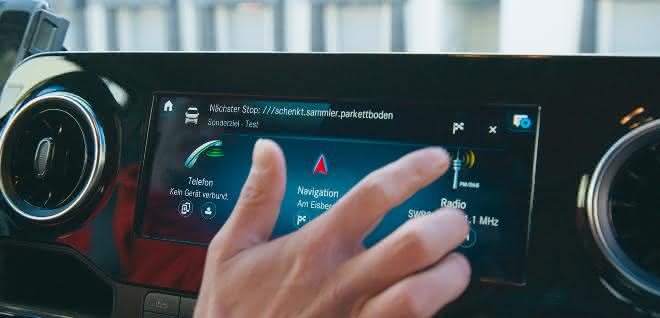
Stuttgart. Two experienced DPD parcel delivery drivers, two almost identical Mercedes-Benz Sprinter vans and what3words teamed up for a special logistics efficiency test in Nagold, Germany. This test was not about acceleration, optimum cornering or engine performance. Instead, the aim was to find out whether the what3words location information system integrated into the Mercedes-Benz Sprinter's on-board navigation system could increase efficiency in parcel delivery. The test area covered the entire city and comprised around 50 deliveries. The 15 percent increase in efficiency for the driver when using what3words compared to a conventional navigation system with a street address was impressive.
what3words is an innovative and very simple way to identify precise locations, anywhere in the world. what3Words has divided the world into 3m squares and assigned a simple and unique address for each square, consisting of three words from the dictionary. This includes places where no regular street addresses exist, such as large industrial areas. In 2017, Mercedes-Benz was the first car manufacturer in the world to integrate the ability to search and navigate to what3words addresses into its in-vehicle MBUX system.
"We are constantly looking for new ways and means to support our drivers in their tasks and increase the efficiency of our processes," says Thomas Steverding, Senior Group Manager, OPS Process and Development at DPD Germany. "When we found out about what3words, we wanted to find out whether we could benefit from a more precise localization of delivery destinations with the 3-word address."
Mercedes-Benz Vans, DPD and the British start-up what3words carried out the test to find out what efficiency gains could be achieved by using the integrated navigation to what3words addresses found in Mercedes-Benz Sprinter vehicles. The test also included the ability to send what3words locations to the vehicle remotely via push notification, a feature currently under development.
Chris Sheldrick, co-founder and CEO of what3words, explained that "street addresses for large sites such as factories or exhibition halls rarely point to the delivery entrance, so drivers waste time searching for the correct drop-off points. This is frustrating for drivers and leads to time and fuel inefficiencies for the business, as well as a poor experience for customers who may miss or receive late deliveries. The precise addressing system from what3words helps logistics drivers who are unfamiliar with their delivery area to reduce the time they spend searching for the exact delivery points. And in this particular test, they were also assigned the exact parking space near the delivery entrance, which is really crucial for last mile deliveries made on foot."
The test
The test was carried out with two identical Mercedes-Benz Sprinters, both equipped with MBUX. In one of them, the navigation was programmed with predefined what3words addresses for parking lots and delivery entrances as a test. Both vans were loaded with 50 parcels and driven by professional DPD parcel delivery drivers who were unfamiliar with the area. Both drivers used the same delivery order based on a real, historical route from DPD. The route included inner city and industrial areas, and the drop-off points on the route were a combination of 55% B2B customers and 45% B2C customers. The routes were driven under everyday conditions in the Nagold delivery area and started at the usual time. Both drivers adhered to traffic regulations at all times.
In logistics, parcel delivery routes consist of two elements: the driving distance between delivery locations and the distance the driver walks to bring the parcels directly to the recipient - a key factor in the overall route. These two elements can be made more efficient by using predefined parking positions to guide the driver as close as possible to the final delivery location.
what3words helps the driver by providing clear and precise predefined stopping points for the van, ensuring that the driver parks more strategically and walking distances are shortened. The integration of what3words into the MBUX system ensures that the driver does not need any additional navigation equipment and the data is seamlessly linked to the navigation.
The result
The test with what3words resulted in an efficiency gain of around 15 percent. The driver with what3words was able to complete his route more than 30 minutes before his colleague who used a navigation system with conventional addresses.
The test showed that 80% of the efficiency gain resulted from providing the what3words address for the optimal parking space. This reduced the travel time and the time spent searching for a parking space. The remaining 20% of the efficiency gain came from having a what3words address for the exact drop-off point, which reduced the driver's walking time.
"The test has shown that the system is a great improvement, especially for new drivers and those who have to work in an unfamiliar delivery area. It also takes a lot of stress off the driver and makes his work much easier. At a time when the number of parcels is constantly increasing, this gives us a clear competitive advantage," says Steffen Raiber, Manager Industry Management CEP & Logistics at Mercedes-Benz Vans.


You might also be interested in
Arvato Takes Over European Logistics for Mister Spex
Starting September 1, 2026, Arvato will take over key logistics and fulfillment processes for Mister Spex in five European countries. The partnership is intended to create a scalable supply chain and support the continued growth of the omnichannel...
 read more...
New Logistics Hub for Panasonic HVAC in Europe
NOSTA Logistics is expanding Ladbergen into a European logistics hub for Panasonic HVAC. To this end, the full-service logistics provider is making 12,000 square meters of space available, where air conditioning, ventilation, and heat pump...
read more...TGW Automates Intersport Distribution Center
Intersport France has launched a new, highly automated distribution center in Saint-Vulbas, near Lyon. The facility, built by TGW Logistics, is designed to support the sporting goods retailer’s growth, smooth out seasonal peaks, and make store...
read more...Major project in the Korean retail sector
Knapp builds Korea's largest shuttle system
Together with Knapp and Doosan Logistics Solutions, Asung Daiso is building a new highly automated omnichannel logistics center in Yangju, South Korea. The facility is the largest shuttle system ever built by Knapp in South Korea.
read more...Kion gets off to a strong start in 2026
Significant increase in incoming orders
The intralogistics company Kion Group records a significant increase in order intake in the first quarter of 2026 and increases profitability and cash flow despite geopolitical uncertainties.
read more...Jungheinrich implements automation for...
Fully automated large warehouse launched in Páty
Gebrüder Weiss has put an automated warehouse into operation in Hungary, largely replacing manual processes. The new logistics center near Budapest increases efficiency, capacity and sustainability and at the same time responds to increasing demands...
read more...Integration of a robotics solution
Lyreco modernizes logistics center in France
Lyreco is pressing ahead with the automation of its central site in Villaines-la-Juhel with an investment volume of over 25 million euros.
read more...Unitechnik modernizes Hela logistics
Retrofit and new build closely linked
Hela Gewürzwerk Hermann Laue has laid the foundations for further growth at its Ahrensburg site by comprehensively modernizing its logistics. Together with Unitechnik Systems, a logistics center was created that combines new and existing structures.
read more...Fiege builds new logistics center in Hesse
The Fiege Group began construction work on its new logistics center in Hessisch Lichtenau in October. The property, which is scheduled for completion in autumn 2026, will have almost 52,000 square meters of logistics space spread across five bays as...
read more...