
First model of a new generation
Yale introduces counterbalanced truck with integrated lithium-ion battery
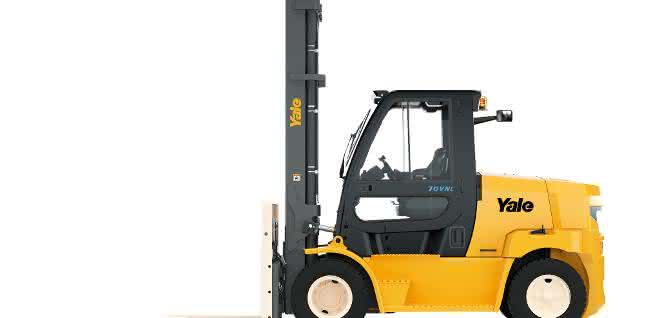
"Our aim at Yale is to develop industry-leading trucks that offer our customers excellent productivity, ergonomic design and low cost of ownership. The ERP70-90VNL is the first in a new range of high performance electric trucks for demanding applications," says Ivor Wilkinson, Solutions Manager at Yale.
The truck can be used in three-shift operation thanks to its fast intermediate charging capability. The truck can be recharged during regular work breaks, eliminating the need to change the battery. To maximize the efficiency of the application, the charging infrastructure can be installed near break rooms. The battery can be recharged from a fully discharged state in just 80 minutes.
"Customers who work in multi-shift operations will find that the purchase costs for forklifts with lithium-ion batteries pay for themselves in less than two years. This makes the truck a viable option for customers for whom low running costs are important," says Wilkinson.
"We have a wide range of attachments for the ERP70-90VNL that enable it to transport bricks and building blocks, engineered timber, building materials and metals," explains Wilkinson.
The Yale Continuous Stability Enhancement enables the ERP70-90VNL counterbalance truck to travel over uneven surfaces and assists the transition between indoor and outdoor use. The mast design allows the operator to see through the mast. "The lift and drive systems are completely independent of each other, so there is no loss of performance when lifting and moving loads at the same time," says Wilkinson.
"For customers looking for sustainable options for their fleet, the ERP70-90VNL is a good choice in terms of performance, comfort, running costs and zero emissions. In these industries, battery-powered equipment may never have been considered before because of the perception that it could not deliver high productivity. However, the ERP70-90VNL can even work in three shifts without losing productivity thanks to the possibility of intermediate charging. Customers can rely on this truck - even in the most demanding applications," concludes Wilkinson.


You might also be interested in
Industrial trucks for luxury cars
Optimized logistics for super sports cars
Automobili Lamborghini manufactures exclusive luxury and super sports cars. Founded in 1963 by Ferruccio Lamborghini, the company is still based at its traditional headquarters in Sant'Agata Bolognese.
 read more...
Explosion-proof forklift trucks for production and warehouses
Sherwin-Williams (legal entity Inver) from Dresden produces industrial coatings for various industries. In order to create a safe working environment, the company has purchased a fleet of Linde explosion-proof forklift trucks. The industrial trucks...
read more...High-voltage forklift trucks for all weather conditions
EP Equipment presented the EFL 10T high-voltage forklift truck at the IFOY Award 2025 Test Camp in Dortmund. The EFL-HV series, including the EFL 10T, is designed to combine the performance of traditional combustion engine equipment with the modern...
read more...Hub for spare parts: KION Regional Distribution Center Central Europe opened
In order to further shorten delivery times and ensure delivery availability of almost 100 percent in the future, Linde Material Handling has built a new, larger spare parts distribution center equipped with modern technology at its existing site in...
read more...Spare parts efficiently brought to the track
The distribution center and spare parts warehouse of an automotive manufacturer in Wallersdorf, which opened in 2016, covers an area of around 235,000 square meters. Customers all over the world are supplied with spare parts and accessories from...
read more...Flexible for indoors and outdoors: New Toyota MH series
Toyota Material Handling has launched the latest generation of its electric counterbalance trucks - the Toyota Traigo48 series. This is intended to impress in terms of performance and design as well as with a comprehensive package of functions.
read more...Hubtex Group takes over Genkinger GmbH
The Hubtex Group has acquired 100 percent of the shares in Genkinger GmbH, based in Münsingen. The aim of this acquisition is to further strengthen the individual brands internationally and to utilize synergies across locations.
read more...Still invests in Hamburg headquarters: 50 million euros for new mechatronics center
On February 19, intralogistics expert Still and Mercurius Industrial Properties officially broke ground for the Still "Centre of Competence Mechatronics" in Hamburg. Still has also announced further site developments in the Hanseatic city: The...
read more...Lift trucks, stackers and order pickers from a single source
Colorbaby distributes toys, outdoor leisure products and household goods from its warehouse in Ibi, Alicante, Spain. The company previously used a fleet of industrial trucks from various manufacturers. After more than five years of good experience...
read more...