
"Revolution meets evolution"
World premiere for Linde Roadster with fuel cell drive
Linde Material Handling says it has set new standards for industrial trucks with its Roadster concept. The company is now adding a model with a fuel cell drive to the range.
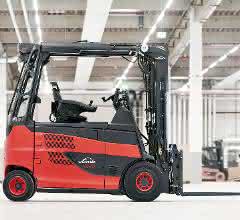
It is one of the crucial questions in goods handling: Which drive technology is best suited to the operating conditions of the forklift fleet? When answering this question, fleet managers need to consider a whole range of factors: are the forklifts used indoors or outdoors, do they work in single or multi-shift systems, what type of goods need to be moved, what is the local infrastructure like - and which drive type is best for the total cost of ownership? "Our customers are looking for economical energy solutions whosecarbon footprint is increasingly playing a decisive role," says Markus Weinberger, International Product Manager Energy Solutions at Linde Material Handling. "Our sales consultants draw from a very wide range of possible energy solutions: from electric drives with lead-acid or lithium-ion batteries to fuel cell devices and internal combustion engine drives with diesel, LPG or natural gas as fuel. The best solution always depends on the conditions on site."
Linde Material Handling has been working on the development of series-ready industrial trucks with fuel cells for two decades. "In 1997, we were the first to focus intensively on this promising technology and put the first trucks into series production in 2010," says Weinberger. "Today, the Linde brand has the largest range of industrial trucks with fuel cell drives on the market. Around 80 percent of all models can be ordered with this promising energy variant. These include low-platform trucks, tow tractors or reach trucks as well as counterbalance trucks, including the Roadster model."
Cleverly combined
With the Linde Roadster, a forklift truck meets a drive concept: thanks to its vehicle layout, it ensures a good view of the route and load. The elimination of the usual A-pillar, which could be dispensed with thanks to the power detour via overhead tilt cylinders and the overhead guard frame, contributes significantly to this. The Roadster versions of the Linde E20 to E35 electric forklift trucks therefore score particularly well in logistics and industrial plants with heavy passenger traffic. The operator can also perform precision work such as storing in containers more easily thanks to the significantly larger field of vision.
"Because the Roadster really comes into its own indoors, the combination with fuel cell technology seemed ideal to us," says Linde expert Weinberger, explaining the expansion of the portfolio. After all, the energy system does not produce any emissions during operation. Energy is generated through the chemical reaction of oxygen and hydrogen. The electricity generated in this way feeds a lithium-ion battery, which in turn supplies the traction and lifting motors; at the same time, the accumulator serves as a buffer for recovered braking energy and as a "power reserve" during power peaks. The only by-products of the process are heat and pure water. The latter is pumped out when refueling with hydrogen.
Keyword refueling: this is where the strength of fuel cell technology is revealed: a complete refueling process takes just three minutes. This ensures availability - especially in tough multi-shift operations, where the energy system also impresses with its continuous power output. As the simple, quick and clean refueling process makes battery changes obsolete, this makes the fuel cell Roadster ideal for use in hygiene-critical sectors such as the pharmaceutical or food industry.
Of course, the economic efficiency factor also plays a decisive role. Linde expert Markus Weinberger: "Our investigations and practical tests show that fuel cell systems can be economically viable from a deployment of around 20 vehicles. If the company already has its own hydrogen infrastructure, as hydrogen is needed in production anyway, the concept becomes even more economically attractive." There is also a whole range of ecological benefits, from the comparatively long service life of a fuel cell of around 10,000 operating hours to theCO2 savings if the hydrogen produced comes from renewable sources such as biogas or electrolysis using solar and/or wind energy.


You might also be interested in
Industrial trucks for luxury cars
Optimized logistics for super sports cars
Automobili Lamborghini manufactures exclusive luxury and super sports cars. Founded in 1963 by Ferruccio Lamborghini, the company is still based at its traditional headquarters in Sant'Agata Bolognese.
 read more...
Explosion-proof forklift trucks for production and warehouses
Sherwin-Williams (legal entity Inver) from Dresden produces industrial coatings for various industries. In order to create a safe working environment, the company has purchased a fleet of Linde explosion-proof forklift trucks. The industrial trucks...
read more...High-voltage forklift trucks for all weather conditions
EP Equipment presented the EFL 10T high-voltage forklift truck at the IFOY Award 2025 Test Camp in Dortmund. The EFL-HV series, including the EFL 10T, is designed to combine the performance of traditional combustion engine equipment with the modern...
read more...Hub for spare parts: KION Regional Distribution Center Central Europe opened
In order to further shorten delivery times and ensure delivery availability of almost 100 percent in the future, Linde Material Handling has built a new, larger spare parts distribution center equipped with modern technology at its existing site in...
read more...Spare parts efficiently brought to the track
The distribution center and spare parts warehouse of an automotive manufacturer in Wallersdorf, which opened in 2016, covers an area of around 235,000 square meters. Customers all over the world are supplied with spare parts and accessories from...
read more...Flexible for indoors and outdoors: New Toyota MH series
Toyota Material Handling has launched the latest generation of its electric counterbalance trucks - the Toyota Traigo48 series. This is intended to impress in terms of performance and design as well as with a comprehensive package of functions.
read more...Hubtex Group takes over Genkinger GmbH
The Hubtex Group has acquired 100 percent of the shares in Genkinger GmbH, based in Münsingen. The aim of this acquisition is to further strengthen the individual brands internationally and to utilize synergies across locations.
read more...Still invests in Hamburg headquarters: 50 million euros for new mechatronics center
On February 19, intralogistics expert Still and Mercurius Industrial Properties officially broke ground for the Still "Centre of Competence Mechatronics" in Hamburg. Still has also announced further site developments in the Hanseatic city: The...
read more...Lift trucks, stackers and order pickers from a single source
Colorbaby distributes toys, outdoor leisure products and household goods from its warehouse in Ibi, Alicante, Spain. The company previously used a fleet of industrial trucks from various manufacturers. After more than five years of good experience...
read more...