
Still can now also do telecommunications
Fast data networks for intralogistics scenarios of the future
In order to participate in various research projects, develop new products and implement a smart factory, intralogistics provider Still has now set up its own 5G network at its Hamburg headquarters.
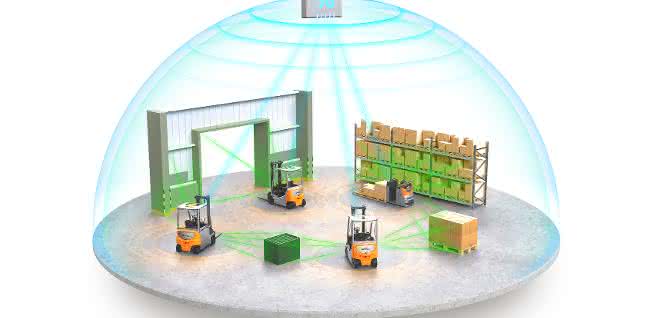
We are already encountering largely autonomous transport vehicles in production halls and warehouses. However, their capabilities still lag behind those of humans, as many processes still need to be learned and they are not intelligent in every respect. Many providers are striving to fill this gap and make their vehicles even more intelligent.
However, this expanded vision of autonomously driving transport vehicles can only be realized with very powerful mobile networks in order to move large amounts of data safely, promptly and efficiently. For this reason, intralogistics specialist Still has now installed its own 5G SA campus network at its company headquarters in Hamburg. "This once again underlines our willingness to innovate, as 5G is not yet widespread in the industry. On the one hand, this 5G network will help us to take autonomous logistics processes to a new level for our customers. To this end, we have already been involved in numerous international research projects for many years that deal with the idea of Industry 4.0. On the other hand, we will optimize our production with super-fast data transmission technology. In future, wireless production robots and people will be able to work together smoothly in the smart factory thanks to fast, wireless communication," says Ansgar Bergmann, Still specialist for data and networking, describing the most important reasons for installing the company's own 5G network.
5G offers various technological approaches
According to Ansgar Bergmann, the performance and reliability aspects of 5G are particularly interesting, as it is a licensed frequency spectrum for the user. "This is interesting, for example, in the area of indoor logistics when integrating driverless transport systems. The operator is better supported than was previously possible with WLAN. Entire AGV fleets can be coordinated in real time and the control and route data can be managed in the company's edge cloud," says the expert. Other potential applications include robotics, collaboration between machines and humans and imaging processes for environment recognition.
Numerous new scenarios conceivable
Industry 4.0 approaches will also receive a noticeable boost from 5G technology. This will optimize the move from traditional to fully automated systems, as Industry 4.0 is primarily based on data-based processes, and it is precisely these that are supported by 5G. All systems and products in the direction of automation, process transparency, pay per use, predictive maintenance or consulting will be further advanced by 5G.
Research projects for future logistics processes
Still wants to turn new visions for machine learning, for which this data transfer boost is expedient, into real technology soon. To this end, the Hamburg-based company is involved in numerous international research projects, such as the ARIBIC project. The aim is to make better use of data that driverless transport vehicles (AGVs) collect via their sensors and cameras during their journeys through the warehouse. For example, this creates a digital twin of the environment that processes relevant information in real time. "These processes generate enormous amounts of data that need to be transferred at a very high speed. Without our new 5G data network, some approaches are not even possible. Previous technologies are generally very susceptible to interference, which makes our work more difficult," says Ansgar Bergmann.
New CampusOS flagship project
Just a few weeks ago, at the beginning of 2022, the CampusOS project was launched, which will receive 18.1 million euros in funding from the Federal Ministry of Economics over the next three years. The aim is to build a modular ecosystem for open 5G campus networks based on open radio technologies and interoperable network components. This should help to strengthen the digital sovereignty of German companies. To this end, various scenarios are being evaluated by industrial project partners in regular operations. Still is one of them. The Hamburg-based technology company is testing and evaluating the low-latency and resilient control of vehicles and the transmission of videos at a very high data rate. Bergmann: "This will be the first test of our new 5G network and it will be benchmarked against other solutions. However, I am absolutely certain that our system will master this task with flying colors. It will also enable Still to expand its advisory function for customers in this technology area."


You might also be interested in
5G for smart intralogistics: Still presents findings
The CampusOS research project spent three years investigating the use of open 5G campus networks in industry. As a central industry partner, Still conducted practical tests to determine which network infrastructures are required for autonomous...
 read more...
Still invests in Hamburg headquarters: 50 million euros for new mechatronics center
On February 19, intralogistics expert Still and Mercurius Industrial Properties officially broke ground for the Still "Centre of Competence Mechatronics" in Hamburg. Still has also announced further site developments in the Hanseatic city: The...
read more...HTEC and Embotech Expand Autonomous Industrial Logistics
HTEC and Embotech aim to accelerate the adoption of autonomous driving solutions in industrial logistics. The strategic partnership is intended to facilitate the rollout to additional vehicle platforms, customer projects, and locations.
read more...KUKA Automates Material Handling at a TV Manufacturer
At TPV Displays Polska, 22 autonomous mobile robots from KUKA handle internal material transport. The solution is designed to stabilize production, reduce the workload on employees, and make the material flow more efficient.
read more...Standardized in design, flexible in use
Automated guided vehicles are increasingly in demand in production and logistics as they automate processes efficiently - but in addition to the vehicle, the right peripherals are also crucial for safe operation. A new solution consisting of a...
read more...Toyota MH introduces SSAB Zero steel for LHM230 hand pallet trucks
Toyota Material Handling Europe has reduced the CO₂ emissions of its Toyota LHM230 hand pallet truck "from the cradle to the factory gate" by 18 percent. This was made possible by using SSAB Zero steel for the forks and frame.
read more...Simulation gains in importance
The use of AGV and AMR systems continues to increase - at the same time, the complexity of planning and operation is growing. Traditional approaches quickly reach their limits.
read more...Smart automated material flow
Albert Eger digitizes its production supply with the AGV LEO flow from Bito-Lagertechnik. The solution automates material transportation even in tight spaces, increases process reliability and reduces the workload of employees.
read more...China's industry undergoing AI transformation
China has launched its 15th five-year plan and is positioning robotics as a central component of its modern industrial system. The aim is to transfer artificial intelligence more strongly into physical applications and thus boost economic growth.
read more...