
Prodrive Technologies relies on Jungheinrich
AMR and narrow-aisle forklift in combination
Prodrive Technologies has put a new, highly automated distribution center into operation in Son, not far from Eindhoven in the Netherlands. The company claims to be the first in the world to combine Jungheinrich's autonomous mobile robots with automated narrow-aisle trucks.
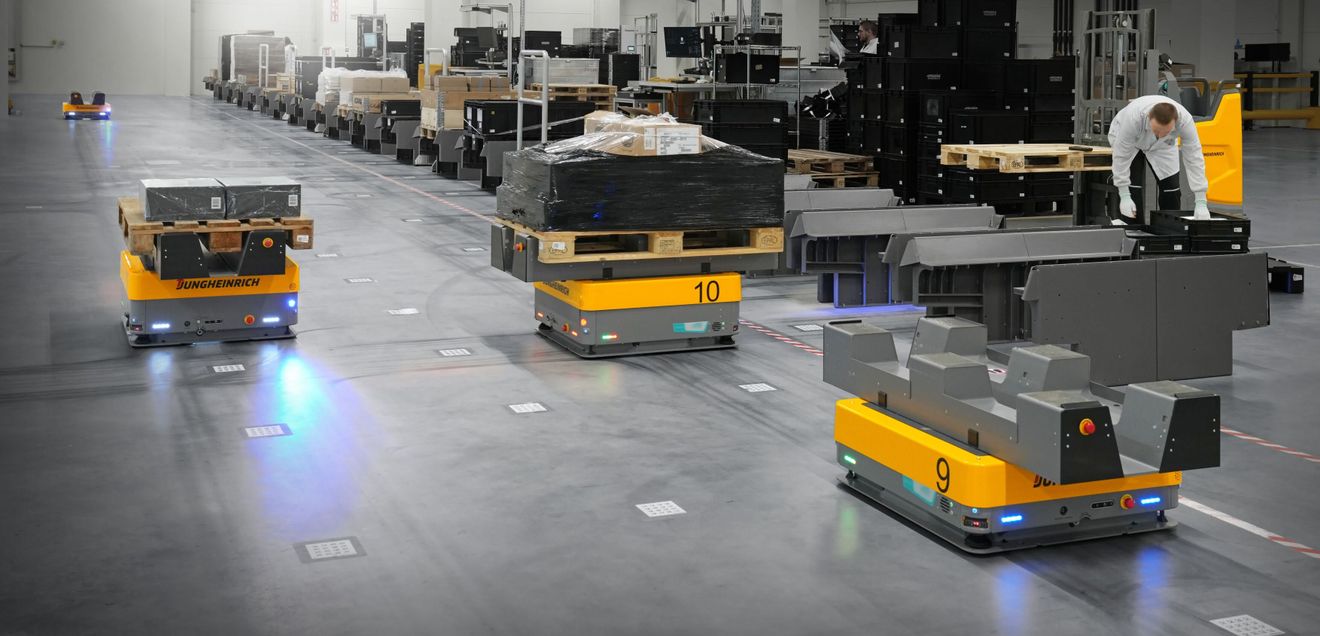
Prodrive Technologies produces a wide range of high-tech solutions, including for the medical, renewable energy, semiconductor and automotive sectors. For the production and assembly of its products, the company has subsidiaries in the United States, China and the Netherlands, among others, with the largest production facility located in Son. This is also the location of the company's headquarters and, since the beginning of 2022, a new distribution center (DC).
Significant growth as a challenge
This has an area of 20,000 square meters and was needed to cope with the massive growth of the company. Prodrive Technologies, which is in the top 10 of the Dutch manufacturing industry, is growing by around 25% annually. "To cope with this growth, we were using several external warehouses spread across multiple locations. With the realization of our new DC, we had the opportunity to improve logistical efficiency and take processes to the next level," says Mark Menting, Global Process Owner Logistics at Prodrive Technologies. The requirements were clear: the new logistics concept had to ensure high productivity and be able to flexibly handle the highly fluctuating logistics requirements. "We were also looking for a scalable solution that could grow with us," continues Menting. Prodrive Technologies found the right solution at Jungheinrich, which supplied a highly automated system with 15 Arculee S autonomous mobile robots (AMRs) and eight EKX 516a automated narrow-aisle trucks as the centerpiece.
Affordable, scalable and flexible
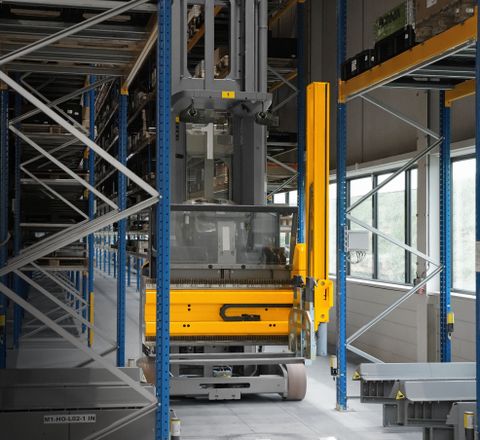
In addition to the automated VNA stackers, Prodrive also looked at shuttles and automated cranes. "The shuttles were quickly rejected because we have far too many different items for them," says Menting. Automated cranes were also out of the question. A shelved warehouse with a height of around 12 m would require so many cranes that the investment would simply be too high. "These narrow-aisle forklifts are cost-effective, scalable and more flexible," says Menting. Initially, eight automated VNA forklifts were delivered. If the business continues to grow, this number could be increased to 16.
Novel combination with AMRs
A unique feature is the combination with the AMRs, which handle transportation between the warehouse and picking station. The autonomous robots offer a flexible solution that can be easily adapted to changing requirements. "The AMRs are also compact, fast and relatively inexpensive," says Menting. "And they guarantee a high level of continuity. If we had opted for conveyor belts, we would have been more prone to errors. If one section failed, the whole system would come to a standstill. That's not the case with these AMRs."
Jungheinrich also supplied the racking and the software required for communication between the systems and with the upstream warehouse management system. The warehouse control system receives orders from the WMS. These are "translated" into comprehensible orders for the stacker cranes and VNAs via the Jungheinrich Logistic Interface.
AMR use in busy environments
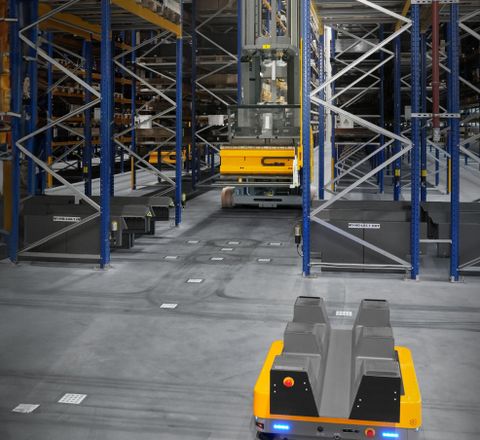
Incoming pallets are placed on a conveyor belt where, among other things, the contours and quality of the pallets are checked. An AMR then picks up the pallet and transports it to the high-bay warehouse. There, the goods are set down by the narrow-aisle stacker at the location assigned by the WMS. Each aisle has four set-down locations, two for incoming and two for outgoing pallets. The outgoing pallets are transported by the AMRs to one of six picking stations, where the orders are picked and prepared for further processing or dispatch. Each picking station has six pick-up/drop-off stations for this purpose. Thanks to various safety sensors, the AMRs can easily be used in environments where other forklifts and people are also working. To maximize productivity, Prodrive has opted to keep interaction between employees and the robots to a minimum. For the same reason, the automated high-bay warehouse is completely off-limits to employees.
The system offers a theoretical picking capacity of 80 pallets per hour. The theoretical capacity for the high-bay compartments is also 80 pallets per hour; 30 incoming pallets and 50 returning pallets from the picking stations.
The new concept has now been in operation for over a year. For Menting, the advantages are obvious: "This solution offers productivity, flexibility and scalability. We are operational almost around the clock. We are also seeing a significant improvement in quality; damage to items and equipment has decreased. We can easily reduce repair costs by ten percent every year. We also have a better insight and overview, and no more items go missing."


You might also be interested in
KUKA Automates Material Handling at a TV Manufacturer
At TPV Displays Polska, 22 autonomous mobile robots from KUKA handle internal material transport. The solution is designed to stabilize production, reduce the workload on employees, and make the material flow more efficient.
 read more...
Standardized in design, flexible in use
Automated guided vehicles are increasingly in demand in production and logistics as they automate processes efficiently - but in addition to the vehicle, the right peripherals are also crucial for safe operation. A new solution consisting of a...
read more...Toyota MH introduces SSAB Zero steel for LHM230 hand pallet trucks
Toyota Material Handling Europe has reduced the CO₂ emissions of its Toyota LHM230 hand pallet truck "from the cradle to the factory gate" by 18 percent. This was made possible by using SSAB Zero steel for the forks and frame.
read more...Kion significantly increases order intake
Kion holds its own in a difficult environment in 2025, increases order intake significantly and looks ahead to profitable growth in 2026 with a new segment name and efficiency gains.
read more...Shelving technology - these are the trends
The most frequently mentioned trends in intralogistics at the moment are artificial intelligence, robots and automation. However, every efficient warehouse solution is still based on the right racking technology. Giovanni Cataldi from heavy-duty...
read more...Industrial trucks for luxury cars
Optimized logistics for super sports cars
Automobili Lamborghini manufactures exclusive luxury and super sports cars. Founded in 1963 by Ferruccio Lamborghini, the company is still based at its traditional headquarters in Sant'Agata Bolognese.
read more...TwinFleet shows what industrial trucks really do
What are industrial trucks doing on the factory floor all day? Leadec TwinFleet answers this question: the solution creates transparency and shows starting points for optimizing the fleet and warehouse.
read more...Scalable automation in practice
Autonomous mobile robots (AMRs) can be flexibly integrated into existing warehouse structures, increase productivity and shorten throughput times - with a fast return on investment.
read more...Swisslog introduces new IntraMove series
Swisslog is expanding its portfolio with the IntraMove series: three autonomous mobile robots (AMR). These were developed for flexible horizontal transportation in dynamic warehouse environments. The AMRs can handle loads of up to 3,000 kilograms...
read more...