

Automotive logistics
Intelligent warehouse management
Miles of walking for employees, long throughput times and a high susceptibility to errors: in companies that fulfill and ship customer orders, the storage and picking process usually takes up the most resources. In times of staff shortages and rapidly changing markets, a functioning and efficient warehouse management system is therefore all the more important in order to be able to process rush orders quickly, optimize routes and shorten the provision time of materials.
In combination with the technologies of Industry 4.0, digitalization, networking and artificial intelligence, completely new levels of productivity and competitive advantages are emerging in all aspects of material flow in production and warehousing. This year's Logimat trade fair is therefore rightly focusing on intelligent and autonomous systems that create new perspectives for the future.
Automotive logistics: delivery of over 57,000 spare parts
Logistikpark Staiger in Wernau, Baden-Württemberg, has also been benefiting from these technologies for almost a year now. As a member of Avag Holding, one of Europe's leading automotive trading groups, Logistikpark Staiger and its 70 employees are dedicated to advising, processing orders and supplying over 57,000 spare parts for various automotive brands. A scale from which the company's customers throughout Europe have benefited, especially since the move to the new logistics center last year.
At the same time, the company headed by Managing Director Daniel Schier took the expansion planned with the move as an opportunity to implement new storage platforms and an efficient order picking system. In spring 2022, the wholesale company turned to HaRo Anlagen- und Fördertechnik in Rüthen, North Rhine-Westphalia, for the latter.
Conveyor system over three levels
The requirements: By installing the storage platforms in the Wernau building, the storage space was to be increased fivefold. A system was therefore needed that would largely eliminate walking distances for employees within the warehouse and reduce throughput times many times over thanks to complete automation. "As a manufacturer of conveyor systems with over 60 years of experience, we specialize in such individual customer requests," emphasizes Christoph Hackländer, Managing Director of the HaRo Group. Together with his project team, he developed two conveyor systems for incoming and outgoing goods for the Staiger logistics park, each extending over three levels.
Roller conveyors with accumulation function
HaRo design manager Markus Löseke explains the special features of the project: "As we only use standardized picking bins in the form of returnable containers with a maximum weight of 35 kilograms at the Staiger logistics park, and these travel a distance of around 52 meters, we integrated powered roller conveyors with an accumulation function." "Our roller conveyors are not only characterized by a long service life, but thanks to their manageable investment costs, the Staiger logistics park also benefits from a high degree of cost-effectiveness," adds the HaRo management.
Vertical conveyors for better use of space
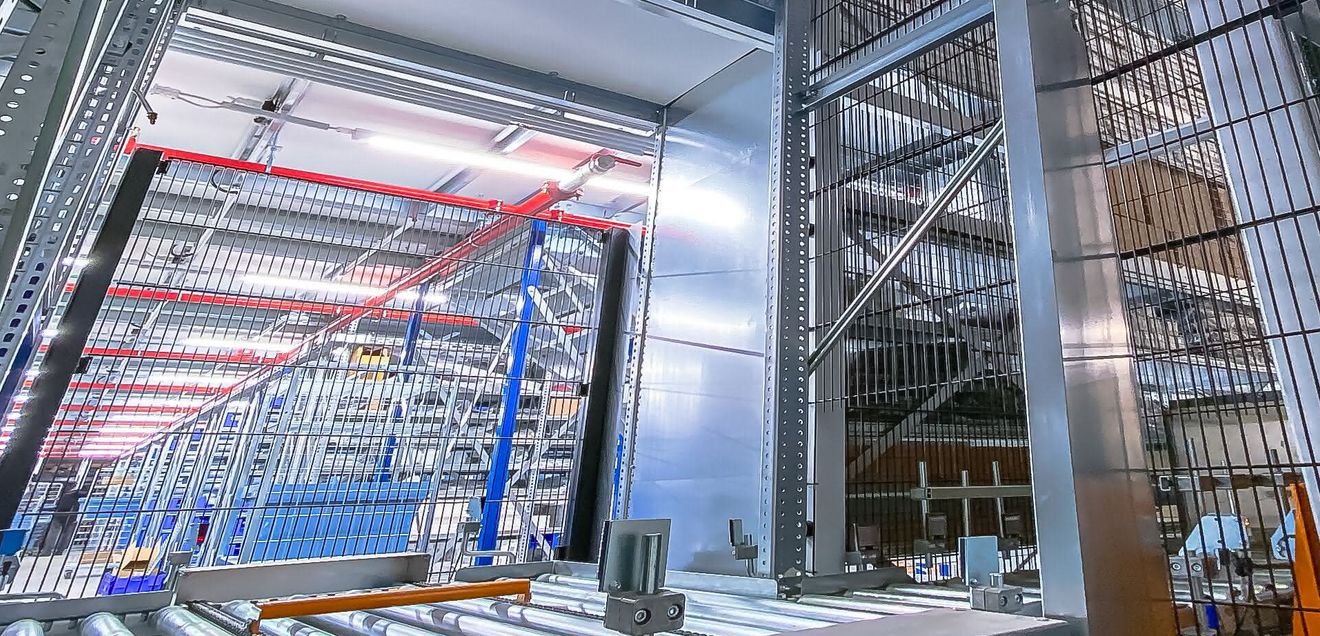
To ensure that the height differences between the racking levels can also be overcome fully automatically, the HaRo Group in Wernau has also installed a vertical conveyor in the incoming and outgoing goods areas of the new warehouse: "The fact that our customer's storage system extends over several levels means that the space is optimally utilized. Our vertical conveyor builds on this potential by reliably and efficiently distributing the conveyed goods to the respective levels without the need for manual intervention," says Markus Löseke.
So how does the new material flow actually work? In the incoming goods area, the picking bins that have already been prepared for storage are first loaded manually by employees at the roller conveyor infeed station. At the touch of a button, the destination on one of the three storage levels is selected for the goods before they are transported fully automatically via the powered roller conveyor to the vertical conveyor. The vertical conveyor, which is around seven meters high, then transfers the order picking box to the designated storage level.
"In view of the enormous throughput volumes in the Staiger logistics park, our vertical conveyor is designed for a capacity of 100 conveyed goods per hour," explains Markus Löseke. Once they have arrived at the respective target level, the picking boxes are transferred from the vertical conveyor to the adjacent roller conveyors.
"We have another special feature here," says Managing Director Christoph Hackländer: "If the pick-up points are free, the returnable containers are pushed directly onto the short, non-driven gravity roller conveyor with the help of an electric pusher." If the pick-up points are full, the containers are transported onwards via the parallel roller conveyor section to one of the three remaining pick-up points, each of which is also equipped with a pusher and works in the same way as the first pick-up point.
In total, the order picking system in the incoming goods area therefore involves twelve pick-up points, spread over three levels. "In addition to the automated transport of the containers, the roller conveyors also serve to buffer them - an indispensable function for our customers, especially in times of peak capacity utilization, which enables a high degree of flexibility," says Löseke.
Efficient outgoing goods
Around 2,500 to 3,500 spare parts leave the warehouse every day. This is an order of magnitude that requires an efficient and reliable material flow in outgoing goods. For this reason, the conveyor system installed in the outgoing goods area has a similar mode of operation to that in the incoming goods area: first, the picked crates are placed manually by the employees at the feeding stations of the roller conveyors.
The powered conveyors also enable fully automated transportation up to the vertical conveyor. Before the conveyed goods overcome the height difference between the levels, they are first separated. Once they arrive at the outgoing goods area, employees are then ready to accept the picked goods.
"Thanks to the installation of the conveyor systems described, which basically only consist of the three main components roller conveyors, pushers and vertical conveyors, the order picking process at the Staiger logistics park can be almost completely automated.
This significantly shortens the immense walking distances that would otherwise be required for employees between the warehouse levels," says HaRo management, explaining the advantages of their conveyor systems. "Thanks to this system, we can guarantee our customers fast delivery times," says Daniel Schier, Managing Director of Logistikpark-Staiger, who is delighted with the new goods system.
While the conveyor technology described has now been in use for almost a year, the logistics park is already planning further optimizations: For example, the company's ERP system is to be linked to the conveyor technology in the foreseeable future - in line with "Big Data" as a key concept of Industry 4.0 - so that the destinations for the picking containers no longer have to be selected manually by employees, but can be identified by the technology using QR codes, automatically transported to their storage location and tracked at any time.
Fully automated material flow at LogiMAT 2024
To get a first-hand impression of the HaRo Group's range of products and services and to experience the conveyor technology components up close in action, visitors to the Logimat trade fair can marvel at a fully automated material flow consisting of two vertical conveyors with a height of around 8 meters and in combination with driven roller conveyors for the automated transport of pallets.
Logimat, Hall 3, Stand D03


You might also be interested in
"Dancing with Robots"
With a live performance under the motto "Dancing with Robots", Trapo will be presenting intelligent automation and robotics solutions for the packaging industry at Interpack 2026.
 read more...
China's industry undergoing AI transformation
China has launched its 15th five-year plan and is positioning robotics as a central component of its modern industrial system. The aim is to transfer artificial intelligence more strongly into physical applications and thus boost economic growth.
read more...Bosch Rexroth at the Logimat 2026
Humanoid robot on AMR platform
Mobile robotics is well established in intralogistics, now humanoid robotics is moving more into focus. At Logimat, Bosch Rexroth is presenting a mobile humanoid robot on an AMR platform for the first time.
read more...Exoskeleton: strength to put on
Automation specialist Comau is expanding its portfolio of wearable robots with a new exoskeleton. The wearable system reduces muscle strain by up to 50 percent and is aimed at a wide range of applications in industry and SMEs.
read more...Flexible lever solutions
Aero-Lift Vakuumtechnik will be exhibiting at Fachpack in Nuremberg from September 23 to 25, 2025. There, the supplier from Baden-Württemberg will be presenting its portfolio of tube lifters from the Force-Lift series - including the Force-Lift | 2,...
read more...Overhead conveyor systems - an alternative to KLT transport
In logistics, companies are faced with the challenge of optimizing their internal material flow in order to maximize productivity, cost savings and efficiency. Overhead conveyor systems play an important role in this context. Due to their flexible...
read more...Save costs with a retrofit
The Spinner Group updated its ageing logistics system with the help of system integrator Klinkhammer Intralogistics: a targeted retrofit of the automated small parts warehouse and conveyor technology meant that it was no longer necessary to invest...
read more...Handling devices and more
Expresso aims to enable customers to improve the efficiency of their intralogistics processes through the use of high-quality handling and transportation equipment. In addition to positioning and conveying systems, the German manufacturer offers a...
read more...Compact motorized castor for pallets and heavy loads
Rulmeca has launched a new motorized roller onto the market. The EPS-AS1 roller motorizes roller conveyors for heavy loads of up to 1,500 kilograms.
read more...