
Conveyor and lifting technology
Warehouse and production perfectly coordinated
With the help of a new logistics system, Erwin Halder KG has been able to improve its material flow and drastically reduce throughput times. The new system, which is based around autonomous transport robots, also means that Halder remains highly flexible for the future.
The product range of Erwin Halder KG in Achstetten-Bronnen includes fixture systems, a multi-vice and conventional clamping devices. A standard range of standard parts with over 8,000 items from stock, hand tools and aviation products round off the large product range.
To manage this wide range of products with fully assembled parts and semi-finished products, Halder previously used a semi-automated combination of pallet racking and storage lifts. "However, with the continuous increase in our product range, warehousing with this system became increasingly complex due to increased replenishment trips between the pallet racks and the storage lifts. In addition, an increase in capacity was absolutely necessary, which would only have been possible to a limited extent with the previous system without a new building," says Operations Manager Michael Dunz, adding: "The decision to install a completely new intralogistics system was therefore only logical."
Servus Intralogistics
Servus Intralogistics develops, produces and supplies customized intralogistics solutions from a single source for its customers in a wide range of industries. Servus uses a modular system that makes it possible to link all areas of the company, from incoming goods, warehouse (AKL), production, assembly and order picking through to outgoing goods, with a single logistics system. At the heart of the Servus system are the globally unique, intelligent and autonomous transport robots ARC (Autonomous Robotic Carrier), which merge logistics and production into a single unit.
Merging logistics and production
Halder also wanted to use the changeover to a new warehouse and material transport system to improve other factors: the existing hall was to be better utilized and unnecessary, non-value-adding activities, such as replenishment trips and interim storage, were to be eliminated. The new warehouse management system should also help here.
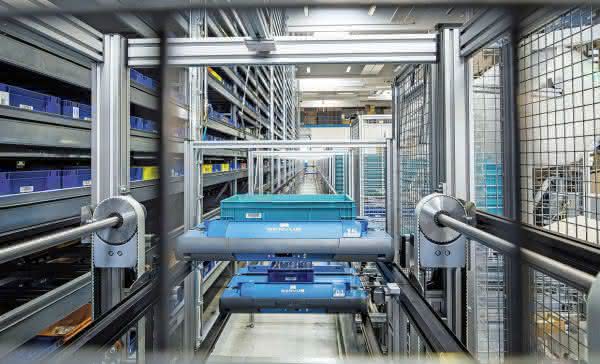
Erwin Halder found the ideal solution in the autonomous transport robots (Autonomous Robotic Carrier, ARC3) from Servus Intralogistics in Dornbirn, Austria. These save Halder time by delivering the goods just-in-time to the man or to production according to the pull principle, and they save space because Servus uses the available space extremely efficiently. "At Halder, our transport robots do not travel overhead on the hall ceiling as is usually the case, but we were still able to implement the Servus system with a relatively small footprint," explains Christian Beer, owner and Managing Director of Servus Intralogistics. And this is despite the fact that Servus connects the incoming goods, order picking and automated small parts warehouse areas without interfaces and also supplies the assembly department.
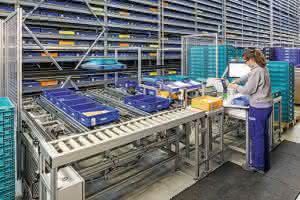
The Servus scope of delivery included all workstations, such as picking, assembly connection, goods receipt and goods issue with the corresponding I-points (human-machine interface), as well as the automated small parts warehouse (AS/RS) including warehouse management software. "In addition to the highest storage density that our miniload systems have, this also gives the customer the advantage of a possible storage fill level of over 99%," says Beer, which Operations Manager Dunz confirms: "We can store more items without having to expand the existing hall capacity."
Flexible for the future despite automation
After two years since commissioning, Operations Manager Michael Dunz can say that all expectations have been met to his complete satisfaction: "The transport system has been perfectly tailored to our requirements. We now have an improved material flow and shorter throughput times. Stock in circulation, interim storage and waiting times have been greatly reduced. The employees receive the goods just-in-time at their workstations. The Servus system is so flexible that we can easily adapt it to larger incoming orders and changing production processes, for example." Halder and Servus have thus shown that automation and flexibility are not necessarily mutually exclusive.
www.halder.com/dewww.servus.info


You might also be interested in
Circular load carriers for more sustainable supply chains
With the planned Industrial Accelerator Act, the European Union wants to accelerate the transformation of industry towards low-carbon production processes and resource-efficient supply chains. Logistics and transportation are also increasingly...
 read more...
Integration of a robotics solution
Lyreco modernizes logistics center in France
Lyreco is pressing ahead with the automation of its central site in Villaines-la-Juhel with an investment volume of over 25 million euros.
read more...Dragsbæk halves pallet area
By using automated pallet solutions from Palomat, Dragsbæk has halved the space required for pallets, optimized processes and sustainably improved working conditions.
read more...Pixels instead of paper
With the solutions from Logistikbude, Bekuplast, manufacturer of plastic containers, keeps an eye on its load carriers, saves costs and can work more efficiently with forwarding partners.
read more...Flexibility in saving space
Purus Plastics has developed a new retail range. The company operates a processing plant for plastics; recycling creates new products from secondary raw materials, including pallets.
read more...Solutions for the food industry
At Werit, the focus is on customer-specific solutions, sustainable recycling and pooling systems and products made from recyclate. The stand concept is divided into four areas: Products and innovations in the food sector, customer solutions,...
read more...Pallets with QR code
At the Epal Germany stand, visitors can gain an insight into the reusable system propagated by Epal, the life cycle of an Epal pallet and the newly developed QR pallet.
read more...The path of the Euro pallet into the IoT
With the introduction of the EPAL Euro Pallet QR in 2024, the European Pallet Association (EPAL) aims to set a new standard for the classic Euro pallet, which has been used successfully for over 60 years, and pave the way for ecologically...
read more...Retail range: flexibility to save space
Purus Plastics has developed a new retail range that is designed to attract the interest of retailers in particular. The company operates a modern plastics processing plant in Arzberg, Bavaria; new products are created from secondary raw materials...
read more...