

Dark Warehouse
The future of picking and packing
The Beumer Group presents its view of the dark warehouse. The company is already developing the innovative systems and services that will support the transition to "lights-out" operations.
The expectation today is that virtually any size and quantity of an item can be delivered on demand," says Gregor Baumeister, Director Warehousing & Distribution Logistic Systems at the Beumer Group. "This trend will continue to grow, and automation is accelerating the transition to dark warehouses. The latest developments in AI and data analysis are also contributing to this development. The Beumer Group is already thinking about what the world of warehousing and distribution will look like in ten years' time and is developing the systems and services that will enable warehouse operators, logistics managers and third-party logistics providers (3PLs) to realize efficient omnichannel distribution through a flexible, automated facility."
Providing end-to-end solutions for automated material flow, including powerful diagnostic services, is part of Beumer's "Easy to do business with" mission statement. The company supports its customers as a full-service provider for technology, software and support throughout the entire life cycle, which will also facilitate the further development of dark warehousing.
Automation on the rise
So what will the inside of a fashion fulfillment center look like in 2035? Physically strenuous work will be replaced by robots or automation processes so that people can concentrate on more productive or administrative tasks. The goods receiving area is a hive of activity: Robots on legs or wheels unload cartons from newly arrived containers. The robots place the cartons on conveyor belts, which in turn feed a high-speed sorting system from Beumer. From here, the cartons are either transferred to palletizing robots for reserve storage or directly to the goods-to-person (GTP) system for storage and picking.
Even complex handling tasks that were previously reserved for humans in GTP applications can now be carried out safely and reliably by autonomous robots. This will be possible in 2035 thanks to rapid developments in the computing power of digital analyses and the speed of cloud-based applications, as well as advances in optical recognition, AI technology and grippers.
Autonomous robots at the heart of order processing
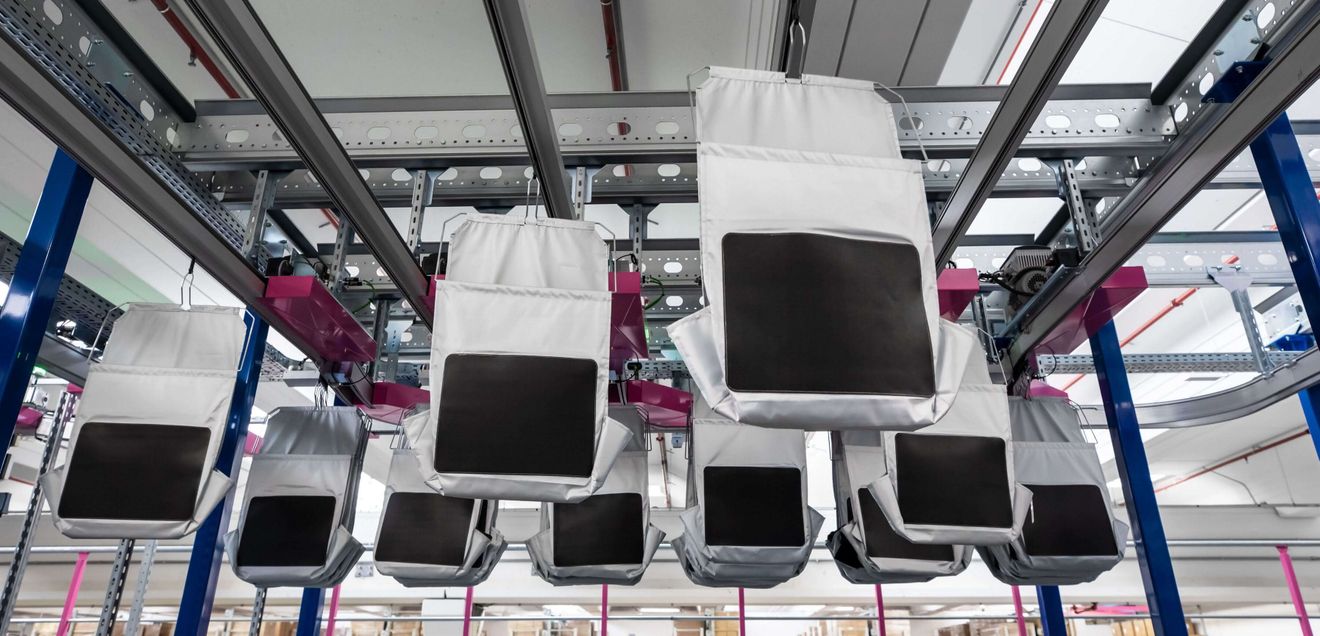
The modular, scalable BG Pouch System processes up to 10,000 items per hour and module used. It can accommodate not only flat-packed garments from the GTP system, but also garments on hangers (Garments-On-Hangers, GoH). This allows several process steps to be combined into a single and simple process. The BG Pouch System is also able to process returns efficiently as it bypasses all storage and picking processes, minimizing the time to resale.
The BG Pouch System picks customer orders fully automatically with maximum accuracy and service quality. At the packing station, the items are automatically unloaded into the packaging systems using sustainable and resource-optimized materials. The system is equipped with a variety of freely programmable sorting options. With their help, warehouse or shelf replenishment can be optimally controlled and dispatch sequences can be easily coordinated.
Packaging interface
The finished packaged goods are then transported to their sorting destinations via a Beumer cross-belt sorter for dispatch. This is characterized by high performance, robustness and flexibility in handling a wide variety of items. At the sorting destination, automated guided vehicles (AGVs) take over the shipping containers for e-commerce orders and load them into the vehicles of the contracted courier express parcel services. When delivering to retailers, the boxes or containers are taken directly to pick-up stations, where autonomous robots load trailers or containers.
Gregor Baumeister: "We are already close to implementing the dark warehouse. Robot and sorting technologies are already available. Advances in software and diagnostics are already making it possible to monitor and optimize warehouse operations more efficiently. Soon, working in physically demanding warehouse and distribution areas will also be a thing of the past. Perhaps we won't have to wait until 2035 for dark warehousing to become a reality."


You might also be interested in
"Dancing with Robots"
With a live performance under the motto "Dancing with Robots", Trapo will be presenting intelligent automation and robotics solutions for the packaging industry at Interpack 2026.
 read more...
China's industry undergoing AI transformation
China has launched its 15th five-year plan and is positioning robotics as a central component of its modern industrial system. The aim is to transfer artificial intelligence more strongly into physical applications and thus boost economic growth.
read more...Bosch Rexroth at the Logimat 2026
Humanoid robot on AMR platform
Mobile robotics is well established in intralogistics, now humanoid robotics is moving more into focus. At Logimat, Bosch Rexroth is presenting a mobile humanoid robot on an AMR platform for the first time.
read more...Exoskeleton: strength to put on
Automation specialist Comau is expanding its portfolio of wearable robots with a new exoskeleton. The wearable system reduces muscle strain by up to 50 percent and is aimed at a wide range of applications in industry and SMEs.
read more...Flexible lever solutions
Aero-Lift Vakuumtechnik will be exhibiting at Fachpack in Nuremberg from September 23 to 25, 2025. There, the supplier from Baden-Württemberg will be presenting its portfolio of tube lifters from the Force-Lift series - including the Force-Lift | 2,...
read more...Overhead conveyor systems - an alternative to KLT transport
In logistics, companies are faced with the challenge of optimizing their internal material flow in order to maximize productivity, cost savings and efficiency. Overhead conveyor systems play an important role in this context. Due to their flexible...
read more...Save costs with a retrofit
The Spinner Group updated its ageing logistics system with the help of system integrator Klinkhammer Intralogistics: a targeted retrofit of the automated small parts warehouse and conveyor technology meant that it was no longer necessary to invest...
read more...Handling devices and more
Expresso aims to enable customers to improve the efficiency of their intralogistics processes through the use of high-quality handling and transportation equipment. In addition to positioning and conveying systems, the German manufacturer offers a...
read more...Compact motorized castor for pallets and heavy loads
Rulmeca has launched a new motorized roller onto the market. The EPS-AS1 roller motorizes roller conveyors for heavy loads of up to 1,500 kilograms.
read more...