
From materialfluss 6/2020
Meticulously timed supply processes with Stöcklin
Networking, information transparency, technical assistance and decentralized decisions are central cornerstones of a "smart factory". In addition to automated distribution centers, the Swiss Stöcklin Group has recently implemented a number of turnkey projects in this segment of production logistics in particular, taking into account the strategic and business objectives of customers.
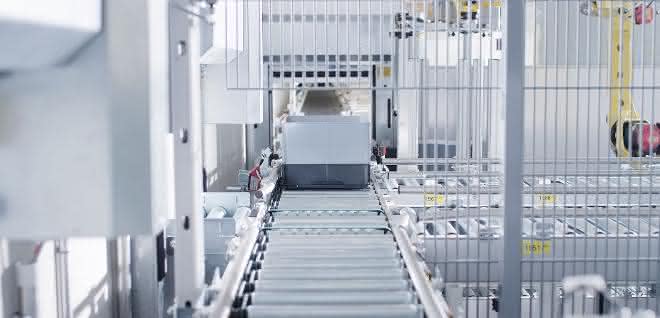
Production is still often the focus of attention when developing new production facilities. Material flow, on the other hand, tends to be assigned a secondary role. However, in times of Industry 4.0, which is based on the core idea of a smart factory and is already feasible in some cases, this kind of differentiation or decoupled planning is increasingly being called into question. Instead, holistic concepts are required so that all processes in production and logistics can be networked and flexibly synchronized. Stöcklin supports the individual optimization of space, time and resources with a wide range of hardware and software products from its own production, which the internationally active intralogistics provider and general contractor, headquartered in Dornach, Switzerland, supplies and implements from a single source.
Swiss quality work
Omega, a brand of the Swatch Group, also relied on this offer when building a new luxury watch manufacturing facility in Biel, Canton Bern. The new production facility combines assembly and quality control as well as a fully automated small parts warehouse with connected conveyor technology under one roof. There are also zones for packaging and preparing the finished products for dispatch. "By implementing a new logistics concept, the material flow and storage facilities were to be optimized and the order picking and storage capacities adapted to future requirements," reports Domenico Palombo, who is responsible for the French-speaking markets in the Systems division of Stöcklin Logistik AG.
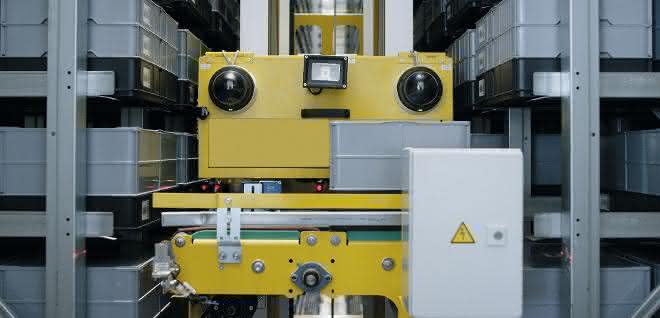
Since commissioning at the end of 2017, the fully automated small parts warehouse (AKL) has been the core of the new five-storey production building, which was practically built around the intralogistics system. This is where components and watch heads are managed, which are stored and retrieved according to work steps and picked on the floors. Specialists are at work there, assembling watch movements with dials, hands, cases and bracelets under clean room conditions. Checks and logistics tasks are partly supported by robots.
Automated small parts warehouse assists with assembly
The automated small parts warehouse offers space for more than 30,000 containers with double-deep storage. In order to provide the best possible protection for the goods in the warehouse, the entire system was designed to be inert. In the case of Omega, the preventive fire protection concept provided for a reduction in the oxygen content to just 15.2 percent. The warehouse is equipped with four storage and retrieval machines from the BOXer family from Stöcklin Logistik, each of which is fitted with a load handling device. Domenico Palombo comments: "Energy efficiency was a major issue right from the start. We meet this requirement with the lightweight design of the BOXer, which is one of the most energy-efficient small parts handlers on the market." Thanks to its modular design, the BOXer is also designed for flexibility and scalability. And the implemented warehouse management system (WMS) with integrated material flow control continuously triggers storage and retrieval strategies, taking into account daily requirements. As a result, the small parts units do not always move at the highest possible speed, but adjust their speed accordingly.
The system (27x10x14m - LxWxH) extends over three floors - from the basement to the 1st floor. The remaining floors are connected to the system via lifts, which are used to move the goods vertically. Omega uses special containers measuring 305x405x230 mm for storage and transportation. In total, around 1,000 container movements per hour are possible in the miniload. The integrated warehouse management system acts as the central control instance.
Integrated protection mechanisms for people and products
Another special feature is that the containers are fitted with special dust protection lids before storage so that the watch heads and components inside are not damaged. The lids are then removed again during the retrieval process. As this is a rather monotonous task for humans in the long term, it is carried out by robots at Omega. Another requirement related to noise protection. "The activities carried out in the workshops require maximum concentration, which is why noise reduction to a minimum is essential here," continues the intralogistics expert. As a result, noise emissions have been reduced accordingly so that people can carry out their demanding work undisturbed. Furthermore, airlocks installed on each floor of the production building prevent dirt particles from entering the premises. While the fully automated small parts warehouse is used to stock watch heads and components and to prepare parts for assembly, finished watches are stored in specially designed warehouses. The supply and removal is carried out via a completely newly developed container conveyor system, which has been adapted to the special requirements of the loading aids used here.
Innovation and excellence taken to the next level
Thanks to the direct integration of the fully automated small parts warehouse, including horizontal and vertical conveyor technology, into the assembly environment, it is now guaranteed that all required parts are always available in full and "just-in-time". This also meets the criteria of "lean production". Reliability at technology level, transparency in order tracking with 100% traceability of components, short throughput times and explicitly adapted supply cycles with moderate process costs and maximum flexibility are the decisive factors here. The concept of integrated and consistently networked production logistics implemented for the Swiss luxury watch manufacturer at the Biel site also impresses with zero-defect strategies and a low-noise working environment. The demands on system availability are correspondingly high. If the worst comes to the worst, the Stöcklin Logistics team is available 24 hours a day, 365 days a year to rectify any faults directly on site and restore delivery readiness in the shortest possible time.


You might also be interested in
Dematic and Hai Robotics launch partnership for flexible AMR solutions
Dematic and Hai Robotics have recently agreed a Europe-wide partnership to work together as integration partners in the field of warehouse automation. Through this cooperation, the provider of automation solutions for supply chains and the...
 read more...
The market for service robots
A recent report from IDTechEx analyzes the global market for service robots and examines key applications for delivery and logistics robots, cleaning and disinfection robots, social robots and more.
read more...Application phase for Innovation Award 2026 begins
How can robotics help to make packaging more sustainable? Kuka is looking for creative and innovative ideas in the new round of the Innovation Award.
read more...Exoskeleton with AI power
Robotics company German Bionic presents its most advanced exoskeleton model to date, called 'Exia', which is fully controlled by augmented AI.
read more...Strategic partnership for the promotion of AI
Jungheinrich and Merantix have announced a strategic partnership. The aim of the cooperation is to promote applications based on artificial intelligence (AI) in the industry.
read more...New robotics organization founded
Omron has announced the establishment of a global robotics organization effective April 1, 2025. It will operate in parallel with Omron's automation business so that both areas can complement and support each other.
read more...No-code tool for programming robot user interfaces
ABB provides 'AppStudio', a software tool that allows users of all skill levels to quickly and easily create customized, graphical user interfaces for robots.
read more...SLAM navigation in real time
'Freestyle Localize', 'Trailer Find' and 'Scanner Switch' are three new features of Sigmatek's real-time location software forcontour-based navigation 'SlamLoc'.
read more...Robotic solution: Aiming high under your own steam
The Skypod system is now used in more than 100 order picking warehouses worldwide by companies in all kinds of industries. The autonomous Skypod robots are able to overcome height differences of up to 12 meters.
read more...