
Model-based approach
KonMaFS project: Research for integrated material flow systems
In a new research project, several chairs are working on the end-to-end development of material flow systems and the avoidance of errors in the product creation process. This is made possible by a model-based approach.
Initial situation
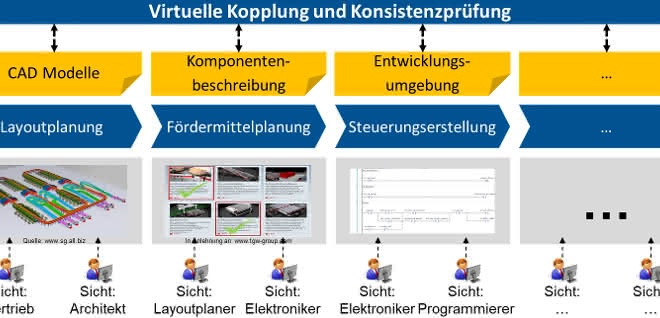
Automated material flow systems are highly complex and are often built precisely to a customer's specifications. Errors can have massive consequences: if they remain undetected until commissioning, unforeseeable additional costs are incurred. Specialists from various technical disciplines are involved in the development process. They each view the system from the perspective required for their specific work. As a result, details are often overlooked. The different perspectives are also only compatible with each other to a limited extent and changes are not always communicated consistently - in science this is referred to as inconsistency.
The KonMaFS project aims to make project work faster and more efficient. To achieve this, it uses a method from computer science. The Virtual Single Underlying Meta Model (V-SUMM) approach establishes relationships between the models of the individual planning specialists. The modeling saves all aspects of the material flow system, but only provides the individual users with the information that is relevant to them.
Objective
KonMaFS pursues three overarching goals:
- The new procedure should help to reduce the number of steps involved in system development in practice.
- The number of errors caused by system breaks should be reduced.
- The aim is to investigate the effects of changes in the overall system (inconsistencies when modifying individual system modules).
Procedure
KonMaFS consists of five project phases:
- A detailed study in cooperation with partner companies from the industry to determine the most important work steps in the development of material flow systems
- Linking the different views of the overall system and defining a V-SUMM modeling approach for automated material flow systems
- Application of the approach to a practical demonstrator
- Expansion of the knowledge gained by adding further properties for the V-SUMM
- Evaluation of the project in cooperation with industrial partners
The project is a cooperation between the Technical University of Munich (Chair of Materials Handling Material Flow Logistics of Prof. Fottner and Chair of Automation and Information Systems of Prof. Vogel-Heuser) and the University of Duisburg-Essen (paluno, specification of software systems of Prof. Goedicke).
(DFG project number 451550676)


You might also be interested in
In and (G)out
As the year draws to a close, Michael Schreckenberg, Professor of Physics of Transport and Traffic at the University of Duisburg-Essen, notes an astonishing trend in the year 2023, which is almost over - and not just in logistics, but also in the...
 read more...
Which world will it be in 2023?
Michael Schreckenberg teaches at the University of Duisburg-Essen as Professor of Physics of Transport and Traffic. Once a year, he addresses the readers of materialfluss, formerly LT-manager, with a critical and humorous expert article on transport...
read more...Next-Generation Cold Storage Facility
Lineage Relying on Automation from TGW Logistics in Texas
Lineage is relying on TGW Logistics’ automation expertise to build one of the world’s largest temperature-controlled distribution centers in Texas. The highly automated cold storage and frozen food warehouse is scheduled to begin operations in late...
read more...Conveyor technology without control cabinet
New materials, more efficient components and digital control concepts are increasingly changing traditional conveyor technology. The focus of many developments is primarily on one goal: reducing overall costs. Considerable expenses are often...
read more...Vectura systems create capacity for peak loads
Swisslog gets high-bay warehouse for Lebkuchen-Schmidt on track
Swisslog has successfully completed the installation of six Vectura storage and retrieval machines in Lebkuchen-Schmidt's new central logistics hub in Nuremberg. The project has thus reached a milestone on the way to the planned commissioning of the...
read more...mk expands conveyor technology portfolio
Intelligent intralogistics from the modular system
The mk Technology Group is expanding its intralogistics portfolio with the new RBF 2000 roller conveyor system. The fully modular system combines flexible conveyor technology with intelligent control architecture and is suitable for transport,...
read more...Pocket sorter: goods transported autonomously to their destination
TGW Logistics installs a SmartPocket system for the mail order company Personalshop in Polling, Tyrol.
read more..."Dancing with Robots"
With a live performance under the motto "Dancing with Robots", Trapo will be presenting intelligent automation and robotics solutions for the packaging industry at Interpack 2026.
read more...100+ installations worldwide: Trust through practice
Automation must function reliably, every day, at all times. With more than 100 adapter-based sorting systems from Dürkopp Fördertechnik (DFT) installed worldwide, the technology has proven itself in continuous industrial operation.
read more...