
From materialfluss 10/2019
From inventor to pioneer
Paul Vahle is one step ahead of his time, and has been since 1912. Read the historical article to find out how the company of the same name has shaped the history of intralogistics and how it has become a pioneer in the industry.
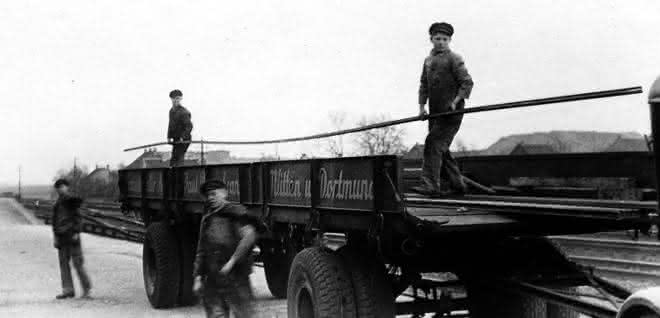
The electrification of German industry, which had begun with the second industrial revolution in the 1880s, was still in its infancy. At this time, Paul Vahle is head of the electrical department at Hoesch in Dortmund. As such, the resourceful engineer has to deal with the constant interruptions to the power supply and the resulting production stoppages and accidents. Vahle apparently also did this in his spare time - with some success: as early as 1912, he invented the conductor rail as a way of reliably supplying electrically powered rail vehicles and other mobile power consumers with electricity. In the same year, the enterprising inventor patented his invention and founded the company that still bears his name today: Paul Vahle GmbH & Co KG. Incidentally, it was another 57 years before the first issue of Materialfluss was published.
It is not known whether Paul Vahle had any idea that his invention would one day make a decisive contribution to the development of industrial production and the mobility of entire societies. He dies in 1926, just 14 years after founding the company and long before the potential of his products can fully unfold. His wife Helene initially continued to run the business, eventually handing over responsibility for the company to her son Paul Werner Vahle in 1932. The company grew slowly but steadily during this period, eventually employing 30 people in 1936. However, hard times began on September 1, 1939 with Germany's attack on Poland. Paul Werner Vahle is drafted and is taken prisoner during the course of the war, from which he is only released in 1949. Meanwhile, a woman continues to run the business: Maria Vahle, Paul Werner's wife.
The winds of reconstruction and the economic miracle finally blow through the production halls of the company based in Dortmund's Brackel district. As early as 1950, the year of the new beginning, turnover amounted to DM 1.2 million. The company flourishes. At the end of the 1950s, the old factory premises finally became too cramped. However, negotiations with the Dortmund city authorities about additional space for an expansion do not bring the desired result. Without further ado, Vahle relocates its company headquarters to neighboring Kamen in 1958. The relocation marked the beginning of a successful decade. One of the reasons for this was the invention of the sea container by Malcom P. McLean, which revolutionized logistics from 1956 and caused the global flow of goods to swell. Development took another leap forward with the introduction of the high-bay warehouse in the 1960s. One of the first in Germany was built by Bertelsmann in Gütersloh in 1962.
For safe energy transmission, they also rely on the high-quality products of the market leader from Kamen. One year later, Vahle adds the KSL safety conductor rail to its product range. Continued growth means that production reaches its limits again in these years, so the company expands again in 1965. However, the new capacity is quickly exhausted. At the beginning of the 1970s - the first edition of Materialfluss has just been published - the Kamen plant is expanded again. At the same time, new products such as the light metal rail ensure increasing sales. In 1971, the one millionth meter of plastic conductor rail leaves the factory. This period also saw a prestigious order for the inventor of the conductor rail: equipping the Transrapid magnetic levitation train on the test track in Emsland. As a result of the development of electric monorail systems, Vahle also designed the U10 conductor rail - the bestseller in automobile production.
In the 1980s and 1990s, intralogistics, which incidentally has only been called that since 2003, was in a state of flux. Concepts such as Just-in-Time from Toyota, Quick Response (QR) and Efficient Consumer Response (ECR) brought material procurement into focus and significantly increased the efficiency of goods supply systems. As a result, data transmission is also gaining in importance. Vahle keeps a watchful eye on this development and reacts in 1995 with the takeover of slotted waveguide data transmission SHL (now SMG) from Deutsche Aerospace AG. Three years later, Vahle develops the Contactless Power Supply (CPS) for inductive power transmission in collaboration with the Technical University of Braunschweig.
The holistic view of the value chain of logistics tasks - the "supply chain" - became fully established at the turn of the millennium. It involves the analysis and optimization of the entire value creation cycle, from the raw material to the handover of the product to the end customer. Vahle demonstrated its pioneering role in the field of intralogistics in 2017 with the establishment of the Automation division. The aim is to develop, produce and supply high-quality drive and control systems with a focus on inductive energy transmission. Vahle Automation GmbH is opened at the headquarters in Schwoich near Kufstein, Austria. Not least this shows that the Kamen-based company has not lost its pioneering spirit over the course of more than 100 years. Paul Vahle would love it.


You might also be interested in
Next-Generation Cold Storage Facility
Lineage Relying on Automation from TGW Logistics in Texas
Lineage is relying on TGW Logistics’ automation expertise to build one of the world’s largest temperature-controlled distribution centers in Texas. The highly automated cold storage and frozen food warehouse is scheduled to begin operations in late...
 read more...
Conveyor technology without control cabinet
New materials, more efficient components and digital control concepts are increasingly changing traditional conveyor technology. The focus of many developments is primarily on one goal: reducing overall costs. Considerable expenses are often...
read more...Vectura systems create capacity for peak loads
Swisslog gets high-bay warehouse for Lebkuchen-Schmidt on track
Swisslog has successfully completed the installation of six Vectura storage and retrieval machines in Lebkuchen-Schmidt's new central logistics hub in Nuremberg. The project has thus reached a milestone on the way to the planned commissioning of the...
read more...mk expands conveyor technology portfolio
Intelligent intralogistics from the modular system
The mk Technology Group is expanding its intralogistics portfolio with the new RBF 2000 roller conveyor system. The fully modular system combines flexible conveyor technology with intelligent control architecture and is suitable for transport,...
read more...Pocket sorter: goods transported autonomously to their destination
TGW Logistics installs a SmartPocket system for the mail order company Personalshop in Polling, Tyrol.
read more..."Dancing with Robots"
With a live performance under the motto "Dancing with Robots", Trapo will be presenting intelligent automation and robotics solutions for the packaging industry at Interpack 2026.
read more...100+ installations worldwide: Trust through practice
Automation must function reliably, every day, at all times. With more than 100 adapter-based sorting systems from Dürkopp Fördertechnik (DFT) installed worldwide, the technology has proven itself in continuous industrial operation.
read more...Bonfiglioli focuses on modularity and automation
Bonfiglioli had two stands at Logimat: in Hall 9 with forklift trucks and warehouse machines and in Hall 3 for materials handling technology and industrial automation. In the area of industrial trucks, the company presented complete drive solutions,...
read more...Movu Robotics at the Logimat 2026
Transformation to a 4-way pallet shuttle system
Movu Robotics, a member of the stow Group, will be demonstrating at Logimat how it is driving the large-scale transformation of automated storage and retrieval systems (ASRS) to 4-way pallet shuttle technology.
read more...