
Conveyor and lifting technology
Degree of automation expanded step by step
Miele has been relying on the Servus intralogistics modular system for material provision in light goods transportation since 2013. Following the third expansion, the autonomous transport robots from Servus now supply two assembly lines with the right material at the right time.
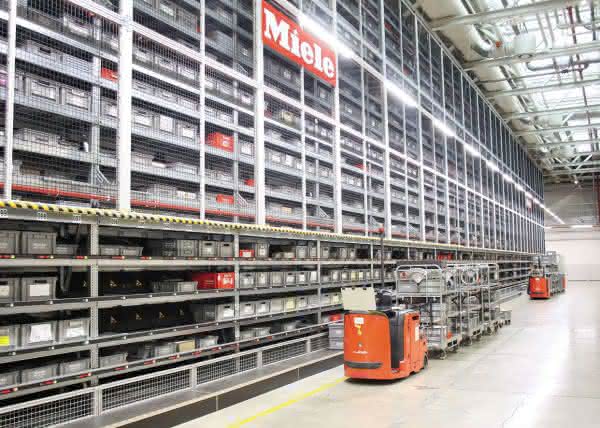
Quality that lasts for many years". This has always been the motto of the long-established German manufacturer of domestic appliances. As high as Miele sets the bar for its products, the traditional German company also sets it high for its suppliers. This is why Miele decided in 2013 to optimize its material flow with the help of Servus Intralogistics GmbH.
Previously, all small parts for the assembly lines, which are used to produce around 5,000 washing machines a day at the main plant in Gütersloh, were supplied from a traditional small parts warehouse with storage and retrieval machines. The distances between the assembly lines in the factory hall and the small parts warehouse in another hall used to be long. The material transport alone required several employees. The cornerstone for more efficient supply processes was a workshop in which the material flows were analyzed and optimized. The system was designed accordingly and future expansion steps were already taken into consideration.
Order picking, AKL and automated supermarket
Starting with 26 transport robots, Miele took a big step towards lean production. The transport robots took over all transportation of containers, empty trays and empty tray stacks between storage, the automated small parts warehouse (AKL), picking stations and an automated supermarket. "Right from the start, we saw Servus as more than just a storage system. We also wanted to use the flexibility of the Servus autonomous transport robots to take the Servus system directly to the assembly line," explains Markus Kahlert, logistics planner at Miele.
Now, five years later, it is clear that Miele has consistently continued along this path and has permanently increased the level of automation and has also been able to combine logistics and production into a single unit.
Fully automatic goods receipt
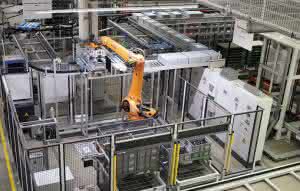
In a first expansion step, the incoming goods department was automated. An articulated robot separates the incoming pallets and transfers the containers to the Servus system. The autonomous transport robots store the containers or supply the picking stations and subsequently the automated supermarket. The milk run driver then loads his trolleys. Incorrect picks are eliminated by means of pick-by-light.
Servus Intralogistics
Servus Intralogistics GmbH develops, produces and supplies customized intralogistics solutions from a single source for its customers in a wide range of industries. Servus uses a modular intralogistics system that makes it possible to link all areas of the company, from incoming goods, warehouse (AKL), production, assembly and order picking through to outgoing goods, with a single logistics system. At the heart of the Servus system are the intelligent and autonomous transport robots ARC (Autonomous Robotic Carrier), which merge logistics and production into a single unit.
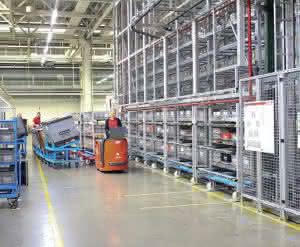
With the latest expansion step, Miele has been able to further increase the level of automation. The now 36 autonomous transport robots now drive right up to the assembly lines, where the Servus system fills the shelves for the milk run directly. The Milkrun driver can dock the already filled trolleys immediately and begin distribution.
Flexible for the future too
Flexibility was one of the main reasons why Miele opted for Servus from the outset: "In view of our throughput volumes and transport routes, we need a system with maximum flexibility, which is why the scalability aspect, for example, was of central importance," says Kahlert, who looks at the figures with satisfaction. "We currently register around 8,500 Servus transport orders every day."
And with Servus as a partner, all options are open to Miele for the future. "As the Servus system is controlled decentrally, new areas in the company can be connected in full operation," says Christian Beer, owner and Managing Director of Servus Intralogistics, adding: "And yet maximum process reliability is guaranteed, as each transport robot acts with swarm intelligence and finds the shortest route to its destination itself. This means that the system always remains simple, regardless of whether 5 or 500 ARCs are in use."
www.miele.dewww.servus.info


You might also be interested in
Sixth AutoStore project for New Wave
Element Logic is implementing its sixth joint project with the New Wave Group: a future-proof AutoStore system for the logistics center in Geiselwind.
 read more...
Everything is in its place
Vet-Concept produces and sells high-quality dry and wet food. The company sells almost exclusively online and also has its own small store in Föhren for customers to collect their own products. BITO-Lagertechnik has supported the company since its...
read more...Designing crisis-proof warehouse technology
Geopolitical tensions, rising costs and increasing protectionism have fundamentally changed the economy. The days when goods were simply stored are long gone - today it's all about remaining flexible, reacting quickly and finding ever smarter...
read more...Sustainable logistics - a sustainable approach
In recent years, environmental protection has become a fundamental concern of society. Sustainable logistics focuses on minimizing the environmental impact of logistics activities without compromising the economic efficiency of companies.
read more...Shelving specialist Elvedi celebrates its 40th anniversary
The shelving system provider Elvedi is celebrating its big anniversary in 2024. The shelving manufacturer intends to continue on this growth path in the future and is planning to expand its sales territory in Europe.
read more...Drill core storage for the Mont Terri rock laboratory
The plant and racking specialist Stöcklin received the order for an unusual racking system in an unusual location and found an unusual solution for it.
read more...MS Motorservice International relies on Kardex Mlog
MS Motorservice International, the sales organization for Rheinmetall's global aftermarket activities, has commissioned Kardex Mlog as general contractor to build a four-aisle high-bay warehouse at its Neuenstadt site. The high-bay warehouse will be...
read more...Warehouse concept from Schulte impresses at Liebherr-Logistics
Liebherr-Logistics built a new warehouse at the Oberopfingen site. Schulte equipped this with a complete package: Within a short space of time, pallet, cantilever and shelving racks were installed in all three sections of the new building.
read more...Mayr-Melnhof Packaging optimizes logistics operations with AR racks
The Chilean subsidiary of the European group for the production and distribution of paper and cardboard packaging has carried out a comprehensive logistics optimization project at its distribution center in Santiago, Chile.
read more...