
Storage systems
Fully automated intralogistics enables further growth
An efficient production supply, a high degree of automation and ergonomic workstations - these are the goals with which Wildeboer, an expert in building components for fire protection, air distribution, building systems technology and sound insulation, has built a modern logistics center. Together with Unitechnik, Wildeboer developed an automated storage system at its headquarters in Weener, which creates the basis for further growth.
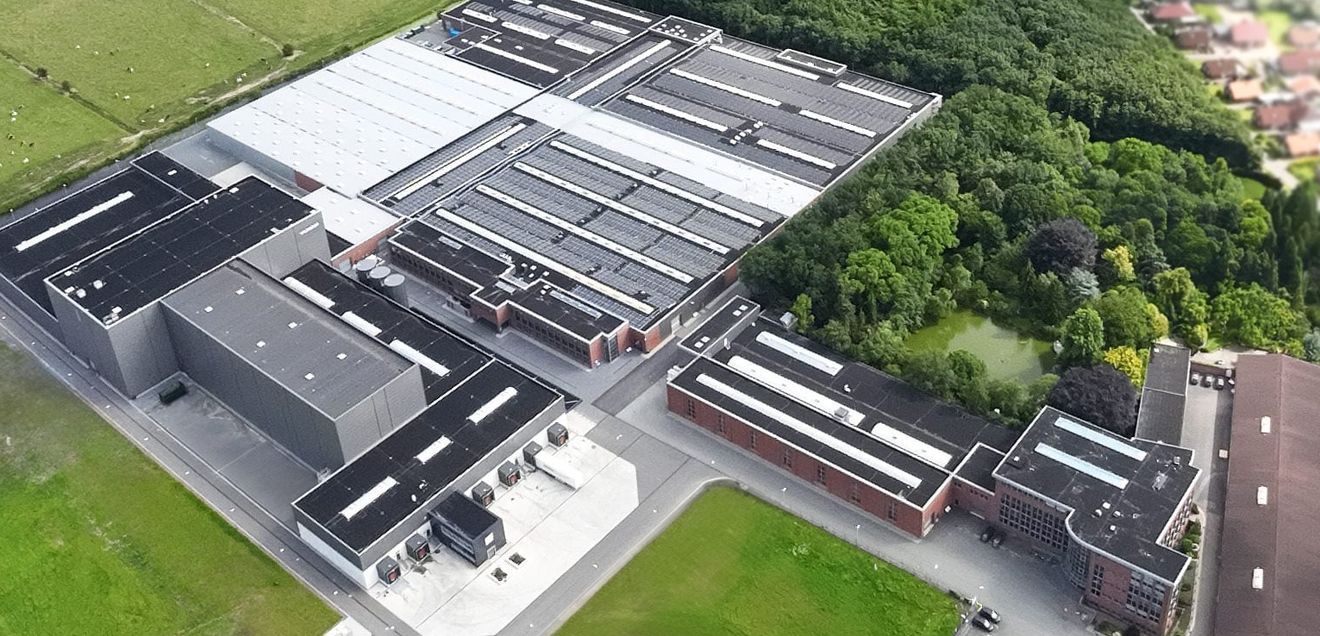
"Simply install confidence" - this is what the family business Wildeboer, founded in 1939, stands for. With an extensive vertical range of manufacture, the engineering company develops and produces components for the areas of fire protection and sound insulation, air distribution and building systems technology - components "made in Germany". The company's head office is located in Weener in East Frisia and is complemented by further sites in Laupheim, Lützen and Utrecht. Over 350 employees work at the headquarters on a total production area of 60,000 square meters.
Decentralized storage slows down processes
At the East Frisian company, a lack of storage capacity meant that large quantities of material had to be stored temporarily in decentralized manual warehouses and on staging areas in the production halls. "Our aim was to centralize the functional areas along the internal logistics chain, introduce a consistent goods-to-person principle and at the same time ensure end-to-end material traceability," explains Arne Bröske, Head of Production at Wildeboer. "The automation of our processes was essential for this." A central, automated storage system was not only intended to minimize manual processes, but also to open up additional space for assembly and production.
Strategic partnership
After Wildeboer had commissioned an external planner with the logistics planning of the automated processes in the warehouse, the decision was made - based on a recommendation - in favor of in-depth expertise from Unitechnik Systems. One of the decisive criteria for the cooperation was Unitechnik's distinct understanding of the process. Equally decisive was the vendor-independent and solution-oriented elaboration of the detailed planning by a medium-sized family business, into which the experience from many realized projects has flowed.
Working together, Wildeboer and Unitechnik initially developed an overall logistics concept that included the separation of production and storage areas as well as the expansion of a total of 10,500 square meters of logistics space. The concept was primarily geared towards the scalability of the logistics. Unitechnik was able to design the storage systems in such a way that they could grow flexibly with future requirements. Process reliability is also a key requirement of the concept: the construction of a new logistics center should ensure reliable production supply and goods dispatch with high availability. Inventory management based on the first-in-first-out principle should guarantee seamless goods tracking. In addition, Unitechnik was able to take into account the supply and connection of component assemblies on different floors in the design. The automated interim storage of customer-specific manufactured products and the dispatch buffering of pre-packed consignments should also contribute to the optimization of Wildeboer's logistics processes. Another key factor is the high degree of automation, which enables ergonomic and efficient workstations in incoming goods, order picking and shipping. These new logistics processes aim to reduce walking distances for employees and manual transportation to a minimum.
Digital warehouse management optimizes processes
The logistics center implemented by Unitechnik is Wildeboer's central material flow hub. At its center are a three-aisle high-bay warehouse for Euro pallets and mesh boxes with 9,230 storage locations and a single-aisle automated small parts warehouse for KLT containers. Raw materials, semi-finished and finished products are stored here. Material for both production and customer orders is assembled at combined pallet and container picking stations. The raw materials for production are transferred to various driverless transport systems. All manufactured components are in turn collected from production by these AGV vehicles, delivered to the Unitechnik conveyor system and stored. The driverless transport systems were procured and commissioned by Wildeboer itself. The special thing about it: in order to be independent of individual manufacturers, Wildeboer relies on a fleet management system in accordance with the VDA 5050 standard. In future, autonomous cleaning robots will even be on the road and "coordinate" with their productive colleagues.
The consolidation of orders plays a major role at Wildeboer. The aim is to minimize the shipping volume. To this end, the pallets destined for customer orders are first automatically stored temporarily in a highly dynamic shipping buffer. The pallets retrieved by Wildeboer's own consolidation software automatically move into the consolidation zone. According to the "Pack by Light" principle, the employee can see at a glance which pallets belong to the same order via colored light displays and arranges the items in such a way that as few pallets as possible are required. This consolidation saves freight costs and protects the environment.
As the collaboration between Wildeboer and Unitechnik began in 2019, the construction of the new logistics center was affected by the challenges of the coronavirus pandemic. Delivery bottlenecks not only led to delays in the schedule, but also demanded a high degree of flexibility from everyone involved in the project. "Timely agreements and well-coordinated collaboration were crucial throughout the course of the project," emphasizes Arne Bröske. "All the more reason for us to appreciate having a competent system integrator like Unitechnik at our side, with whom the partnership-based cooperation was characterized by uncomplicated agreements."
Lifetime partnership for sustainable success
Even after the project has been completed, both project partners remain in regular contact and exchange information with each other. "It is particularly important for us to remain a reliable contact for Wildeboer even after the successful implementation," explains Yusuf Kaya, Key Account Manager for logistics systems at Unitechnik. Unitechnik laid the foundations for future expansions right at the start of the project: The interfaces of the new logistics center were prepared in terms of software and conveyor technology so that Wildeboer could easily integrate driverless transport systems.


You might also be interested in
One of the largest Autostore facilities in...
Buttinette automates with Element Logic
For the new logistics center of Buttinette Textil-Versandhaus GmbH, the system integrator Element Logic is responsible for planning and implementing the automated intralogistics solutions for storage and order processing. One of the largest...
 read more...
Dematic automates for the ERAM Group
Dematic has received an order from the French shoe and clothing brand ERAM to automate its new distribution center in Chemillé-en-Anjou in western France. The decision is part of the strategy to make the fashion division's warehouse and distribution...
read more...Fast retrofit for a stable supply chain
For KWM Weisshaar, the ability to deliver is a key promise to its customers. This is why the sheet metal specialist relies on Kasto's storage solutions, including for the retrofit of the Kasto Unigrip buffer storage system. After a short conversion...
read more...New distribution center for electronics wholesalers
The new distribution center of the electronics wholesaler Avnet in Europe was built by the high-bay racking expert Voestalpine Krems Finaltechnik. The warehouse in Bernburg (Saale) in Saxony-Anhalt protects semiconductors and other sensitive...
read more...Smart logistics ideas to the power of two
From the warehouse technology specialist for the logistics expert - Bito-Lagertechnik has implemented two new logistics systems in parallel for Briem Speditions.
read more...Logistics concept with modular production...
Perfectly driven for sophisticated logistics at SEW-Eurodrive
SEW-Eurodrive, the market leader in drive technology, decided to build a new plant at its Bruchsal site in order to be able to meet the constantly growing demand for electronic components in the future. In addition to state-of-the-art production...
read more...Alliance for warehouse logistics
Reesink Logistic Solutions and Movu Robotics cooperate
The integrator Reesink Logistic Solutions, a subsidiary of Royal Reesink, and the robotics and automation specialist Movu Robotics, a subsidiary of the Stow Group, present the results of their collaboration: two projects for the Weinig Group in...
read more...Storage solutions: Efficiency counts
Reliable movement, efficient storage - that's what Dexion's storage solutions offer. The company will be showcasing efficient storage solutions such as pallet storage reloaded or compressed storage with modern pallet pull-outs.
read more...Intralogistics modular system that can be experienced
At Stöcklin Logistik, the focus is on a modular system kit for complete turnkey solutions including the Logos software suite and long-life services for an improved, future-oriented flow of goods and materials.
read more...