
From materialfluss 5/2020
New centerpiece for production
In 2014, the foundation stone was laid for Coop's new production site in Pratteln near Basel, Switzerland. As part of the consolidation of three production facilities under one roof, the wholesaler commissioned Gilgen Logistics AG as general contractor for the implementation of intralogistics.
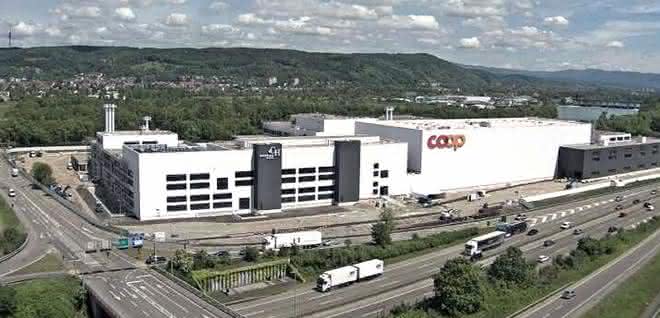
The scope of supply and services included project management, engineering, site coordination, installation and commissioning of the automated high-bay warehouse with stacker cranes and the fully automated pallet and combination conveyor system with the associated safety systems and the corresponding system control. Gilgen was also commissioned to maintain the intralogistics system. After three years of construction, the plant with a volume of 870,000 cubic meters was opened. Since then, Chocolats Halba has been producing Coop chocolate here for the whole of Switzerland and abroad, CAVE, the country's largest wine bottling plant, and Sunray trail mixes, nut and snack mixes for Coop's own brands are produced here.
Precise coordination and detailed planning
"System planning and organization are the be-all and end-all of such large-scale projects," says Andreas Marti, overall project manager at Gilgen Logistics. He was responsible for the overall project management and the integration of all logistics trades. "To ensure the project ran successfully, we divided the large-scale project into subsections and worked with Coop to draw up a detailed specification. As a wide variety of companies were on site at the same time during assembly and commissioning, including construction, excellent coordination and detailed planning were essential." The building envelope, consisting of a steel rack construction in silo design as well as the roof and façade and the pallet/combination conveyor technology, was planned by Gilgen, taking into account the safety concept (escape routes and fire protection technology), and implemented with the involvement of long-standing partners.
Fully automated storage of over 8,000 items
In the fully automated high-bay warehouse with around 41,000 pallet spaces, over 8,000 different items are managed and delivered to the Coop sales outlets every day. Eight storage and retrieval machines (SRMs) store and retrieve the pallets fully automatically. For the different pallet widths (EURO and industrial pallets), the storage and retrieval machines were equipped with single-deep or double-deep telescopic forks. The forks can be moved in the X-direction so that the different pallet widths can be picked up and delivered. The pallets can also be discharged into the rack compartment via the rack uprights. This optimizes performance, as the SRM does not have to move additionally for loading/unloading. The SRMs with a height of 33.6 meters have a load capacity of 2 x 1,000 kilograms. Two network cameras are installed on each of the load handling devices. The live images are transmitted via the Profinet network and can be viewed in the process control station or on the panel on the landside stacker crane control cabinet. If a fault occurs, the last recorded minutes are saved and can be used for fault analysis. This allows targeted intervention to be initiated to rectify the fault. The storage bins are managed and transport orders are generated via the Coop warehouse management/material flow computer. The storage bin assignments are generated dynamically according to load carriers, compartment heights and temperature zones.
Energy and resource-optimized
In order to achieve energy-optimized operation of the SRMs without reducing the storage/retrieval performance, the control of the travel and lifting drive was designed accordingly. By means of DC link coupling of the two SEW inverters and coordinated control of the two axes via a special algorithm, the regenerative energy generated during braking operation of one axis is used for accelerating or moving the other axis wherever possible. Operation with reduced acceleration and speed ("green level" operation) was planned in order to save additional energy when the system is under low load. The material flow computer uses adjustable parameters to trigger operation with reduced power.
The two automated warehouses (high-bay warehouse and roller container storage) and the entire conveyor system are displayed on the Coop-side visualization (Lighthouse). Gilgen uses the VisiWin process visualization system for operator visualization. The VisiWin server communicates with the individual PLC controllers via the local network and prepares the collected system data graphically. A large number of touch panels distributed throughout the system (stationary and mobile panels) access the Visu server and display the status of the corresponding conveyor area to the user. To control the conveyor elements manually, manual mode and the corresponding conveyor area must be selected. If the conveyor area is in "Manual mode", it is displayed in color. The individual conveyor elements can then be selected and operated using the "Manual mode" buttons in inching mode.
Efficient supply and picking of the production areas
Up to 2,000 pallets are fed onto the conveyor system every day for the production operations, picking and the high-bay warehouse. Each pallet is automatically checked when it is fed in and reaches its destination via horizontal and vertical conveyor elements. Pallets that are rejected are forwarded by the MFR to the NIO lanes for further processing. The three production areas are supplied with goods via the high-bay warehouse. Pallets from the production plants are temporarily stored in the high-bay warehouse until they are delivered to the customer. The pallet supply (fast movers / replenishment pallets) for order picking on the upper floor is ensured from the high-bay warehouse. Once the pallets have been retrieved and transported via the conveyor system and elevator, they are distributed to the 138 three-place picking gravity roller conveyors by a transfer carriage. At the same time, empty roll containers are transported from the roll container buffer to the picking area via the combined conveyor system. The employee loads his picking vehicle with two roll containers and picks the goods using pick-by-voice. The completed setup orders (store-related) are manually transferred to the roll container conveyor system. After checking and wrapping the picked goods, the roll containers are automatically transported via connecting lines and elevators to the intermediate buffer, directly to the rail hall or to the truck removal point. Three pallet labelers are used to ensure that all transport units are labelled on the way to the outgoing goods area. To ensure safe loading between the high-bay warehouse and the trucks, Gilgen also supplied the 27 loading stations with door systems and door seals as well as five scissor lift tables.
Automatic interim storage of roll containers
The logistics building is connected via a rail ramp. This is where the empty, nested roll containers are delivered from the Coop sales outlets. Two elevators are used to buffer the roll containers in the fully automated intermediate buffer until they are called up for order picking. The intermediate buffer is defined in three occupancy zones - empty or full roll containers and full pallets. The buffer is designed for a capacity of 2,112 doubled roll containers and 172 pallets. Three high-performance transfer carriages continuously fill and empty the buffer. A positive drive, which is installed directly on the transfer carriage, enables all 120 buffer tracks to be operated by a single drive element on the transfer carriage by engaging/disengaging the toothed belt to the inactive buffer track.
High redundancy of material flows
The entire logistics system was planned and implemented with a high level of redundancy in the material flows; this means that all transports can be rerouted via alternative routes in an emergency. The maintenance concept, which is constantly being refined together with Coop, guarantees that most of the maintenance work can be carried out during normal working hours. The new production and distribution center strongly supports the Coop Group's "Carbon Neutral 2023" vision. This includes the gradual shift of transportation from road to rail. Coop already transports two thirds of its goods by rail. Thanks to the new location in Pratteln, Coop can reduce its carbon dioxide emissions by a further 1,600 tons per year.


You might also be interested in
Circular load carriers for more sustainable supply chains
With the planned Industrial Accelerator Act, the European Union wants to accelerate the transformation of industry towards low-carbon production processes and resource-efficient supply chains. Logistics and transportation are also increasingly...
 read more...
Integration of a robotics solution
Lyreco modernizes logistics center in France
Lyreco is pressing ahead with the automation of its central site in Villaines-la-Juhel with an investment volume of over 25 million euros.
read more...Dragsbæk halves pallet area
By using automated pallet solutions from Palomat, Dragsbæk has halved the space required for pallets, optimized processes and sustainably improved working conditions.
read more...Pixels instead of paper
With the solutions from Logistikbude, Bekuplast, manufacturer of plastic containers, keeps an eye on its load carriers, saves costs and can work more efficiently with forwarding partners.
read more...Flexibility in saving space
Purus Plastics has developed a new retail range. The company operates a processing plant for plastics; recycling creates new products from secondary raw materials, including pallets.
read more...Solutions for the food industry
At Werit, the focus is on customer-specific solutions, sustainable recycling and pooling systems and products made from recyclate. The stand concept is divided into four areas: Products and innovations in the food sector, customer solutions,...
read more...Pallets with QR code
At the Epal Germany stand, visitors can gain an insight into the reusable system propagated by Epal, the life cycle of an Epal pallet and the newly developed QR pallet.
read more...The path of the Euro pallet into the IoT
With the introduction of the EPAL Euro Pallet QR in 2024, the European Pallet Association (EPAL) aims to set a new standard for the classic Euro pallet, which has been used successfully for over 60 years, and pave the way for ecologically...
read more...Retail range: flexibility to save space
Purus Plastics has developed a new retail range that is designed to attract the interest of retailers in particular. The company operates a modern plastics processing plant in Arzberg, Bavaria; new products are created from secondary raw materials...
read more...