
Automated pallet warehouse
The linchpin of production
Maximum storage space in a limited area and high flexibility in production supply - these were the primary objectives of supplier Roland Erdrich when building its new automated pallet warehouse. The company was able to make its internal logistics processes more efficient with the viastore solution.
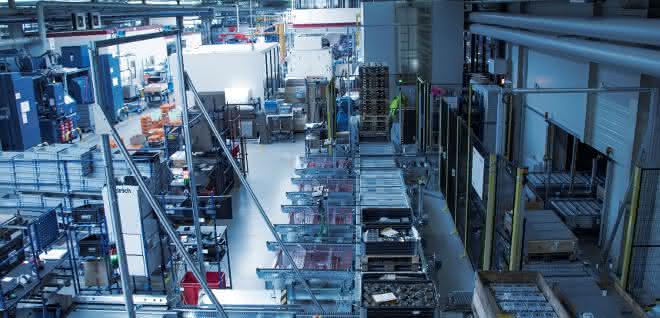
It all started in the laundry room: Roland Erdrich founded a small turning shop there in 1974. "The garage only came in the second stage of development," explains his son Ken Erdrich with a grin. Today, he runs the business of Roland Erdrich GmbH - not in a garage, however, but on a 7,500 square meter site in Oppenau near Offenburg in Baden-Württemberg. Around 150 employees produce high-quality turned and milled parts as well as complete assemblies for customers from almost all sectors - from mechanical and plant engineering to electrical engineering, medical technology and laser technology.
A specialist for turned and milled parts
The company currently has 24 CNC lathes, 25 machining centers and seven turning/milling centers in operation. The company mainly processes aluminum, but also steel, stainless steel, copper and titanium. In addition to the turned and milled parts, the company offers a whole range of additional services - from individual documentation to additional processing steps, which are carried out by partner companies.
The offer is well received: since Erdrich moved into the Oppenau site, the operating area has already had to be expanded three times. The company is growing by an average of five to ten percent per year. "More measuring technology for quality assurance, increasingly complex parts, higher expectations in terms of look and feel and always some free capacity for new orders," explains Ken Erdrich. "We have to grow in order to meet the ever-increasing demands of our customers."
As a result, the previous narrow-aisle warehouse with its 700 pallet spaces became too small. In addition to the finished parts, it also stores raw materials and semi-finished parts. It is therefore the linchpin of production. "In the end, we had to set up several makeshift warehouses and also store the goods at different locations in production," Erdrich describes the situation. The warehouse ultimately became the limiting factor: "In the end, our storage was too confusing and we were increasingly busy looking for goods." An expansion was not possible due to lack of space; in fact, only a 10 by 55 meter strip directly next to the hall on the company premises remained to build a new warehouse.
Maximum number of pallets in a limited space
"Our core requirement was to accommodate a maximum number of storage locations in this limited space - this was only possible with an automated warehouse," Erdrich outlines. A completely new topic for him and his team: "We are not logistics specialists, we are manufacturers. But it doesn't work without logistics: I can build up endless production capacities - if the material isn't made available and the finished parts flow out, the whole concept doesn't work." The new warehouse should therefore also significantly increase the efficiency of these processes. Erdrich was looking for a provider who could plan the entire system and hand it over as a turnkey solution. The company found the right expert in viastore: the Stuttgart-based system integrator offers automated storage and material flow systems as well as software for management, transportation and control from a single source. The manufacturing industry is an important target group.
Complete system from a single source
viastore planned a single-aisle, automated pallet warehouse with 1,400 storage locations for Euro pallets and pallet cages. A conveyor loop connects the warehouse with four order picking stations, the incoming goods area, a quality assurance area and two retrieval lines to production. The entire system is controlled by the viadat warehouse management and material flow management system. "We expected this software to have the most flexible interfaces possible so that we could connect our other systems - from ERP to production planning," says Erdrich. The software also had to be efficient and require as few mouse clicks as possible. viadat meets the requirements across the board: the software is intuitive to use. It can be connected to ERP systems from different manufacturers and has a standard interface to all common manufacturing execution systems (MES). It can also be implemented quickly through configuration, is fully scalable in terms of function and performance and offers more than 2,500 logistics functions as standard. It was precisely this flexibility that was needed, as the project showed that even a small warehouse can require a number of complex functions.
More efficiency in the processes
The new warehouse has been in operation since May 2020. Roland Erdrich has not only doubled the number of storage locations, but has also been able to make its logistics processes significantly more efficient overall. For example, while new goods were delivered to various points in production before the new warehouse was built, they are now recorded and booked in centrally at the I-point for incoming goods. "As a result, we now always know where which goods are. We no longer have to search, the goods are available more quickly and throughput times have been reduced," says Erdrich happily. Life has also become easier for the workers at the production machines: Previously, they had to fetch the required raw materials and semi-finished parts themselves. "So we had an open warehouse for around a hundred people - with all the associated problems," adds Ken Erdrich.
Increased transparency
Today, the workers simply report their material requirements from the machine - the logistics system then works together with the other software solutions in the company to ensure that the goods arrive at the right production facility on time. This means that production can now be much better utilized. The overview of stock levels has also become much more accurate, as Ken Erdrich emphasizes: "In the past, for example, semi-finished parts that were temporarily stored somewhere in production were not booked in. Today, we have all items - raw materials, semi-finished parts and finished parts - recorded in the system and stored in the automated warehouse." All in all, the new logistics system has enabled Erdrich to reduce time-consuming ancillary activities and unnecessary transportation to a minimum. "We are now simply much more efficient," concludes Ken Erdrich.
This article appeared in issue 11-12/2021.


You might also be interested in
Circular load carriers for more sustainable supply chains
With the planned Industrial Accelerator Act, the European Union wants to accelerate the transformation of industry towards low-carbon production processes and resource-efficient supply chains. Logistics and transportation are also increasingly...
 read more...
Integration of a robotics solution
Lyreco modernizes logistics center in France
Lyreco is pressing ahead with the automation of its central site in Villaines-la-Juhel with an investment volume of over 25 million euros.
read more...Dragsbæk halves pallet area
By using automated pallet solutions from Palomat, Dragsbæk has halved the space required for pallets, optimized processes and sustainably improved working conditions.
read more...Pixels instead of paper
With the solutions from Logistikbude, Bekuplast, manufacturer of plastic containers, keeps an eye on its load carriers, saves costs and can work more efficiently with forwarding partners.
read more...Flexibility in saving space
Purus Plastics has developed a new retail range. The company operates a processing plant for plastics; recycling creates new products from secondary raw materials, including pallets.
read more...Solutions for the food industry
At Werit, the focus is on customer-specific solutions, sustainable recycling and pooling systems and products made from recyclate. The stand concept is divided into four areas: Products and innovations in the food sector, customer solutions,...
read more...Pallets with QR code
At the Epal Germany stand, visitors can gain an insight into the reusable system propagated by Epal, the life cycle of an Epal pallet and the newly developed QR pallet.
read more...The path of the Euro pallet into the IoT
With the introduction of the EPAL Euro Pallet QR in 2024, the European Pallet Association (EPAL) aims to set a new standard for the classic Euro pallet, which has been used successfully for over 60 years, and pave the way for ecologically...
read more...Retail range: flexibility to save space
Purus Plastics has developed a new retail range that is designed to attract the interest of retailers in particular. The company operates a modern plastics processing plant in Arzberg, Bavaria; new products are created from secondary raw materials...
read more...