
Technology strategy presented
World premiere of the Mercedes-Benz fuel cell truck
Truck manufacturer Daimler Trucks recently presented its technology strategy for the electrification of its vehicles, from urban distribution to international long-distance transportation.
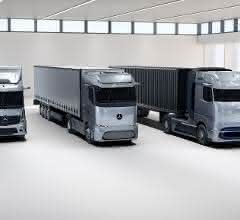
The event focused on the technology for hydrogen-based fuel cell trucks for the long-distance transport segment. The Mercedes-Benz GenH2 Truck, which celebrated its world premiere today as a concept vehicle, marks the beginning of fuel cell drive technology. With the GenH2 Truck, Daimler Trucks is demonstrating for the first time which specific technologies the manufacturer is driving forward at full speed so that heavy fuel cell trucks can drive flexible and demanding long-distance transport operations with ranges of up to 1,000 kilometers and more on one tank of fuel. Daimler Trucks plans to start customer testing of the GenH2 Truck in 2023, with series production set to follow in the second half of the decade. Thanks to the use of liquid hydrogen instead of gaseous hydrogen, the vehicle's performance should be on a par with that of a comparable conventional diesel truck due to its significantly higher energy density.
Daimler Trucks has also given a preview of a purely battery-electric long-distance truck for the first time: the Mercedes-Benz eActros LongHaul. It is designed to cover regular journeys on predictable routes in an energy-efficient manner. Daimler Trucks plans to have the eActros LongHaul ready for series production in 2024, with a range of around 500 kilometers on a single battery charge. With the Mercedes-Benz eActros for distribution transport, which was presented back in 2018 and has since been intensively tested by customers in everyday transport operations, Daimler Trucks will also be bringing a purely battery-electric heavy-duty truck into series production from next year. The range of the series-produced eActros with one battery charge will significantly exceed that of the prototype of around 200 kilometers.
Daimler Trucks is pursuing similar vehicle and time schedules as for Europe for the North American and Japanese markets. By 2022, the Daimler Trucks portfolio in the main sales regions of Europe, the USA and Japan is to include production vehicles with battery-electric drive systems. The company also has the ambition to only offer new vehicles in Europe, Japan and North America by 2039 that areCO2-neutral in operation ("tank-to-wheel").
As a new global modular platform architecture, the so-called ePowertrain will be the technological basis for all medium and heavy-duty locallyCO2-neutral, fully electric series trucks from Daimler Trucks - whether powered purely by batteries or hydrogen-based fuel cells. It will be characterized by high performance, efficiency and durability. Daimler Trucks plans to use it to achieve synergy and economies of scale across all relevant vehicles and markets.
Martin Daum, Chairman of the Board of Management of Daimler Truck AG and Member of the Board of Management of Daimler AG, and Sven Ennerst, Member of the Board of Management of Daimler Truck AG, responsible for Development, Purchasing and Region China, presented the technology strategy at STATION-Berlin. Andreas Scheuer, Federal Minister of Transport and Digital Infrastructure, was also among the speakers.
Genuine localCO2-neutral alternatives for truck customers
Martin Daum: "We are consistently pursuing our vision ofCO2-neutral transportation. We are concentrating on the truly locallyCO2-neutral battery and hydrogen-based fuel cell technologies, which also have the potential to establish themselves on the market in the long term. With this combination, we can offer our customers the best vehicle options depending on the application. The lighter the charge and the shorter the distance, the more likely the battery will be used. The heavier the charge and the longer the distance, the more likely the fuel cell will be the vehicle of choice."
"Our customers make rational purchasing decisions and do not want to compromise on the everyday usability, tonnage and range of their trucks. With our alternative drive concepts from Mercedes-Benz, the GenH2 Truck, the eActros LongHaul and the eActros, our electric trucks from the Freightliner and FUSO brands, we have a clear view of customer requirements - and are creating genuine locallyCO2-neutral alternatives for them. We have now set out the key technological specifications of our e-trucks so that the requirements are known to all stakeholders at an early stage. Now it is up to politicians, other stakeholders and society as a whole to put the right framework conditions in place. In order to makeCO2-neutral, fully electric vehicles competitive, regulatory and governmental control measures are required, including the necessary infrastructure for charging green electricity and for the production, storage and transportation of green, liquid hydrogen," Daum continued.
Key figures of the GenH2 truck based on conventional long-distance trucks
The developers at Daimler Trucks have based the GenH2 Truck on the characteristics of the conventional Mercedes-Benz Actros long-haul truck in terms of tractive power, range and performance. The series version of the GenH2 Truck, for example, has a gross vehicle weight of 40 tons and a payload of 25 tons. Two special liquid hydrogen tanks and a particularly powerful fuel cell system will make this high payload and long range possible. They therefore form the heart of the GenH2 Truck concept.
For the development of the liquid hydrogen tanks, the Daimler experts can draw on existing expertise and are also working closely with a partner. With regard to the fuel cell, the manufacturer benefits from the decades of experience of its experts, both in terms of technology and production methods and processes. This represents an enormous advantage. In April of this year, Daimler Truck AG and the Volvo Group signed a provisional, non-binding agreement to establish a new joint venture for the series-ready development, production and marketing of fuel cell systems for use in heavy commercial vehicles and other areas of application. The joining of forces is intended to reduce development costs for both companies and accelerate the market launch of fuel cell systems. The joint venture will draw on the expertise of Daimler Truck AG and the Volvo Group. In order to facilitate the joint venture with the Volvo Group, Daimler Truck AG has combined all Group-wide fuel cell activities in the newly founded subsidiary Daimler Truck Fuel Cell GmbH & Co KG.
Liquid hydrogen enables applications with high energy throughput
Daimler Trucks prefers liquid hydrogen (LH2), as the energy carrier in this aggregate state has a significantly higher energy density in terms of volume compared to gaseous hydrogen. As a result, a fuel cell truck refueled with liquid hydrogen requires much smaller and, due to the lower pressure, considerably lighter tanks. This allows for a larger loading space and a higher payload weight of the truck. At the same time, more hydrogen can be refueled, which significantly increases the range. This makes the series GenH2 truck, like corresponding conventional diesel trucks, suitable for long-distance transportation that is difficult to plan and lasts several days, where the daily energy throughput is high.
Daimler Trucks is currently driving forward the development of the tank system technologies required to make liquid hydrogen usable as an energy source for fuel cell series trucks for mobile use. In stationary applications, for example in industry or in hydrogen filling stations, the storage of cryogenic liquid hydrogen at -253 degrees Celsius is already common practice. This also applies to the transportation of liquid hydrogen as a cargo.
Interaction of battery and fuel cell system
With a capacity of 80 kg (40 kg each), the two stainless steel liquid hydrogen tanks planned for the series version of the GenH2 Truck will be characterized by a particularly high storage capacity for covering long distances. The stainless steel tank system consists of two tubes, one inside the other, which are connected and vacuum-insulated. In the series version of the GenH2 Truck, the fuel cell system will deliver 2 x 150 kW, while the battery will also deliver up to 400 kW for a limited period of time. The storage capacity of the battery is relatively low at 70 kWh, as the battery is not intended to be used for energy requirements, but mainly for situational power support of the fuel cell: for example, during peak loads during acceleration or when driving uphill with a full load.
At the same time, the relatively light battery enables a greater payload. It is to be charged in the production vehicle using braking and excess fuel cell energy. A core element of the operating strategy of the fuel cell and battery system is a cooling and heating system that keeps all components at the ideal operating temperature and thus enables the longest possible service life. In a pre-series version, the two electric motors are designed for a total of 2 x 230 kW continuous and 2 x 330 kW maximum output. The torque is 2 x 1577 Nm and 2 x 2071 Nm respectively.
The battery-electric Mercedes-Benz eActros LongHaul long-haul truck will operate in the same vehicle class as the GenH2 Truck. Its characteristics will be largely on a par with those of the series version of the GenH2 Truck or a conventional diesel truck. The comparatively shorter range of the eActros LongHaul with a single charge is offset by its high energy efficiency: Battery electric drives have the highest efficiency of all alternative drives. This offers transport companies significant advantages in the application scenarios envisaged for the eActros LongHaul due to low energy costs.
A large proportion of long-distance transport applications in the operational practice of transport companies do not require a greater range than the 500 km or so that the eActros LongHaul will be able to cover on a single charge, simply because of the route. In addition, legal requirements for truck drivers' driving times limit the need for longer ranges, depending on the case. For example, truck drivers in the EU must take a break of at least 45 minutes after driving for 4.5 hours at the latest. During this time, thanks to state-of-the-art charging technology, a large proportion of the energy can be recharged for the onward journey. The eActros LongHaul will therefore be the right choice for transport companies for regular use on predictable routes and with appropriate distances and charging options.
Charging infrastructure for eActros LongHaul soon available
The eActros LongHaul will be available some time before the GenH2 truck with its market launch from the middle of the decade. The necessary infrastructure can also be set up in a shorter time - and at comparatively low cost - by the transport companies themselves for charging at their depots. This so-called depot charging is the most important step for the use of the eActros LongHaul. This means that the first areas of application can already be covered. In addition, opportunity charging to extend the range, for example at the unloading or loading point where the electric truck makes a stop anyway, is another key component. In the future, charging at publicly accessible stations along central traffic routes will also become an increasingly important pillar - a comprehensive charging infrastructure maximizes the range of battery electric trucks. New, more durable batteries, which will reduce the total cost of ownership over the life cycle of the vehicle, will also contribute to the competitiveness of battery-electric trucks.
Mercedes-Benz eActros to be integrated into advisory services
At the IAA 2016, Daimler Trucks was the first manufacturer worldwide to present a heavy-duty electric truck. At the beginning of 2018, the manufacturer celebrated the world premiere of the completely further developed Mercedes-Benz eActros, and intensive practical tests with customers have been underway since fall 2018. The findings from the customer trials have since been directly incorporated into the further development of the prototype into a series-production vehicle. So far, they have shown that the purely battery-electric eActros is ideally suited for sustainable heavy-duty distribution transport. It is in no way inferior to a conventional diesel truck in terms of availability and performance.
However, the series-produced eActros will be clearly superior to the previous prototype in some respects, such as range, drive power and safety. The series-produced eActros will also be on a par with a conventional Actros in terms of payload. The eActros will be launched on the market as a two- and three-axle vehicle. Daimler Trucks will embed the vehicle in a holistic ecosystem that also includes e-mobility consulting services. This includes route analyses, checking possible subsidies, support with operational fleet integration and the development of suitable charging infrastructure solutions.
Daimler Trucks & Buses: comprehensive practical e-expertise
The first practical deployments of the Mercedes-Benz eEconic low-floor truck announced by Daimler Trucks this year, which is based on the eActros, are planned for next year. The start of series production is planned for 2022. The eEconic will mainly be used as a waste collection vehicle in urban waste management operations. This area of application is very well suited to the use of battery-electric trucks due to its comparatively short and fixed routes of up to around 100 km and a very high proportion of stop-and-go driving. In the USA, the medium-duty Freightliner eM2 and the heavy-duty Freightliner eCascadia are also currently undergoing practical tests with customers. In series production, they are expected to have a range of around 370 km (eM2) and up to 400 km (eCascadia) respectively.
The planned start of series production of the eCascadia is mid-2022 and that of the Freightliner eM2 is the end of 2022. As part of a small series, more than 170 FUSO eCanter light trucks are in use with numerous customers in Japan, the USA and Europe; the first customer handovers already took place in 2017. The eCanter offers a range of 100 km. The Mercedes-Benz eCitaro has been in series production at Daimler Buses since fall 2018. The variant with a fuel cell as a range extender will follow from 2022. With almost 400 vehicles in customer hands, Daimler Trucks & Buses has gained e-expertise - and can boast a total of well over seven million kilometers driven by customers worldwide with battery-electric trucks and buses in tests and series production.


You might also be interested in
New low lift pallet truck with lithium-ion technology
Clark presents a completely newly developed electric pallet truck with lithium-ion technology (Li-Ion).
 read more...
material flow PRODUCT OF THE YEAR 2024
Category 3: Conductix-Wampfler - ContactCharger
The KontaktCharger is the solution for efficient and economical conductive charging of lithium-ion vehicle batteries in intralogistics.
read more...ReachStacker with hydrogen fuel cell
Hyster, a provider of container handling solutions, has delivered a reach stacker with a hydrogen fuel cell to the Port of Valencia in Spain. It is part of the H2Ports project. The aim of H2Ports is to introduce hydrogen-powered vehicles and...
read more...Material flow in pure culture
Electromobility is booming and the demand for batteries is greater than ever. In order to serve this market, more and more battery plants are currently being built in Europe. Mobile systems from SEW-Eurodrive are being used in the new plant of a...
read more...Winner material flow PRODUCTS OF THE YEAR 2023
Wagner Group: Fire protection solution for the storage of lithium-ion batteries at Kettler Alu-Rad
For the fully automated high-bay warehouse at the new production site, in which up to 50,000 e-bikes can be packed ready for dispatch and stored with installed batteries, Wagner implemented a customized fire protection solution that reduces the risk...
read more...Winner material flow PRODUCTS OF THE YEAR 2023
Conductix-Wampfler: ChargeLine 0865
Two-pole conductor rail segments for efficient opportunity charging of shuttles, suitable for thousands of cycles per day.
read more...Intelligent charging with solar energy
Charge industrial trucks with solar power and optimize your own consumption? This is now possible with a new function in the Charge & Connect portal from Fronius Perfect Charging.
read more...Paper manufacturer with innovative production logistics
Paper manufacturer Franz Veit has made its intralogistics operations much more efficient with the help of Linde Material Handling and Ernst Müller Fördertechnik.
read more...Battery logistics and more
Alfred Schuon presented its portfolio of transport and contract logistics services at Transport Logistic. The focus was also on the company's expertise in battery logistics.
read more...