

Utility vehicles
The joy of becoming dangerous (From: LT-manager 1/17)
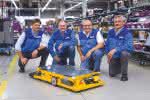
BMW has recently started building driverless transport systems for internal material flows. The "BMW Enterprise-Lab for Flexible Logistics" at the Fraunhofer IML in Dortmund debunks the hype surrounding incubators and shows that the old economy can be disruptive. LTM author and columnist Anita Würmser on the opportunities and limits of a revolution in intralogistics.
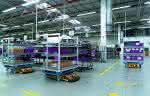
Swiss Post is developing electric transporters, mail order company Amazon is becoming a logistics service provider and BMW is now building automated guided vehicles (AGVs). After just six weeks, a prototype called BMW STR (Smart Transport Robot) was developed in the "BMW Enterprise-Lab for Flexible Logistics" in Dortmund. After just 12 months of development, the rollout and pre-series production began in Wackersdorf. Never before has an AGV been brought to practical maturity so quickly.
Whether it's the post office, Amazon or BMW - customers are no longer satisfied with the standard products offered by logistics suppliers. They are increasingly being judged by major customers as not meeting their needs, not innovative enough, inflexible and expensive. Post CEO Frank Appel recently gave the commercial vehicle board members a lecture at the IAA opening ceremony. His idea of an efficient postal vehicle was a driver's seat, a range of 80 kilometers, maximum payload, and if the manufacturers didn't deliver, the postal service could do it itself. No sooner said than done. The company's own purchasing volume alone should turn the project into good business.
You develop yourself
Disruptive changes are currently taking place much more radically in logistics than in production, for example, because several approaches are being combined. Corporations in particular want to benefit from this optimization potential. If they have to, they will develop something themselves that the market does not offer. After all, innovations not only promise more flexibility, but also quantum leaps in costs. In any case, the classic amortization calculation has had its day in the age of Industry 4.0 and digitalization. An investment should pay for itself not in three years, but in three months. Instead of a 10 or 20 percent reduction in costs, BMW even considers over 70 percent of the current market price for a complete intralogistics installation to be realistic. Especially if components from automotive mass production with corresponding economies of scale are used. For example, the battery of the BMW i3. The battery pack consists of 8 Li-ion modules. Even if one of them is no longer suitable for use in road traffic, it is always sufficient for use in intralogistics. The AGV project was born when the plan to recycle the battery was met with the desire to implement autonomous driving in the internal material flow.
"No robot can come close to humans, and that will remain the case for a long time to come," says Dr. Dirk Dreher, Head of BMW International Supply
"
Our aim was to create a highly flexible AGV system and not to purchase a rigid one," explains Dr. Dirk Dreher, Head of BMW International Supply, in an interview with LT-manager. Because BMW is not a specialist in AGV construction, the classic purchasing route was initially followed. This leads via the suppliers of intralogistics solutions. If the manufacturers had had something suitable in the drawer, he would have taken it. In real life, the machine manufacturer regrets the slow pace of life. "The discussions with the manufacturers were sobering," he reports. The inertia was high and the intralogistics providers held on to their cash cows for too long, believing that they were still earning good money with proven, robust technology. Although the market offers robust hardware, it is not very agile, and optical systems or flexible adhesive line solutions for lane guidance have not proven themselves in tough everyday industrial environments. There are autonomous tugger trains and AGVs on the market, but usually with central control systems. The willingness to build autonomous systems with decentralized intelligence, to develop common manufacturer-independent basic capabilities such as localization & navigation, path planning without "rails", fine positioning as well as load recognition and handling is not yet present among the providers.
One point in particular proved to be critical: "If you want to bring in your own knowledge, you can't do that with a traditional intralogistics manufacturer." However, this was precisely what mattered to the car manufacturer in the end. After all, BMW has enough experience on the road with regard to autonomous and electric driving to make it accessible to AGV construction. So it made sense to take the first leap into a new generation of material handling technology itself.
Logistics research at BMW and how the lab came about?
At BMW, research is always a business case based on the principle of "innovation with impact". "We know what goals and financial results we want to achieve in the next five years and exploit any potential that presents itself," says Dreher. The second-use idea of the BMW i3 battery was one such potential. Through strategic cooperation agreements with universities, the Group has access to a global network that makes it easy for the departments to start a research project or award doctoral and master's theses. The right research institute was quickly found. "Thanks to its AGV experience and practical relevance, the IML in Dortmund was my first choice," says Dreher, "I simply got in the car and drove to Professor ten Hompel. It was just right that the newly established labs were just starting up there. The concept met the requirements, because it involves concrete research and both partners can contribute know-how without it flowing away. In this case, Fraunhofer contributes the AGV development experience, while BMW Logistik provides the practical requirements and integration experience.
[gallery type="slideshow" ids="8658,8656,8655,8654,8657,8653"]
The AGV project has been turned into what a car manufacturer always does: a vehicle project. Not because the company has any ambition to enter the driverless transport systems business. Rather, it is about developing and maintaining expertise. The knowledge built up should help with purchasing and the modular combination of in-house and new technologies. "We have good ideas and they will set us apart for a while". But Dreher also knows that every month a start-up pops up that nobody had on their radar. The Wackersdorf Innovation Park is there for this eventuality. "If a start-up came along tomorrow with a new logistics innovation, we would be interested. I'm offering a space in Wackersdorf to try it out together," he promises. Various innovation projects along these lines are already underway at the Innovation Park.
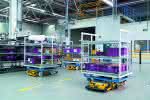
The "BMW Enterprise-Lab for Flexible Logistics" works in two parts: The "Smart Transport Robotics" sub-project is concerned with the development of a Smart Transport Robot (STR) for transporting roller coasters in order to supplement and partially replace the tugger trains still widely used in the plants with automated individual transports and to further develop them into an autonomous system. The second sub-project focuses on network design and the optimization of global supply chains for supplying the BMW overseas plants in volatile environments. In a nutshell: autonomous driving is just complicated, and network design is also top secret.
The small difference to traditional research
In contrast to contract research, the Lab does not just commission research, but tackles the topic with vigor and its own resources. And not from the university environment or rookies who have just graduated. "We employ top-class internal and external IT specialists, developers and our own project managers with many years of practical experience. We bring these people together with the IML developers," explains Dreher. In the STR project team, BMW's maintenance technicians, IT engineers and computer scientists in Wackersdorf and Munich work in an interdisciplinary team. A technically experienced practitioner who still maintains highly complex conveyor systems and has a background in mechatronics is the BMW project manager for STR development.
Dreher considers the fact that tight deadlines were set right from the start to be a success factor. Nevertheless, they always pay attention to the pain threshold. They are constantly learning from each other, there is much more interdisciplinary collaboration and you can feel the positive spirit. "The result is great proof that the IML and the lab were the right choice and also a radical difference to other research projects," says the mechanical engineer. In classic contract research, research is carried out on defined issues and after a while an innovation finds its way into practice. Getting an AGV prototype up and running in six weeks would not have been possible at this speed with other partners.
The end of the route train
After a year of lab research, Dreher draws a sober conclusion. "The innovative applications no longer come from traditional materials handling companies, but from robotics and IT. That's where the music is currently being played," says Dreher. This is where the lab's interdisciplinarity really comes into its own. The BMW man leaves no doubt that the Lab's research will bring the desired breakthrough. The first major hurdle has already been overcome. Following the STR prototype in November 2015, a pre-series of 10 devices has now been launched in Wackersdorf. Autonomous driving and the low body with a load capacity of up to 600 kilograms must now prove themselves in practice. Series production should follow in one to two years.
The lab is already a BMW-internal beacon for successful research. It wouldn't have taken much to turn it into a showcase out of enthusiasm, with a logo, cladding and design, a BMW speedster, just based on the principle of the joy of driving. In the end, the focus on functionality won out. "We didn't want to build fancy prototypes, but rather achieve the greatest possible technological leaps in innovation within a period of one to three years through agile research," explains Dreher. It is foreseeable that he will be right, as the roll-out of the STR into the BMW production network is due to start in 2017. Although he does not want to name exact quantities, there is still plenty of conservative industrial truck technology in use at the plants in the BMW production network. The application potential of STR is correspondingly high.
Hello, colleague robot
How the robot colleague will then fit in is still open in many respects, but transport robotics and the use of autonomous tugger trains are already an integral part of work organization at BMW. The transition should be evolutionary, even if we would sometimes like it to be a little faster. However, there is still too much homework to be done, such as the question of what the workplace of the future or traffic rules on the store floor should look like. That takes time.
Nor are STRs intended to replace human jobs. The focus is on escaping the rampant shortage of skilled workers and making work easier and more flexible. Robots help where no staff are available or where physically heavy work is required, and who wants to spend the whole day pushing racks weighing up to 600 kilograms? But the hierarchy is clear: humans remain the boss. "No robot can compete with humans and that will remain the case for a long time to come," the organizational developer is convinced. It is just as clear that the momentum of autonomization will pick up speed with increasing digitalization. There will be more and more tasks - repetitive, difficult, simple - that lend themselves to automation.
One question remains: will BMW sell its BMW STR in the future? Dreher just smiles: "I can imagine an initial flow line for the internal BMW network, but our core business is developing and building cars and motorcycles. I'm hoping for a jolt in the logistics sector and a bit more openness to new things. Let's see." Anita Würmser


You might also be interested in
New Podcast: “AGVs: The Silent Logistics Pros”
AGVs in Use in Logistics and Production
Autonomous guided vehicles (AGVs) are becoming increasingly important in industry and intralogistics. In Phoenix Contact’s “Elektrisiert” podcast, Jörn Dauer explains the applications, technical requirements, and future prospects of these autonomous...
 read more...
HTEC and Embotech Expand Autonomous Industrial Logistics
HTEC and Embotech aim to accelerate the adoption of autonomous driving solutions in industrial logistics. The strategic partnership is intended to facilitate the rollout to additional vehicle platforms, customer projects, and locations.
read more...Standardized in design, flexible in use
Automated guided vehicles are increasingly in demand in production and logistics as they automate processes efficiently - but in addition to the vehicle, the right peripherals are also crucial for safe operation. A new solution consisting of a...
read more...Outdoor AGV networks production and logistics
An international company in the plastics industry is automating its intralogistics at its German site with a solution from ek robotics. A specially developed vehicle model from the Out Move series, an outdoor AGV, is being used.
read more...Transport systems for automated material flow
The Leo transporters from Bito make it easier for users to get started with the automation of material processes, which is possible from 20,000 euros. The system is a flexible all-in-one complete solution that is ready for immediate use and can be...
read more...Automated logistics for the university hospital
As part of the new construction of the University Hospital of Reims (CHU), France, the hospital has taken a number of steps to improve the needs of its patients and the working environment of its employees.
read more...K.Hartwall: Topping-out ceremony for the German site
The topping-out wreath was raised at the new building in the TIP Innovationspark Nordheide in Buchholz near Hamburg on February 27: The new K.Hartwall plant will comprise approx. 3,500 m² of hall space and around 2,000 m² of office and social areas.
read more...Noerpel Group tests driverless high lift trucks
The Noerpel Group has tested driverless pallet trucks in one of its two logistics facilities in Giengen. During a four-week trial, two autonomous systems were used to transport goods within the warehouse.
read more...Supply and disposal of printing machines by AGV
Numerous companies rely on AGVs in intralogistics to increase efficiency and meet challenges such as the shortage of skilled workers. One such company is GGP Media GmbH in Pößneck, Thuringia.
read more...